




JLR Tackles Weight with Structural Electronics
Jaguar Land Rover sees structural electronics as a weight-saving, package-improving, design-enhancing technology.

Ashutosh Tomar, electrical research technical manager at Jaguar Land Rover (JLR) said he has absolute confidence in the game-changing potential of structural electronics (SE) now being pioneered by the company. Dubbed LESA (Lightweight Electronics in Simplified Architecture) is expected in upcoming JLR models, though its use in the next-generation Jaguar XJ to be launched in 2020 has not been confirmed.

JLR is completing a successful R&D program into printed SE, initially to introduce curved dashboard screens. The company claims an industry first that has the potential to radically alter vehicle interiors, with other applications forthcoming. SE is not a new technology. Decades ago the aerospace industry was considering it as part of aircraft-surface morphing capability to adapt to varying flight conditions.


Building on existing printable electronic technology, Tomar said that the system uses Computer Animated Drawings (CAD) to virtually unfold a part into a 2D structure, and that an ECU is no longer necessary. “The required electronic circuit is printed onto the flat unfolded 2D surface,” Tomar explained, “and components are mounted before the CAD is folded back into its original 3D. The part is then manufactured with the electronics printed into the structure.”
Irregular surfaces
Applications for SE already figure in medical, military and consumer technologies (health-monitoring clothing, curved OLED TV screens). The big attraction is it avoids the use of large, often load bearing structures that are conformable, saving weight. With widespread use of SE throughout a vehicle, Tomar said he expects electronic weight saving to be 60%. “Wiring, sensors – a typical JLR product has 100-plus – and computing are contained within all non-metal materials. An IP can be turned into a functional space,” Tomar said, giving vehicle owners wide-ranging customization capability.
The JLR LESA project started three years ago and the dashboard was chosen as a the most difficult cabin challenge for it. “We took that really hard application to prove that LESA works,” Tomar said. “We have taken it through all necessary qualifications – shake, squeak, rattle – together with very high temperatures and thermal shocks.”
It was not a straightforward R&D course. “At first, we tried to injection mold and everything melted. But now we can say with confidence that SE technology is available for us. There are no five- or 10-year issues blocking its use.” As part of the R&D program JLR trialed LESA on a prototype overhead control panel, achieving the target weight saving of 60% and minimizing the part’s thickness from 5.5cm to 3.4cm (2.16 to 1.33 in.), delivering capability with minimal mass and volume.
Touching wood
Tomar cited multiple impacts LESA can have on functions and systems, including the capability to provide touch controls and display information on surfaces such as wood, without the necessity for a screen. This could be a boon for designers seeking wraparound buttonless presentations, help reduce sensor count and deliver ECUs that are part of the system, with cabling becoming flatter. Energy harvesting and the use of lightweight solar panels are other potential assets.
Echoing the clothing industry’s use of SE for flexible wearables, the conformability of the technology could be applied to seating fabrics or heated leather steering wheels. With all new technologies the cost/benefit ratio must be persuasive, and Tomar said there are definite cost benefits, with R&D investments recouped once production economies of scale are achieved. New printer technologies are entering the sector, with faster, simpler and more automated processes appearing.
Transforming the industry
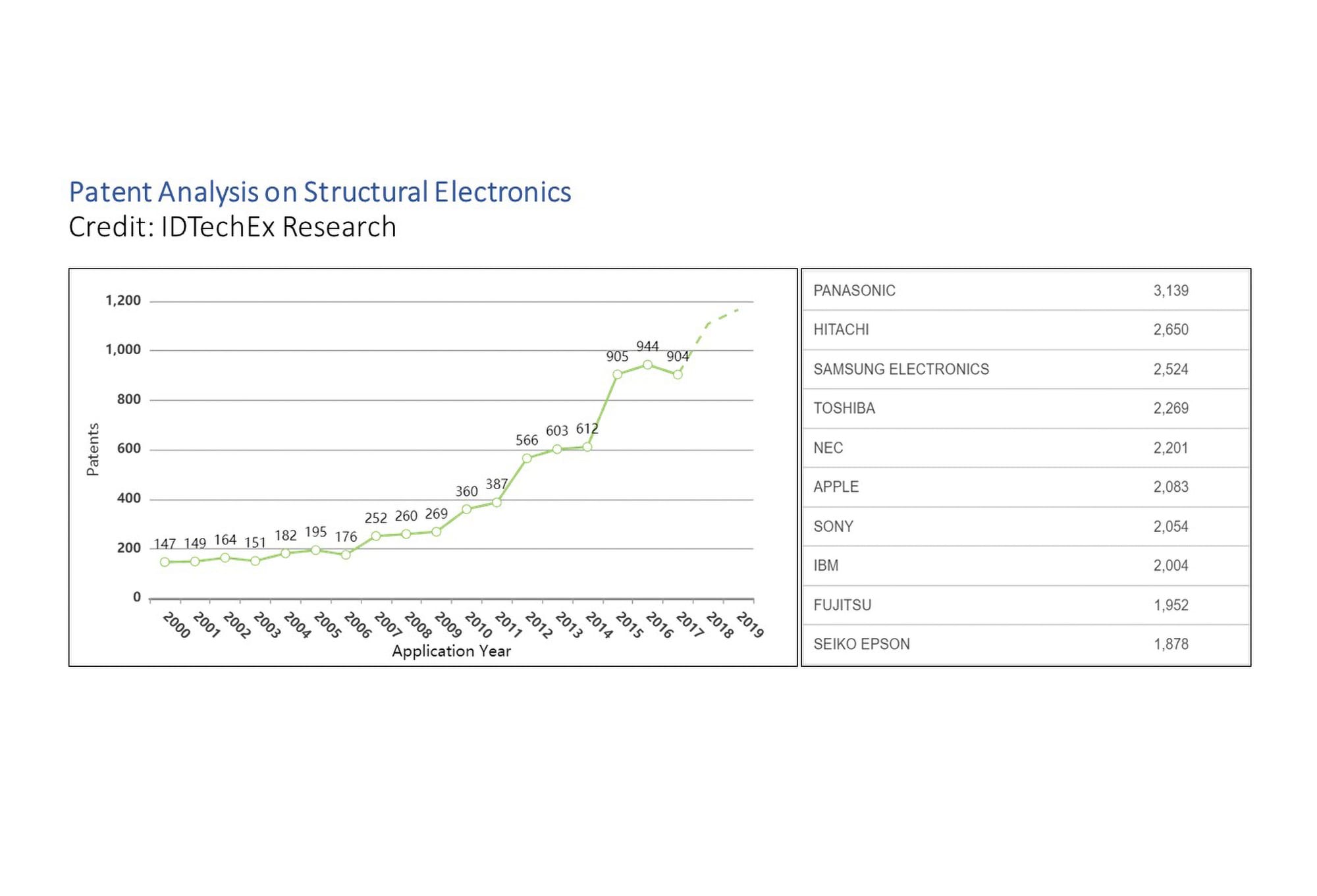
Two reports from IDTechEx Research ("Smart Materials as Structural Electronics and Electrics 2019-2029"; “Smart Material Opportunities in Structural Electronics 2020-2030”), give an overview of the technology transforming the materials industry. The reports examined making steel, plastic, glass and concrete smart, and what it describe as gaps in the market, role models of success and future roadmaps for the technology. Never-plug-in solar cars and Vehicle Integrated Photovoltaics (VIPV) also figure.
The findings of the IDTechEx analysis instance automotive applications such as adjusting seat position at the touch of the interior trim. The earlier report stated: “The term massless power has been coined by making a car body into a load-bearing supercapacitor and/or photovoltaics at a lighter weight than the dumb steel that is replaced. Such technologies will create multi-billion dollar businesses but bankrupt laggards.”
More From SAE Media Group
Automotive Engineering
CES 2021: Mercedes-Benz Hyperscreen Brings Dash-Wide Displays to Production
Automotive Engineering
Volkswagen Turns Classic Van into Innovative, Retro-Ride EV

Automotive Engineering
Unzipping the Future of Sustainable Electronics
Automotive Engineering
Powering the IoT Without Batteries Using Energy Harvesting
Automotive Engineering
Advanced Electrical Architectures Demand New Developmental Strategies

Battery & Electrification Technology
Fully Stretchable Fabric-Based Lithium-Ion Battery

Autonomous Vehicle Engineering
Sony Jumps into AV Sensors, Software
Tech Briefs
Rapidly Testing Stretchable Sensors


Tech Briefs
5 Ws of 3D-Printing Piezoelectric Materials
Autonomous Vehicle Engineering
Flash! Lidar’s Next Generation Arrives
Aerospace & Defense Tech Briefs
Industry Invited to Participate in AeroTech Aerospace and Defense Technical Program
Aerospace & Defense Tech Briefs
SAE International Extends Call for Abstracts, Seeks Submissions for AeroTech Conference
Medical Manufacturing and Machining
Process Developed to 3D Print Piezoelectric Materials
Automotive Engineering
Power over Coaxial in Automotive: A Simplified Path to Advanced Vehicle Systems


Tech Briefs
A Thin, Flexible OLED Display
Tech Briefs
Providing Robots a Soft Touch Using 3D Printing

Automotive Engineering
Volvo EX90 Uses AI, NVIDIA SoC to Make Automated Driving Safer
Tech Briefs
Wearable Liquid Unit Harvests Energy
Automotive Engineering
New 300-Mm Wafer Fab Is Key to Bosch’s Chip Future
Sensor Technology
Energy Harvesting for Smart Home Sensing
Automotive Engineering
Talking SDVs and Zonal Architecture with TE Connectivity
Battery & Electrification Technology
New Products
Top Stories
INSIDERAerospace
 How Airbus is Using w-DED to 3D Print Larger Titanium Airplane Parts
NewsUnmanned Systems
 Microvision Aquires Luminar, Plans Relationship Restoration, Multi-industry Push
INSIDERRF & Microwave Electronics
 A Next Generation Helmet System for Navy Pilots
ArticlesUnmanned Systems
 Accelerating Down the Road to Autonomy
INSIDERDesign
 New Raytheon and Lockheed Martin Agreements Expand Missile Defense Production
ArticlesUnmanned Systems
 CES 2026: Bosch is Ready to Bring AI to Your (Likely ICE-powered) Vehicle
Webcasts
Automotive
 Advantages of Smart Power Distribution Unit Design for Automotive...
Transportation
 Quiet, Please: NVH Improvement Opportunities in the Early Design...
Electronics & Computers
 Cooling a New Generation of Aerospace and Defense Embedded...
Automotive
 Battery Abuse Testing: Pushing to Failure
Connectivity
 A FREE Two-Day Event Dedicated to Connected Mobility
