




Fast-Charging, Long-Running, Bendable Supercapacitor
This technology has potential as a portable power supply in several applications, including electric vehicles, cellphones, and wearable technology.
A new bendable supercapacitor made from graphene has been developed that charges quickly and safely stores a record-high level of energy for use over a long period. The technology overcomes the issue faced by high-powered, fast-charging supercapacitors: they usually cannot hold a large amount of energy in a small space.
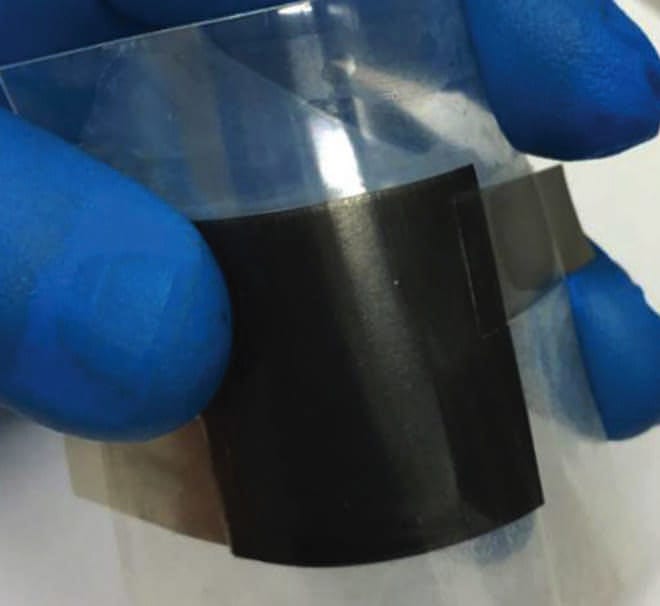
The new supercapacitor is extremely promising for next-generation energy storage technology as either a replacement for current battery technology, or for use alongside it, to provide the user with more power. It was designed with materials that give it a high power density and a high energy density. It also can bend to 180 degrees without affecting performance and doesn’t use a liquid electrolyte, which minimizes risk of explosion and makes it suitable for integrating into phones or wearable electronics.
A graphene electrode material with pores can be changed in size to store the charge more efficiently. This tuning maximizes the energy density of the supercapacitor to 88.1 Wh/L (Watt-hour per liter). Similar fast-charging commercial technology has a relatively poor energy density of 5-8 Wh/L and traditional slowcharging; long-running lead-acid batteries used in electric vehicles typically have 50-90 Wh/L. Power density is two orders of magnitude higher at over 10,000 Watt per liter.

The researchers made electrodes from multiple layers of graphene, creating a dense but porous material capable of trapping charged ions of different sizes. They characterized it using a range of techniques and found it performed best when the pore sizes matched the diameter of the ions in the electrolyte. The optimized material, which forms a thin film, was used to build a proof-of-concept device with both high power and high energy density.
The 6 × 6-cm supercapacitor was made from two identical electrodes layered on either side of a gel-like substance that acted as a chemical medium for the transfer of electrical charge. This was used to power dozens of light-emitting diodes (LEDs) and was found to be highly robust, flexible, and stable.
For more information, contact Bex Caygill at
More From SAE Media Group

Automotive Engineering
Nano-Based Ultracap Tech Boosts EV Power Density
Automotive Engineering
Clarios to Build Supercapacitor Plant in U.S.
Aerospace & Defense Tech Briefs
Rolls-Royce and Superdielectrics Explore Supercapacitor Technology
Battery Technology
Stretchable Micro-Supercapacitors Self-Power Wearable Devices
Battery & Electrification Technology
Micro-Supercapacitors Enable Fast Charging
Tech Briefs
Ultrahigh-Energy-Density Capacitor
Automotive Engineering
‘Laxatives’ May Ease Challenge of Lithium-Ion Alternative
Tech Briefs
Supercapacitor Based on Manganese Oxide
Tech Briefs
Supercapacitors for Wearable Devices

Tech Briefs
Novel, Solid-State Hybrid Ultracapacitor Battery
Medical Design Briefs
Stretchable Micro-Supercapacitors to Self-Power Wearable Devices
Power Electronics INSIDER
Scalable Supercapacitor Technology Made from Graphene
Battery & Electrification Technology
Sodium Battery Is Capable of Rapid Charging in Just a Few Seconds
Battery & Electrification Technology
Researchers Unveil Scalable Graphene Technology to Revolutionize Battery Safety and Performance
Battery & Electrification Technology
Advancing High-Energy-Density Devices
Medical Design Briefs
Powering Wearable Technology with MXene Textile Supercapacitor ‘Patch’

Automotive Engineering
NAWA Aims for 5-Minute EV Charge
Battery & Electrification Technology
An Energy-Storing Concrete-Based Supercapacitor
Battery & Electrification Technology
Oxygen-Ion Battery: A Solution for Large Energy Storage Systems
Power Management INSIDER
Fast-Charging Supercapacitor is an Energy Storage Breakthrough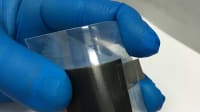
Medical Design Briefs
‘Candy Cane’ Polymer Weave Could Power Future Functional Fabrics and Devices
Battery & Electrification Technology
Recyclable ‘Water Batteries’ That Won’t Catch Fire
Tech Briefs
Stretchable Power Source for Wearables
Battery Technology
3D-Printed Biodegradable Battery
Top Stories
NewsSensors/Data Acquisition
 Microvision Aquires Luminar, Plans Relationship Restoration, Multi-industry Push
INSIDERRF & Microwave Electronics
 A Next Generation Helmet System for Navy Pilots
INSIDERWeapons Systems
 New Raytheon and Lockheed Martin Agreements Expand Missile Defense Production
NewsAutomotive
 Ford Announces 48-Volt Architecture for Future Electric Truck
INSIDERAerospace
 Active Strake System Cuts Cruise Drag, Boosts Flight Efficiency
ArticlesTransportation

Webcasts
Aerospace
 Cooling a New Generation of Aerospace and Defense Embedded...
Energy
 Battery Abuse Testing: Pushing to Failure
Power
 A FREE Two-Day Event Dedicated to Connected Mobility
Automotive
 Quiet, Please: NVH Improvement Opportunities in the Early Design Cycle
Electronics & Computers
 Advantages of Smart Power Distribution Unit Design for Automotive &...
Unmanned Systems
 Sesame Solar's Nanogrid Tech Promises Major Gains in Drone Endurance