




Autonomous Vehicle Engineering - September 2020
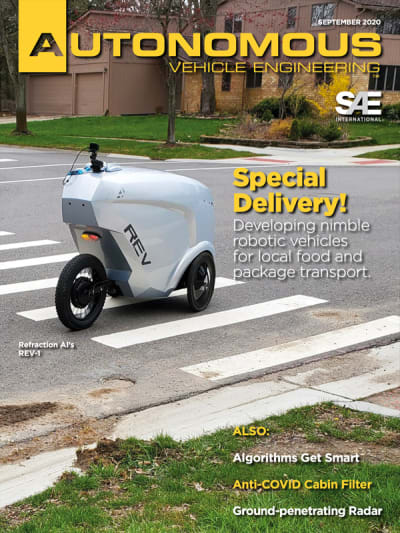
Inside this issue
Overview
The September 2020 issue of Autonomous Vehicle Engineering presents a comprehensive overview of the latest advancements and challenges in the field of autonomous vehicles (AVs). This edition features a variety of articles that delve into technological innovations, regulatory developments, and the evolving landscape of mobility solutions.
One of the key highlights is the increasing presence of semi-autonomous delivery vehicles, particularly the REV-1s developed by Refraction AI. These electric trikes are designed for last-mile delivery, efficiently transporting meals, groceries, and packages within a 3.5-mile radius in Ann Arbor, Michigan. The initiative, spearheaded by engineering and robotics professors from the University of Michigan, showcases the potential of mobility tech startups in enhancing urban logistics.
The issue also addresses the growing importance of lidar technology in the automotive sector. Once considered essential only for fully autonomous vehicles, lidar sensors are now being integrated into lower-level driver-assistance systems (ADAS). This shift indicates a broader acceptance of advanced sensing technologies across various vehicle categories, enhancing safety and functionality.
A significant focus of this issue is on the simulation strategies employed by autonomous vehicle developers. Experts suggest that many current approaches may be flawed, leading to calls for a reevaluation of simulation practices. The article proposes practical solutions to improve the effectiveness of simulation in developing automated driving functions, emphasizing the need for large-scale data refinement to train AI algorithms effectively.
In addition to technological advancements, the magazine discusses regulatory developments, particularly the United Nations Economic Commission for Europe (UNECE) taking initial steps toward establishing regulations for autonomous vehicles. This move is crucial as it sets the groundwork for a standardized framework that can facilitate the safe integration of AVs into existing transportation systems.
The issue also highlights Marelli's innovative HVAC insert, which claims to kill viruses, including COVID-19, in shared mobility environments. This development has significant implications for public health and safety in the context of shared transportation, addressing concerns that have arisen during the pandemic.
Another intriguing topic covered is the exploration of ground-penetrating radar as a potential sensing technology for autonomous vehicles. Two companies are pursuing this avenue, each with different perspectives on its readiness for mass market adoption. This exploration reflects the ongoing quest for more reliable and effective sensing solutions in the AV industry.
The magazine concludes with a discussion on the challenges facing the commercialization of autonomous vehicles, particularly in the commercial sector. While there is a clear trajectory toward increased autonomy, technical hurdles and implementation challenges remain significant barriers. The article emphasizes the need for collaboration between technology developers and regulatory bodies to navigate these complexities.
Overall, this issue of Autonomous Vehicle Engineering provides a rich tapestry of insights into the current state of the AV industry. It highlights the interplay between technology, regulation, and market dynamics, offering readers a well-rounded understanding of the opportunities and challenges that lie ahead in the pursuit of fully autonomous transportation solutions.
Articles
-
Features
Is Ground-Penetrating Radar the Next Innovation for Automated-Vehicle Sensing?
Reconstructing Accidents in the ADAS Age
New Roles for Lidar in Autonomy’s Lower Levels
Marelli’s COVID-Killing Cabin Purifier
Stories
Top Stories
INSIDERAerospace
 How Airbus is Using w-DED to 3D Print Larger Titanium Airplane Parts
NewsAutomotive
 Microvision Aquires Luminar, Plans Relationship Restoration, Multi-industry Push
INSIDERManufacturing & Prototyping
 A Next Generation Helmet System for Navy Pilots
INSIDERDefense
 New Raytheon and Lockheed Martin Agreements Expand Missile Defense Production
ArticlesAR/AI
 Accelerating Down the Road to Autonomy
Road ReadyDesign

Webcasts
Automotive
 Advantages of Smart Power Distribution Unit Design for Automotive...
Unmanned Systems
 Quiet, Please: NVH Improvement Opportunities in the Early Design...
Defense
 Cooling a New Generation of Aerospace and Defense Embedded...
Power
 Battery Abuse Testing: Pushing to Failure
Power
 A FREE Two-Day Event Dedicated to Connected Mobility
