




Autonomous Vehicle Engineering - November 2021
Inside this issue
Overview
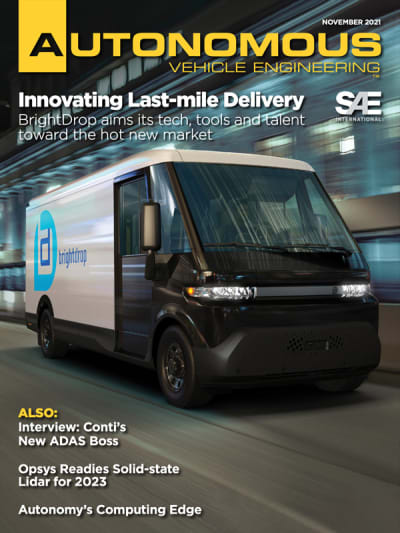
The November 2021 issue of Autonomous Vehicle Engineering presents a comprehensive overview of the latest developments in the autonomous vehicle (AV) industry, focusing on innovations, technologies, and market trends that are shaping the future of mobility.
BrightDrop's Last-Mile Delivery Solutions
One of the standout features of this issue is an in-depth look at GM's BrightDrop, a startup aimed at revolutionizing last-mile delivery. BrightDrop is introducing a range of electric vehicles, including the EV600 delivery van, designed specifically for urban logistics. The company’s holistic approach seeks to enhance productivity, improve safety, and reduce costs associated with fleet operations. By focusing on electric solutions, BrightDrop also aims to mitigate street congestion and lower emissions, addressing both environmental concerns and operational efficiency.
NHTSA's Increased Scrutiny of Automated Driving
The issue opens with a discussion on the National Highway Traffic Safety Administration (NHTSA) signaling a more rigorous examination of automated driving technologies. This shift indicates a growing recognition of the complexities and safety implications associated with AVs. The editorial emphasizes the need for manufacturers to ensure that their systems are not only innovative but also safe and reliable.
Revenue Opportunities for OEMs
Another key article explores the potential for Original Equipment Manufacturers (OEMs) to significantly increase their revenue through the provision of services related to autonomous vehicles. The discussion highlights how OEMs can leverage data and connectivity to create new business models, moving beyond traditional vehicle sales to include subscription services, maintenance, and software updates.
Advancements in Lidar Technology
The issue also features a spotlight on Opsys Tech, which is preparing to launch a new solid-state lidar system in 2023. This technology, derived from smartphone VCSEL (Vertical-Cavity Surface-Emitting Laser) technology, aims to provide high-performance lidar solutions at a competitive price point of under 0 per module. The introduction of affordable lidar systems is expected to enhance the capabilities of AVs, making them more accessible to a broader range of manufacturers.
ADAS Developments
Continental’s new Advanced Driver Assistance Systems (ADAS) are also discussed, with insights from the company’s new ADAS leader. The article outlines the next steps in automated driving technology, emphasizing the importance of integrating advanced sensors and software to improve vehicle autonomy. Continental's focus on enhancing safety features and user experience is indicative of the industry's broader trend towards more sophisticated and reliable AV systems.
Edge Computing in Autonomous Vehicles
The issue delves into the role of edge computing in reducing latency and improving the functional safety of autonomous vehicles. Stellantis is highlighted as a pioneer in this area, conducting trials that demonstrate the benefits of processing data closer to the devices that use it. This approach is crucial for real-time decision-making in AVs, which is essential for ensuring safety and efficiency on the road.
Challenges and Opportunities in Automated Commercial Vehicles
A panel discussion from COMVEC ‘21 is summarized, addressing the challenges and opportunities presented by automated commercial vehicles. The panelists discuss the need for standardization in simulation and data management, as well as the importance of cybersecurity in protecting AV systems from potential threats. The insights shared during this discussion underscore the multifaceted nature of developing and deploying AV technologies in commercial applications.
Emerging Tools and Technologies
The issue concludes with a section dedicated to new tools and technologies that are emerging in the AV space. This includes advancements in software, hardware, and systems integration that are critical for the development of safe and efficient autonomous vehicles. The ongoing innovation in this sector is vital for addressing the challenges posed by urban mobility and the increasing demand for sustainable transportation solutions.
Overall, the November 2021 issue of Autonomous Vehicle Engineering provides a rich tapestry of insights into the current state and future direction of the autonomous vehicle industry. With a focus on innovation, safety, and sustainability, the articles collectively highlight the transformative potential of AV technologies and the collaborative efforts required to realize this vision. As the industry continues to evolve, the insights shared in this issue will be invaluable for stakeholders looking to navigate the complexities of the autonomous vehicle landscape.
Articles
Top Stories
INSIDERAerospace
 How Airbus is Using w-DED to 3D Print Larger Titanium Airplane Parts
NewsAutomotive
 Microvision Aquires Luminar, Plans Relationship Restoration, Multi-industry Push
INSIDERManufacturing & Prototyping
 A Next Generation Helmet System for Navy Pilots
INSIDERDefense
 New Raytheon and Lockheed Martin Agreements Expand Missile Defense Production
ArticlesAR/AI
 Accelerating Down the Road to Autonomy
Road ReadyDesign

Webcasts
Automotive
 Advantages of Smart Power Distribution Unit Design for Automotive...
Unmanned Systems
 Quiet, Please: NVH Improvement Opportunities in the Early Design...
Defense
 Cooling a New Generation of Aerospace and Defense Embedded...
Power
 Battery Abuse Testing: Pushing to Failure
Power
 A FREE Two-Day Event Dedicated to Connected Mobility
