




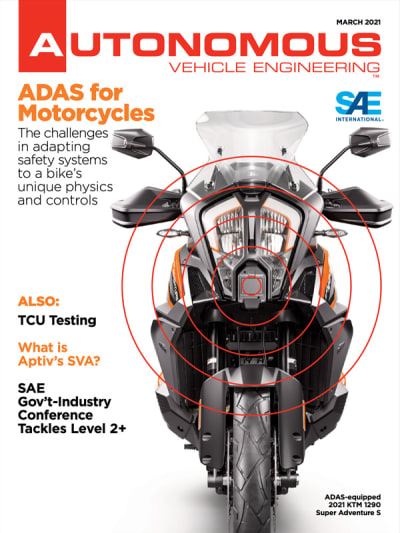
Autonomous Vehicle Engineering - March 2021
Inside this issue
Overview
The March 2021 issue of Autonomous Vehicle Engineering presents a comprehensive overview of the latest advancements and trends in the field of autonomous vehicles and related technologies. This edition features a variety of articles that delve into the integration of advanced systems, the challenges faced by manufacturers, and the future of vehicle automation.
Key Highlights:
-
Miniaturization of ADAS Sensors: The issue opens with a focus on the miniaturization of hardware, which is crucial for incorporating Advanced Driver Assistance Systems (ADAS) sensors into two-wheelers. The 2021 KTM 1290 Super Adventure S is highlighted, showcasing its Bosch-supplied Adaptive Cruise Control (ACC) radar unit, which is cleverly integrated beneath the bike’s headlamp module. This development signifies a significant step towards enhancing safety and automation in motorcycles, a sector that has traditionally lagged behind four-wheeled vehicles in terms of advanced safety features.
-
SPACs and Electric Vehicle Startups: An editorial discusses the rising trend of Special Purpose Acquisition Companies (SPACs) as a funding mechanism for electric vehicle (EV) startups. The editorial critiques the SPAC model, noting that it allows companies with no revenue to achieve public ownership and often results in inflated valuations. This trend has implications for the automotive industry, particularly as many startups are promoting their automated-driving capabilities without a proven track record.
-
Mapping the Future of Automated Driving: The magazine features an article titled "The Navigator," which explores the importance of mapping technologies in achieving safe and natural automated driving. It emphasizes the need for accurate and reliable mapping systems to support the navigation and operational capabilities of autonomous vehicles.
-
Motorcycles Entering the ADAS Age: A detailed examination of how leading motorcycle manufacturers like BMW, Ducati, and KTM are integrating ADAS technologies into their latest models is presented. The article discusses the challenges of rider control strategies and the necessity for advancements in technology to ensure safety and performance in motorcycles equipped with automated systems.
Aptiv’s Smart Vehicle Architecture: Aptiv’s Smart Vehicle Architecture (SVA) is introduced as a key innovation for simplifying and enhancing the performance of ADAS and autonomous vehicle systems. The article outlines how this central controller can streamline vehicle operations, making them more compact and efficient.
-
Driver Monitoring Technologies: A panel discussion from SAE International’s 2021 Government/Industry Meeting is summarized, highlighting the critical role of effective driver monitoring in assisted-driving technology. The panelists agree that while assisted-driving systems are beneficial, ensuring that drivers remain engaged and attentive is essential for safety.
-
Next-Generation LIDAR Technologies: The issue also covers advancements in LIDAR technology, focusing on new solutions from emerging players and alliances that aim to reduce costs while improving performance. This section underscores the importance of LIDAR in the development of autonomous vehicles, as it provides essential data for navigation and obstacle detection.
-
Horiba MIRA’s Autonomous Vehicle Testing Center: An article features Horiba MIRA’s new autonomous vehicle development center, Assured CAV, which boasts a range of assets and capabilities for testing and validating autonomous systems. This facility is positioned as a world-class center for AV testing, contributing to the advancement of safe and reliable autonomous technologies.
-
Telematics Control Unit (TCU) Testing: The magazine discusses the significance of telematics control units in vehicle connectivity. It emphasizes the need for a focused approach to testing these vital components to ensure they operate effectively within the vehicle’s ecosystem.
-
Networking and Collaboration Opportunities: The issue highlights the importance of networking opportunities at industry events, such as the SPE ACCE conference, which attracts over 800 attendees worldwide. The conference aims to educate the industry about the benefits of composites in transportation applications, showcasing innovations that can drive value by reducing weight and costs while increasing performance.
Conclusion:
The March 2021 issue of Autonomous Vehicle Engineering encapsulates the dynamic landscape of the automotive industry as it transitions towards greater automation and electrification. With a focus on technological advancements, funding mechanisms, and the integration of safety features, this edition serves as a valuable resource for industry professionals seeking to stay informed about the latest trends and innovations in autonomous vehicle engineering. The articles collectively underscore the importance of collaboration, research, and development in shaping the future of transportation.
Articles
-
The Navigator
Top Stories
INSIDERAerospace
 How Airbus is Using w-DED to 3D Print Larger Titanium Airplane Parts
NewsAutomotive
 Microvision Aquires Luminar, Plans Relationship Restoration, Multi-industry Push
INSIDERManufacturing & Prototyping
 A Next Generation Helmet System for Navy Pilots
INSIDERDefense
 New Raytheon and Lockheed Martin Agreements Expand Missile Defense Production
ArticlesAR/AI
 Accelerating Down the Road to Autonomy
Road ReadyDesign

Webcasts
Automotive
 Advantages of Smart Power Distribution Unit Design for Automotive...
Unmanned Systems
 Quiet, Please: NVH Improvement Opportunities in the Early Design...
Defense
 Cooling a New Generation of Aerospace and Defense Embedded...
Power
 Battery Abuse Testing: Pushing to Failure
Power
 A FREE Two-Day Event Dedicated to Connected Mobility
