




Additive Manufacturing
Marotta Controls
Montville, NJ
973-334-7800
www.marotta.com
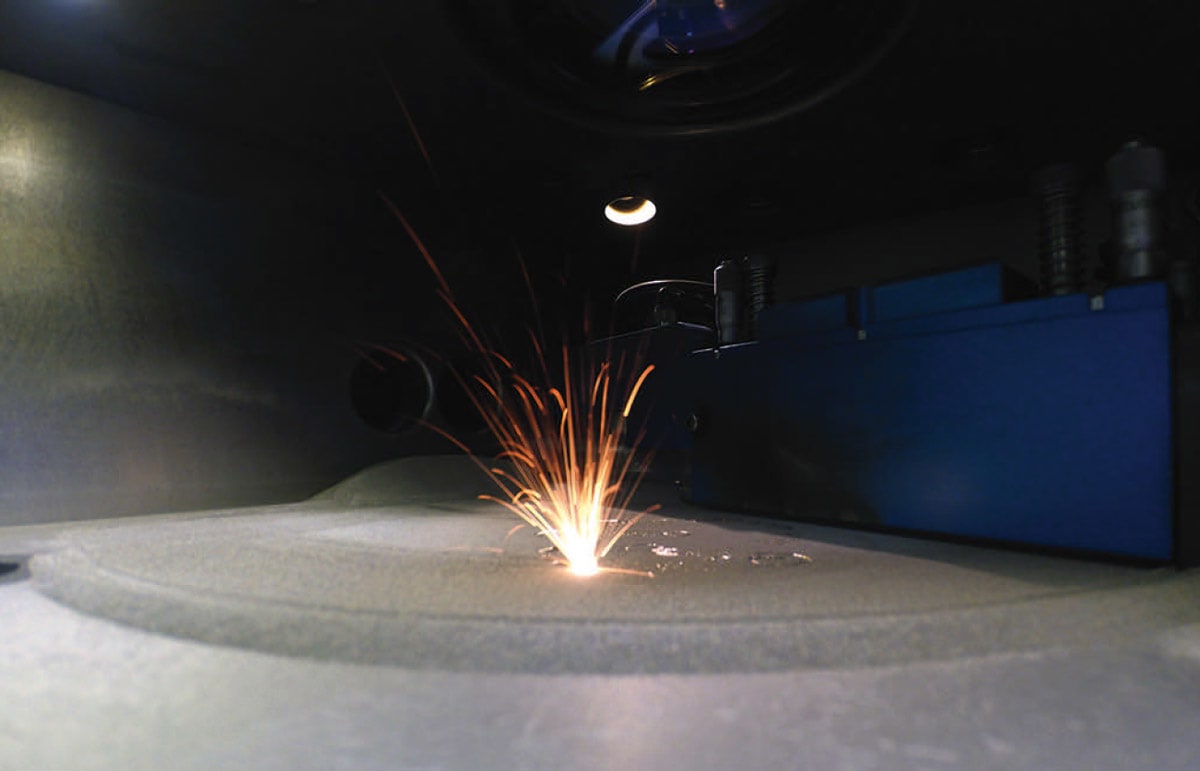
Marotta Controls, a rapidly growing aerospace and defense supplier based in New Jersey, recently announced the successful integration of additive manufacturing (AM) into its portfolio of services. The company validated the capability’s viability by using its now patented method to create internal features of an advanced manifold valve. The selective laser sintering (SLS) design technique generated nuanced radial passages in various geometries not possible to achieve via traditional machine boring methods. Given this, the new manifold valve delivered increased velocity pressure control.
Marotta also confirmed that it is incorporating AM to reduce parts, simplify assembly and shorten lead times to deliver lower cost, higher performing products. Additive manufacturing has long been touted across many industries as a smart way to accelerate the supply chain, initially used as a rapid tooling solution for custom injection mold creation and the like. Notably, a 2020 market report by Mordor Intelligence forecasted that the aerospace and defense market’s use of 3D printing will experience a 20 percent CAGR by 2025. This trend will only likely increase as military standards continue to adapt not just to the manufacturing process itself, but to the use of the necessary composite materials, too.
Marotta Controls first came into existence troubleshooting valve designs that, despite being accepted as proven parts, continued to leak in end-applications. The company ultimately fixed these issues and others, establishing itself as a go-to engineering shop capable of solving difficult problems. That is why the company took on the challenge of improving the manifold’s performance in high-pressure applications—a problem that required re-evaluating how and where best to apply Bernoulli’s equation within the system’s design.
Early manifold iterations saw performance increases driven by the introduction of new materials, chamber reconfigurations, and other mechanical adaptations. These solutions launched new product lines for Marotta that were customizable to a wide range of standards for military as well as commercial applications. However, the company still saw additional areas for innovation.
Valves and manifolds are historically produced via subtractive machining, with boring tools removing unwanted material to construct their radial passages within a single metal block. The radial passages are typically cylindrical or slightly frustoconical in nature. This design approach allows for passages that expand in two dimensions. By introducing a third dimension through AM, however, Marotta has improved those passage features to achieve desired performance.
Marotta’s patented approach starts with a 3D CAD model of choice that can meet varying ranges of end application specifications. Via the SLS machine, powdered metal is fused together layer by layer to construct a solid, single-pieced component with three-dimensional passage structures that can vary in shape— diamond, horizontal dome, spindle, branch-like, and others.
Marotta has evaluated its 3D valve concept in more than a dozen design configurations, with the passage structures varying. Velocity improvements are notable as is the part’s impact on the overall manifold’s production and performance.
Founded in 1943, Marotta Controls' current product portfolio includes pressure, power, motion, fluid, and electronic controls for tactical systems, shipboard and sub-sea applications, satellites, launch vehicles, and aircraft systems.
For Free Info Visit Here
More From SAE Media Group

Aerospace & Defense Tech Briefs
Streamlining Post-Processing in Additive Manufacturing
Aerospace Manufacturing and Machining
How Additive Manufacturing is Changing the Aerospace Industry

Off-Highway Engineering
Adding 3D Printing to Design, Manufacturing Processes

Aerospace & Defense Tech Briefs
Lifting 3D Printing to New Heights
Automotive Engineering
Demand up for Composite-Grade, High-Performance Plastics Across Aerospace, Automotive
Tech Briefs
Device Measures Laser Power in Real Time
Aerospace & Defense Tech Briefs
SAE International Extends Call for Abstracts, Seeks Submissions for AeroTech Conference
Off-Highway Engineering
3DEO Launches New Metal 3D-Printing Platform

Tech Briefs
Using 3D Printing to Strengthen Jet Engines
Off-Highway Engineering
Bosch Invested in Large-Scale Metal 3D Printing
Medical Design Briefs
As 3D Printing Grows, Compounders Become Production Partners
Aerospace & Defense Tech Briefs
GE Aviation and DM3D to Ramp up 3D-Printed Fan Blade Production for GE9X Engine
Tech Briefs
Executive Roundtable: 3D Printing
Aerospace Manufacturing and Machining
Lightweighting Parts Using 3D Metal Printing
Aerospace & Defense Tech Briefs
3-D Manufacturing of Titanium Components Takes Off
Off-Highway Engineering
Additive Manufacturing Is Transforming Mobility Engineering, Driving the Factory of the Future
Aerospace & Defense Tech Briefs
Additive Manufacturing Adoption Up, Growing Rapidly in Aerospace
Off-Highway Engineering
Moving Metal AM Forward


Tech Briefs
Products of Tomorrow
Aerospace & Defense Tech Briefs
Curing the Porosity Problem in Additive Manufacturing

Aerospace & Defense Tech Briefs
Industry Invited to Participate in AeroTech Aerospace and Defense Technical Program
Aerospace & Defense Tech Briefs
SAE International Issues, Revises Technical Reports for Aerospace Engineering
Top Stories
INSIDERManufacturing & Prototyping
 How Airbus is Using w-DED to 3D Print Larger Titanium Airplane Parts
INSIDERManned Systems
 FAA to Replace Aging Network of Ground-Based Radars
NewsTransportation
 CES 2026: Bosch is Ready to Bring AI to Your (Likely ICE-powered) Vehicle
NewsSoftware
 Accelerating Down the Road to Autonomy
EditorialDesign
 DarkSky One Wants to Make the World a Darker Place
INSIDERMaterials
 Can This Self-Healing Composite Make Airplane and Spacecraft Components Last...
Webcasts
Defense
 How Sift's Unified Observability Platform Accelerates Drone Innovation
Automotive
 E/E Architecture Redefined: Building Smarter, Safer, and Scalable...
Power
 Hydrogen Engines Are Heating Up for Heavy Duty
Electronics & Computers
 Advantages of Smart Power Distribution Unit Design for Automotive...
Unmanned Systems
 Quiet, Please: NVH Improvement Opportunities in the Early Design...
