




Stretchable Micro-Supercapacitors Self-Power Wearable Devices
A stretchable system can harvest energy from human breathing and motion.

Current versions of batteries and supercapacitors powering wearable and stretchable health-monitoring and diagnostic devices have many shortcomings including low energy density and limited stretchability.
An alternative to batteries, micro-supercapacitors are energy storage devices that can complement or replace lithium-ion batteries in wearable devices. Micro-supercapacitors have a small footprint, high power density, and the ability to charge and discharge quickly; however, when fabricated for wearable devices, conventional micro-supercapacitors have a “sandwich-like” stacked geometry that displays poor flexibility, long ion diffusion distances, and a complex integration process when combined with wearable electronics.
Researchers developed alternative device architectures and integration processes to advance the use of micro-super-capacitors in wearable devices. They found that arranging micro-supercapacitor cells in a serpentine, island-bridge layout allows the configuration to stretch and bend at the bridges, while reducing deformation of the micro-supercapacitors — the islands. When combined, the structure becomes what the researchers refer to as micro-supercapacitor arrays. By using an island-bridge design when connecting cells, the micro-supercapacitor arrays displayed increased stretchability and allowed for adjustable voltage outputs, allowing the system to be reversibly stretched up to 100%.
By using non-layered, ultrathin, zinc-phosphorus nanosheets and 3D laser-induced graphene foam — a highly porous, self-heating nano-material — to construct the island-bridge design of the cells, the team saw drastic improvements in electric conductivity and the number of absorbed charged ions. This proved that these micro-supercapacitor arrays can charge and discharge efficiently and store the energy needed to power a wearable device.
The researchers also integrated the system with a triboelectric nanogenerator — an emerging technology that converts mechanical movement to electrical energy. This combination created a self-powered system. With the wireless charging module that’s based on the triboelectric nanogenerator, energy can be harvested based on motion such as bending an elbow, breathing, and speaking.
By combining this integrated system with a graphene-based strain sensor, the energy-storing micro-supercapacitor arrays — charged by the triboelectric nano-generators — are able to power the sensor.
For more information, contact Megan Lakatos at
More From SAE Media Group

Medical Design Briefs
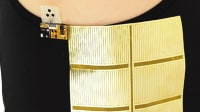
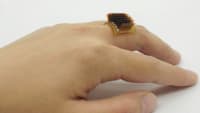
Stretchable Micro-Supercapacitors to Self-Power Wearable Devices
Tech Briefs
Wearable Liquid Unit Harvests Energy
Medical Design Briefs
Flexible High-Energy Textile Lithium Battery Designed for Wearables
Battery & Electrification Technology
Fast-Charging, Long-Running, Bendable Supercapacitor
Aerospace & Defense Tech Briefs
Rolls-Royce and Superdielectrics Explore Supercapacitor Technology
Tech Briefs
Supercapacitors for Wearable Devices
Tech Briefs
Stretchable Power Source for Wearables

Medical Design Briefs
E-Health Patches Monitor Pulse and Blood Pressure
Medical Design Briefs
Self-Powered Wearable Tech
Tech Briefs
Ultrahigh-Energy-Density Capacitor
Tech Briefs
Supercapacitor Based on Manganese Oxide
Medical Design Briefs
Powering Wearable Technology with MXene Textile Supercapacitor ‘Patch’

Battery Technology
3D-Printed Biodegradable Battery
Battery & Electrification Technology
Micro-Supercapacitors Enable Fast Charging
Automotive Engineering
Nano-Based Ultracap Tech Boosts EV Power Density
Medical Design Briefs
Stretchable Battery Packaging Could Power the Future of Wearable Devices
Medical Design Briefs
Wearable Battery Uses Super-Coiled Fibers

Tech Briefs
Novel, Solid-State Hybrid Ultracapacitor Battery

Battery & Electrification Technology
Fully Stretchable Fabric-Based Lithium-Ion Battery
Medical Design Briefs
Reduced Heat Leakage Improves Wearable Heat Harvester
Automotive Engineering
Clarios to Build Supercapacitor Plant in U.S.
Tech Briefs
Tin Electrode Amplifies Supercapacitors
Top Stories
INSIDERDesign
 How Airbus is Using w-DED to 3D Print Larger Titanium Airplane Parts
NewsSensors/Data Acquisition
 Microvision Aquires Luminar, Plans Relationship Restoration, Multi-industry Push
INSIDERManned Systems
 A Next Generation Helmet System for Navy Pilots
NewsAR/AI
 Accelerating Down the Road to Autonomy
INSIDERDefense
 New Raytheon and Lockheed Martin Agreements Expand Missile Defense Production
ArticlesAR/AI
 CES 2026: Bosch is Ready to Bring AI to Your (Likely ICE-powered) Vehicle
Webcasts
Transportation
 Advantages of Smart Power Distribution Unit Design for Automotive...
Automotive
 Quiet, Please: NVH Improvement Opportunities in the Early Design...
Electronics & Computers
 Cooling a New Generation of Aerospace and Defense Embedded...
Power
 Battery Abuse Testing: Pushing to Failure
AR/AI
 A FREE Two-Day Event Dedicated to Connected Mobility
