




3D Printed Rocket Engine Parts Survive 23 Hot-Fire Tests
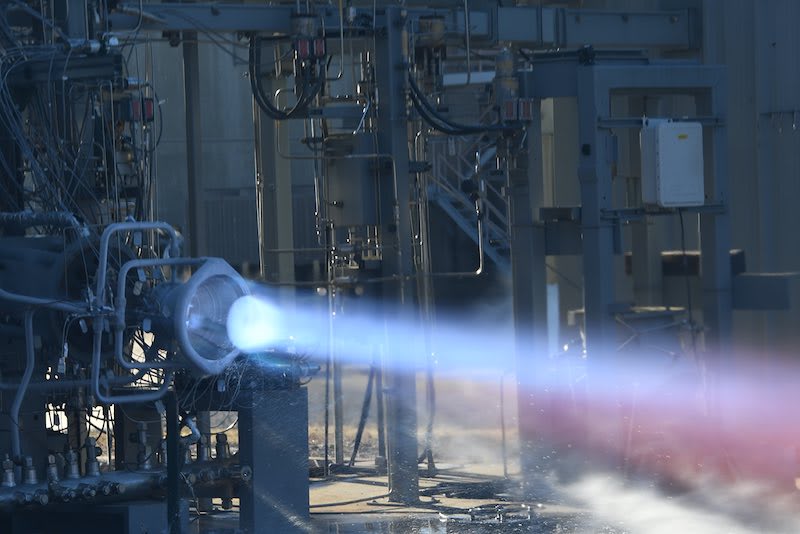
Future lunar landers might come equipped with 3D printed rocket engine parts that help bring down overall manufacturing costs and reduce production time. NASA is investing in advanced manufacturing – one of five industries of the future – to make it possible.
Through a series of hot-fire tests in November, NASA demonstrated that two additively manufactured engine components – a copper alloy combustion chamber and nozzle made of a high-strength hydrogen resistant alloy – could withstand the same extreme combustion environments that traditionally manufactured metal structures experience in flight.
A team of Marshall test engineers put the 3D printed parts through their paces, performing 23 hot-fire tests for a total duration of 280 seconds over 10 test days. Throughout the testing, engineers collected data, including pressure and temperature measurements in hardware coolant channels and the main chamber, and high-speed and high-resolution video of the exhaust plume and chamber throat. The team also calculated the chamber's performance and how efficiently the engine used propellant overall.
The high-strength iron-nickel superalloy nozzle was printed using a method called laser powder directed energy deposition, which deposits and melts the metal powder locally to create freeform structures. This method allows engineers to manufacture small and large-scale components, as demonstrated in NASA’s RAMPT project.
The tests were a part of NASA’s Long-Life Additive Manufacturing Assembly (LLAMA) project, which aims to enable these 3D printed parts – along with other additively manufactured hardware – for use on future lunar landers. The team will perform additional hot-fire tests to further demonstrate and validate the durability of the engine components. Marshall leads the LLAMA project for NASA's Game Changing Development program, part of the agency’s Space Technology Mission Directorate.
More From SAE Media Group

Aerospace Manufacturing and Machining INSIDER
RAMFIRE Project Develops, Tests 3D-Printed Aluminum Rocket Engine Nozzle

Test & Measurement/Sensors INSIDER
NASA Tests 3D-Printed Rocket Fuel Pump

NASA Spinoff
Some Engineering Is Only Skin Deep


Tech Briefs
Printed Polymer Makes Integrated Airplane Parts
Tech Briefs
Using 3D Printing to Strengthen Jet Engines
Aerospace INSIDER
NASA 3D Printing Technique Creates Metal Spacecraft Parts
Aerospace & Defense Tech Briefs
Orbex Debuts Innovative Smallsat Launch Vehicle

Aerospace & Defense Tech Briefs
To the Moon and Beyond with Additive Manufacturing
NASA Spinoff
3D Printed Engines Propel Next Industrial Revolution
NASA Spinoff
Printed Polymer Makes Integrated Airplane Parts

Tech Briefs
3D-Printed Rocket Turbopump Successfully Tested
Aerospace INSIDER
Public-Private Partnership to Improve Liquid Rocket Engines
Aerospace & Defense Tech Briefs
Using Advanced Computational Engineering Software to Meet Aerospace & Defense Industry Challenges
Tech Briefs
NASA’s John F. Kennedy Space Center
Aerospace & Defense Tech Briefs
Scientists Fuse Simulations and Machine Learning to Accelerate Novel Additively Manufactured Materials

Aerospace & Defense Tech Briefs
Laser Wire Additive Manufacturing System
Aerospace & Defense Tech Briefs
Metal-Plated, High-Temperature Plastics

Aerospace INSIDER
Ursa Major Performs First Successful Hotfire of Hypersonic Draper Engine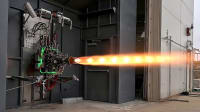
Top Stories
INSIDERMaterials
 How Airbus is Using w-DED to 3D Print Larger Titanium Airplane Parts
NewsRF & Microwave Electronics
 Microvision Aquires Luminar, Plans Relationship Restoration, Multi-industry Push
INSIDERWearables
 A Next Generation Helmet System for Navy Pilots
INSIDERManufacturing & Prototyping
 New Raytheon and Lockheed Martin Agreements Expand Missile Defense Production
NewsAutomotive
 Ford Announces 48-Volt Architecture for Future Electric Truck
ArticlesTransportation

Webcasts
Unmanned Systems
 Quiet, Please: NVH Improvement Opportunities in the Early Design Cycle
Aerospace
 Cooling a New Generation of Aerospace and Defense Embedded...
Energy
 Battery Abuse Testing: Pushing to Failure
Connectivity
 A FREE Two-Day Event Dedicated to Connected Mobility
Electronics & Computers
 Advantages of Smart Power Distribution Unit Design for Automotive &...
Aerospace
 Sesame Solar's Nanogrid Tech Promises Major Gains in Drone Endurance