




Correlational Analysis of Speech Intelligibility Tests and Metrics for Speech Transmission
Analysis of the common methods of evaluating the quality and limitations of speech could serve as a resource for users of standard speech intelligibility measurement methods.

Speech is a form of language (communication code) that uses vocally produced sounds to convey thoughts, meanings, and feelings. To communicate by speech, speech sounds must be both produced and perceived. Speech production refers to the process by which predetermined vocalized sounds are produced by the talker and organized in sequences forming communication signals. Speech perception is the process by which the listener is able to hear and interpret (understand) the message encoded in the speech signals.
The effective design and use of audio communication systems requires some knowledge of the physical properties of speech and the rules that govern the human perception of speech. The two main physical descriptors of speech signal are its sound intensity and spectral content.
The long-term average sound intensity levels of phonated speech produced with various levels of vocal effort are as follows:

However, individual phonemic components of speech vary greatly in their intensity with vowels carrying much greater energy than consonants. The strongest vowel, /aw/, as in the word “all,” is about 28 dB more intense than the weakest consonant, /th/, as in the word “thin.” Whispered (unphonated) speech levels are in the order of 40 dB(A), but this kind of speech is not used in formal communication.
A person’s vocal level effort depends on the visual and auditory clues stemming from the distance (real or perceived) to the listener and the emotional state of the talker. In noisy environments vocal effort is naturally higher (raised, loud, or shouted) than in quiet (normal) environments, because talkers involuntarily raise their voices to the level needed for them to hear themselves. Conversely, talkers wearing hearing protectors reduce their vocal efforts by about 3 dB, compared to when unprotected, if the background noise level exceeds 75 dB A (ISO 2003).
The speech levels referenced above are the levels measured in front of the talker’s mouth. However, the vocal source is quite directional and the levels at the talker’s back may measure up to 5–7 dB lower. This difference is relatively small at low- and mid-frequencies but sharply increases for spectral content at higher frequencies (consonants).
This work was done by Tomasz R. Letowski and Angelique A. Scharine for the Army Research Laboratory. For more information, download the Technical Support Package (free white paper) below. ARL-0229
This Brief includes a Technical Support Package (TSP).
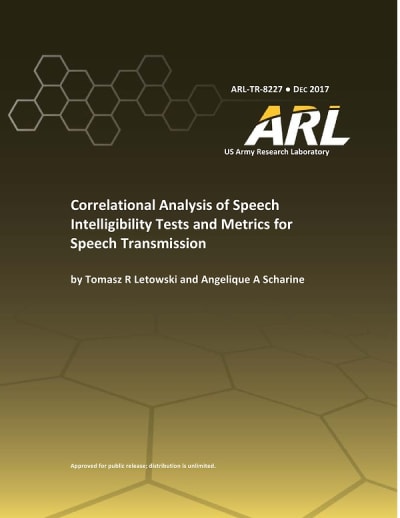
Correlational Analysis of Speech Intelligibility Tests and Metrics for Speech Transmission
(reference ARL-0229) is currently available for download from the TSP library.
Don't have an account?
More From SAE Media Group

Photonics & Imaging Technology
Testing 800G Direct Modulated Optical Signaling
Aerospace & Defense Tech Briefs
Multi-Agent RF Propagation Simulator

Tech Briefs
Vote for Tech Briefs Product of the Year 2021
Sensor Technology
The Many Benefits of Smart IIoT Connected Factories
Tech Briefs
Approach Makes Unmanned Agents Self-Sufficient
Aerospace & Defense Tech Briefs
Optimal UAS Assignments and Trajectories for Persistent Surveillance and Data Collection from a Wireless Sensor Network
Tech Briefs
Long-Range Wireless Sensor Network
Aerospace & Defense Tech Briefs
SAE International Extends Call for Abstracts, Seeks Submissions for AeroTech Conference
Aerospace & Defense Tech Briefs
Soldier-Robot Team Communication: An Investigation of Exogenous Orienting Visual Display Cues and Robot Reporting Preferences
Tech Briefs
Three-Dimensional Electronic Flying Microchip
Sensor Technology
3D Ultrasonic Sensors Support New Industrial Applications


Automotive Engineering
Provizio Eyes Safety with Radar, Not LiDAR
Off-Highway Engineering
Addressing Electromagnetic Compatibility in the Context of Aircraft Electrification
Aerospace & Defense Tech Briefs
Quality Management Experts Provide Guidance on AS9100 Standard, Equipment Calibration
Aerospace & Defense Tech Briefs
3D Data Acquisition Platform for Human Activity Understanding
Sensor Technology
For Power-Efficient Wireless Sensing, Start with Analog Processing
Sensor Technology
Harness Wireless IoT Sensors for Integrated Building Management

Aerospace & Defense Tech Briefs
Ka-Band Front-End Monolithic Microwave Integrated Circuits (MMICs) and Transmit/Receive (T/R) Modules Testing
Motion Design
OPC UA Standard for Industrial Automation
Aerospace & Defense Tech Briefs
Taking the Tactical Cloud with You Small Form Factor, Modular Data Centers at the Edge of the Battlefield
Aerospace & Defense Tech Briefs
Industry Invited to Participate in AeroTech Aerospace and Defense Technical Program
Photonics & Imaging Technology
Integrated Silicon Photonic Switch Demonstrates Lowest Signal Loss Ever in High-Speed Data Transmission
Tech Briefs
Atom-Based Radio Communications
Overview
The document titled "Correlational Analysis of Speech Intelligibility Tests and Metrics for Speech Transmission" is a technical report authored by Tomasz R. Letowski and Angelique A. Scharine, published by the US Army Research Laboratory in December 2017. The report covers research conducted between June 1, 2017, and September 29, 2017, focusing on the assessment of speech intelligibility, which is crucial for effective communication in various environments, particularly in military settings.
The primary objective of the study is to analyze the correlation between different speech intelligibility tests and various metrics used to evaluate speech transmission. Speech intelligibility refers to the clarity and comprehensibility of spoken language, which can be affected by numerous factors, including background noise, transmission medium, and speaker characteristics. Understanding these correlations is essential for developing effective communication systems and improving operational effectiveness in environments where clear communication is vital.
The report outlines the methodologies employed in the research, including the selection of speech intelligibility tests and the metrics used for analysis. It discusses the significance of these tests in evaluating how well speech can be understood in different conditions, which is particularly relevant for military personnel who may operate in noisy or challenging environments.
The findings of the report are intended to provide insights that can inform the design and implementation of communication systems, ensuring that they are optimized for clarity and intelligibility. The research aims to contribute to the development of standards and guidelines for assessing speech intelligibility in various contexts, ultimately enhancing the effectiveness of communication in critical situations.
The document is approved for public release, indicating that the findings and methodologies can be shared with a broader audience, including researchers, military personnel, and communication specialists. The report emphasizes the importance of ongoing research in this area to adapt to evolving communication needs and technological advancements.
In summary, this technical report serves as a valuable resource for understanding the relationship between speech intelligibility tests and transmission metrics, with implications for improving communication systems in military and other high-stakes environments.
Top Stories
INSIDERAerospace
 How Airbus is Using w-DED to 3D Print Larger Titanium Airplane Parts
NewsUnmanned Systems
 Microvision Aquires Luminar, Plans Relationship Restoration, Multi-industry Push
INSIDERWearables
 A Next Generation Helmet System for Navy Pilots
ArticlesDesign
 CES 2026: Bosch is Ready to Bring AI to Your (Likely ICE-powered) Vehicle
NewsManned Systems
 Accelerating Down the Road to Autonomy
ArticlesAutomotive
 Rewriting the Engineer’s Playbook: What OEMs Must Do to Spin the AI Flywheel
Webcasts
Energy
 Hydrogen Engines Are Heating Up for Heavy Duty
Automotive
 Advantages of Smart Power Distribution Unit Design for Automotive...
Automotive
 Quiet, Please: NVH Improvement Opportunities in the Early Design...
AR/AI
 A FREE Two-Day Event Dedicated to Connected Mobility
Power
 E/E Architecture Redefined: Building Smarter, Safer, and Scalable Vehicles
Aerospace
 How Sift's Unified Observability Platform Accelerates Drone Innovation