




Green Aerospace Test Uses No Explosives
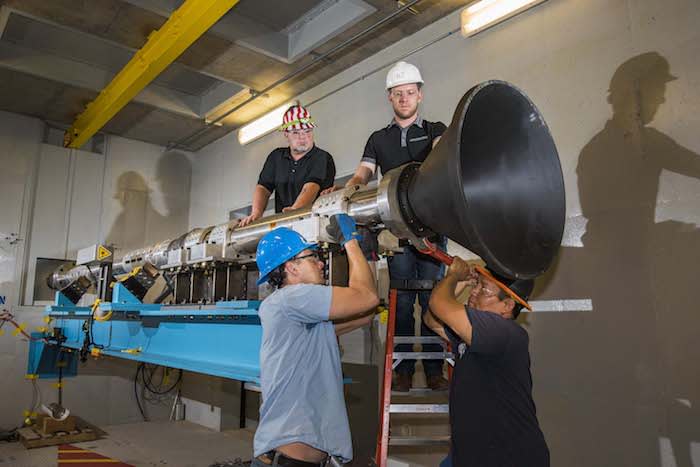
Sandia National Laboratories has successfully demonstrated a new, more environmentally friendly method to test a rocket part to ensure its avionics can withstand the shock from stage separation during flight. The Alternative Pyroshock Test uses a nitrogen-powered gas gun to shoot a 100-pound steel projectile into a steel resonant beam, which then transfers energy through a resonant cone attached to the part being tested. The resulting energy transfer mimics the conditions of stage separation in space.
Until now, pyroshock tests to ensure aerospace parts were ready for the rigors of flight had used explosives encased in lead to provide the impacts to parts needed for such experiments. The lead and explosives were environmental hazards, so cleanup was costly and time-consuming.
More From SAE Media Group

Aerospace INSIDER
Ursa Major Performs First Successful Hotfire of Hypersonic Draper Engine

Aerospace INSIDER
Hermeus Quarterhorse Joins Hypersonic High Cadence Testing Program
Aerospace & Defense Tech Briefs
OmegA Rocket Sustains Explosion During First Static Test, Northrop Grumman Maintains Test Was a Success
Tech Briefs
Thin Film Sensor for Ultra High-Temp Measurement
Aerospace INSIDER
Blue Origin Rocket Reaches Intended Orbit on First Launch
NASA Spinoff
Separation Device Launches New Science Payloads
Aerospace INSIDER
Oscillating Heat Pipes Tested for Use in Space
NASA Spinoff
Test Rockets Prepare for Distant Landings
Tech Briefs
Affordable Vehicle Avionics (AVA)
Tech Briefs
AFRL: Behind the Scenes
Aerospace INSIDER
Moonlighter Satellite to Host First On-Orbit Cybersecurity Challenge


Aerospace & Defense Tech Briefs
Stratolaunch All-Composite Aircraft Achieves First Flight


Aerospace & Defense Tech Briefs
Northrop Grumman Tests, Qualifies Orion Launch Abort Motor for Flight in Cold Conditions
Aerospace & Defense Tech Briefs
U.K. Space Agency Partners with Industry to Advance Spaceflight Program
Aerospace Manufacturing and Machining INSIDER
Missile Warning Satellite Completes Thermal Vacuum Testing

Aerospace INSIDER
Characterizing the Performance of Variable Emissivity Materials in Space
Aerospace Manufacturing and Machining INSIDER
RAMFIRE Project Develops, Tests 3D-Printed Aluminum Rocket Engine Nozzle
Tech Briefs
GPS-Enhanced Onboard Navigation System (GEONS)
Tech Briefs
Getting NASA Data to the Ground with Lasers
Top Stories
INSIDERManufacturing & Prototyping
 How Airbus is Using w-DED to 3D Print Larger Titanium Airplane Parts
INSIDERManned Systems
 FAA to Replace Aging Network of Ground-Based Radars
NewsTransportation
 CES 2026: Bosch is Ready to Bring AI to Your (Likely ICE-powered) Vehicle
NewsSoftware
 Accelerating Down the Road to Autonomy
EditorialDesign
 DarkSky One Wants to Make the World a Darker Place
INSIDERMaterials
 Can This Self-Healing Composite Make Airplane and Spacecraft Components Last...
Webcasts
Defense
 How Sift's Unified Observability Platform Accelerates Drone Innovation
Automotive
 E/E Architecture Redefined: Building Smarter, Safer, and Scalable...
Power
 Hydrogen Engines Are Heating Up for Heavy Duty
Electronics & Computers
 Advantages of Smart Power Distribution Unit Design for Automotive...
Unmanned Systems
 Quiet, Please: NVH Improvement Opportunities in the Early Design...
