




Wireless Tamper Detection Sensor and Sensing System
The sensors can detect and locate cracks, material strain, or impact damage.
NASA's Langley Research Center researchers have developed a wireless, connection-free inductor capacitor sensor system that can be placed on or embedded in materials and structures to monitor for and detect damage. The sensors can also be used to detect package tampering and pilfering. This innovation — SansEC (Sans Electrical Connections) — makes sensors more damage-resilient and more environmentally friendly to manufacture and use.
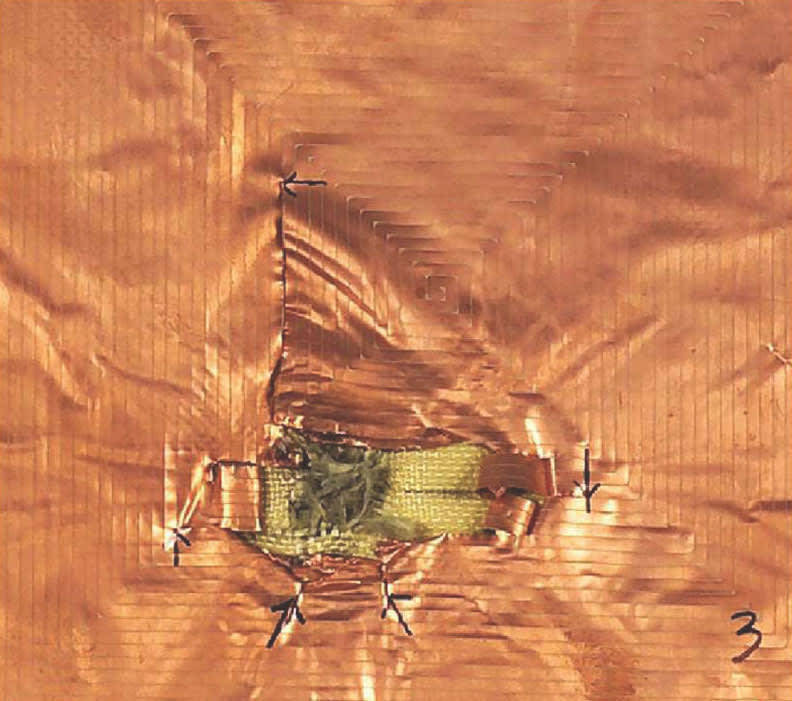
The sensors use a NASA award-winning magnetic field response measurement acquisition device to provide power to the sensors, and to acquire physical property measurements from them. The sensors can be continuously or occasionally monitored to detect cracks, material strain, or impact damage. Damage location can also be readily identified with this system.
The SansEC sensor system consists of multiple pairs of inductor-capacitor sensors, with no electrical connections, that are placed throughout the material being monitored for damage. The sensors are embedded in or placed directly onto the surface of the material. Strains and breaks are detected by changes in resonant frequency read by the accompanying magnetic field data acquisition system. When pulsed by a sequence of magnetic field harmonics from the acquisition system, the sensors become electrically active and emit a wireless response. The magnetic field response attributes of frequency, amplitude, and bandwidth of the inductor correspond to the physical property states measured by the sensor. The received response is correlated to calibration data to determine the physical property measurement. Each sensor pair has its own frequency response, and when damage occurs to that circuit, the frequency response changes. This change identifies the damage location within the material.
A unique feature achieved by eliminating electrical connections is that damage to a single point will not prevent the sensor from being powered or interrogated. If a sensor is broken, two concentric inductively coupled sensors are created, thus identifying tamper or damage location.
Possible applications include package tamper/pilfering detection, puncture detection in hazmat suits or other protective clothing, finding cracks or anomalies in composite vehicle structures, and damage detection of multilayer materials.
NASA is actively seeking licensees to commercialize this technology. Please contact The Technology Gateway at
More From SAE Media Group
Tech Briefs
Wireless Damage Location Sensing System
Medical Design Briefs
EIT-Based Tactile Sensor
Tech Briefs
Capacitive Pressure Sensor System and Packaging


Medical Design Briefs
Smart Facemask Sends Alerts
Tech Briefs
Rapidly Testing Stretchable Sensors
Medical Design Briefs
Highly Sensitive Sensors Show Promise in Enhancing Human Touch



Medical Design Briefs
Sound-Powered Sensors
Tech Briefs
5 Ws of Floating Sensors
Tech Briefs
Printable IoT Sensor Development Platform
Medical Design Briefs
Highly Sensitive Biosensor Detects Extremely Small Changes in Tears, Blood
Medical Design Briefs
Drawn-on-Skin Electronics Offer Breakthrough in Wearable Monitors
Tech Briefs
Upper Body Robotic Exoskeleton
Medical Design Briefs
Designing Rugged Myoelectric Interfaces for Highly Functional Prosthetics
Medical Design Briefs
Low-Voltage, Low-Power Pressure Sensors Monitor Health
Sensor Technology
Machine Condition Monitoring Keeps a Factory Running

Motion Design
New Capabilities for Grasp-Assisting Gloves
Off-Highway Engineering
CES 2024: Aeva Launches 4D Lidar for SAE Level 4 Trucks
Sensor Technology
‘Impossible’ Millimeter Wave Sensor Has Wide Potential
Aerospace & Defense Tech Briefs
Electrokinetics Models for Micro- and Nano-Fluidic Impedance Sensors
Aerospace & Defense Tech Briefs
Damping Measurement for Wafer-Level Packaged MEMS Acceleration Sensors
Tech Briefs
Short-Range Communication System
Top Stories
INSIDERManufacturing & Prototyping
 How Airbus is Using w-DED to 3D Print Larger Titanium Airplane Parts
NewsAutomotive
 Microvision Aquires Luminar, Plans Relationship Restoration, Multi-industry Push
INSIDERAerospace
 A Next Generation Helmet System for Navy Pilots
INSIDERDesign
 New Raytheon and Lockheed Martin Agreements Expand Missile Defense Production
ArticlesAR/AI
 CES 2026: Bosch is Ready to Bring AI to Your (Likely ICE-powered) Vehicle
Road ReadyDesign

Webcasts
Semiconductors & ICs
 Advantages of Smart Power Distribution Unit Design for Automotive...
Unmanned Systems
 Quiet, Please: NVH Improvement Opportunities in the Early Design...
Electronics & Computers
 Cooling a New Generation of Aerospace and Defense Embedded...
Power
 Battery Abuse Testing: Pushing to Failure
AR/AI
 A FREE Two-Day Event Dedicated to Connected Mobility
