




Exo-Brake Enables Safe Return for Small Spacecraft
The tension-based, flexible braking device resembles a cross parachute.
NASA's Exo-Brake is a critical technology that can potentially help science payloads return to Earth from the International Space Station through the deployment of small spacecraft. The Exo-Brake is a tension-based, flexible braking device resembling a cross-parachute that deploys from the rear of a satellite to increase the drag. It is a deorbit device that replaces the more complicated rocket-based systems that would normally be employed during the deorbit phase of re-entry.
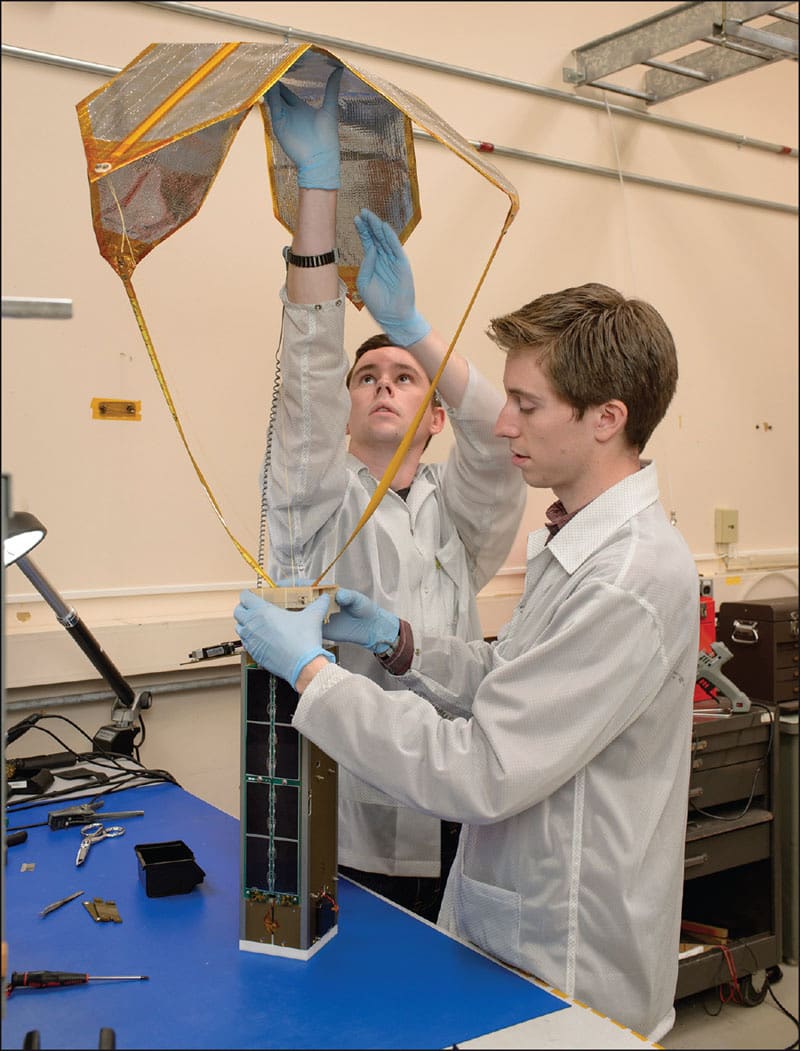
The Exo-Brake is made of Mylar, and is almost 4 square feet in cross section (0.35 square meters). “The Exo-Brake's current design uses a hybrid system of mechanical struts and flexible cord with a control system that ‘warps’ the device — much like how the Wright brothers used warping to control the flight behavior of their first wing design,” said Marcus Murbach, principal investigator and inventor of the Exo-Brake. This warping, combined with real-time simulations of the orbital trajectory, allows engineers to guide the spacecraft to a desired entry point without the use of fuel, enabling accurate landing for future payload return missions.
Engineers at NASA's Ames Research Center in Moffett Field, CA, have been testing the Exo-Brake. The technology demonstration mission is a part of the Technology Education (TechEdSat-5) nanosatellite that was launched Dec. 9 on Japan's H-II Transfer Vehicle from Tanegashima Space Center in Japan. The Exo-Brake will reside on the space station until its deployment in early 2017.
Since 2012, the Exo-Brake has been tested on balloons and sub-orbital rockets through the Sub-Orbital Aero-dynamic Re-entry Experiments, or SOAREX, flight series. Earlier versions of the Exo-Brake and other critical systems also have been tested on orbital experiments on TechEdSat nano-satellite missions. In addition to the goal of returning samples from the space station, the project seeks to develop building blocks for larger scale systems that might enable future small or nanosatellite missions to reach the surface of Mars and other planetary bodies in the solar system.
The Exo-Brake is funded by the Entry Systems Modeling project within the Space Technology Mission Directorate's Game Changing Development program. Additional funding for the Exo-Brake is provided by NASA Ames Research Center and the NASA Engineering and Safety Center.
For more information on the Game Changing Development program, visit Here .
More From SAE Media Group
Motion Design INSIDER
Exo-Brake “Parachute” to Enable Safe Return for Small Spacecraft

Tech Briefs
Spacecraft to Remove Orbital Debris
Motion Design
Component Helps Perseverance Sample Mars


Tech Briefs
5Ws of a 3D-Printed Electrospray Engine
Motion Control Technology
Actuator Controls Valving in Micro-Satellite Thruster


Motion Design INSIDER
NASA Demonstrates Software ‘Brains’ Shared Across Satellite Swarms
Tech Briefs
Rad-Hard Avionics for Moon Rover

Tech Briefs
Watch NASA's Perseverance Rover Land on Mars


Tech Briefs
Motion in Space: Astrobee Breakthrough
Aerospace & Defense Tech Briefs
NASA Invites Proposal from Space-Based Large-Scale 3D-Printing Company

Tech Briefs
Flexible, Spinning Heat Shield for Spacecraft

Aerospace & Defense Tech Briefs
Space Docking and Satellite AI Research
Motion Design
Docking System Enables Safe Rendezvous in Space

Aerospace & Defense Tech Briefs
Space Tango Takes Its Next Steps in Orbital Manufacturing
Top Stories
INSIDERDesign
 How Airbus is Using w-DED to 3D Print Larger Titanium Airplane Parts
NewsSensors/Data Acquisition
 Microvision Aquires Luminar, Plans Relationship Restoration, Multi-industry Push
INSIDERManned Systems
 A Next Generation Helmet System for Navy Pilots
NewsAR/AI
 Accelerating Down the Road to Autonomy
INSIDERDefense
 New Raytheon and Lockheed Martin Agreements Expand Missile Defense Production
ArticlesAR/AI
 CES 2026: Bosch is Ready to Bring AI to Your (Likely ICE-powered) Vehicle
Webcasts
Semiconductors & ICs
 Advantages of Smart Power Distribution Unit Design for Automotive...
Unmanned Systems
 Quiet, Please: NVH Improvement Opportunities in the Early Design...
Electronics & Computers
 Cooling a New Generation of Aerospace and Defense Embedded...
Automotive
 Battery Abuse Testing: Pushing to Failure
Transportation
 A FREE Two-Day Event Dedicated to Connected Mobility
