




Morphing Nanotubes into Tougher Carbon for Aerospace
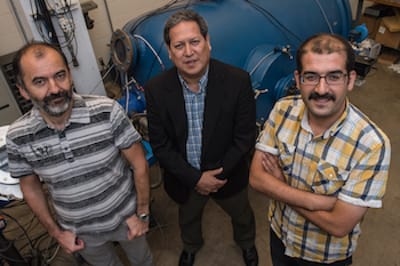
Rice University materials scientists are making nanodiamonds and other forms of carbon by smashing nanotubes against a target at high speeds. The process will enrich the knowledge of engineers who design structures that resist damage from high-speed impacts. The diamonds are the result of a detailed study on the ballistic fracturing of carbon nanotubes at different velocities. Such high-energy impacts caused atomic bonds in the nanotubes to break and sometimes recombine into different structures.
The work is intended to help aerospace engineers design ultralight materials for spacecraft and satellites that can withstand impacts from high-velocity projectiles like micrometeorites.
More From SAE Media Group
Aerospace INSIDER
Making Airplane Parts Without the Massive Infrastructure
Tech Briefs
Thin Heat Shield for Superfast Aircraft

Tech Briefs
Solid-State Carbon Dioxide Sensor
Tech Briefs
Method Produces Fine-Grained Targets
Tech Briefs
Technique Creates Adaptive Materials


Tech Briefs
Fiber-Metal Laminate Manufacturing Technique

Tech Briefs
Method Enables Wings to be De-Iced in Flight
Medical Design Briefs
3D Printable Polymer Nanocomposite Ink
Aerospace Manufacturing and Machining INSIDER
NASA to Advance Unique 3D Printed Sensor Technology
Aerospace Manufacturing and Machining INSIDER
Hybrid Nanomaterials Hold Promise for Improved Ceramic Composites
Tech Briefs
Nano-Infused Ceramic Can Report its own Health
Tech Briefs
Fabrication of Multilayer Ferritin Arrays


Aerospace & Defense Tech Briefs
‘Nanostitches’ Enable Lighter and Tougher Composite Materials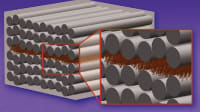
Electronics & Sensors INSIDER
MIT Team Takes a Major Step Toward Fully 3D-Printed Active Electronics
Motion Design INSIDER
Superlubricity Coating for Nearly Friction-Free Surfaces
Tech Briefs
Shear Assisted Processing and Extrusion
Tech Briefs
Products of Tomorrow

Aerospace & Defense Tech Briefs
Design of New Piezoelectric Composites Using Nanocellulose
Top Stories
INSIDERManufacturing & Prototyping
 How Airbus is Using w-DED to 3D Print Larger Titanium Airplane Parts
INSIDERManned Systems
 FAA to Replace Aging Network of Ground-Based Radars
NewsTransportation
 CES 2026: Bosch is Ready to Bring AI to Your (Likely ICE-powered) Vehicle
NewsSoftware
 Accelerating Down the Road to Autonomy
EditorialDesign
 DarkSky One Wants to Make the World a Darker Place
INSIDERMaterials
 Can This Self-Healing Composite Make Airplane and Spacecraft Components Last...
Webcasts
Defense
 How Sift's Unified Observability Platform Accelerates Drone Innovation
Automotive
 E/E Architecture Redefined: Building Smarter, Safer, and Scalable...
Power
 Hydrogen Engines Are Heating Up for Heavy Duty
Electronics & Computers
 Advantages of Smart Power Distribution Unit Design for Automotive...
Unmanned Systems
 Quiet, Please: NVH Improvement Opportunities in the Early Design...
