




Navy Grant Fuels Effort to Improve Safety of Military Technology
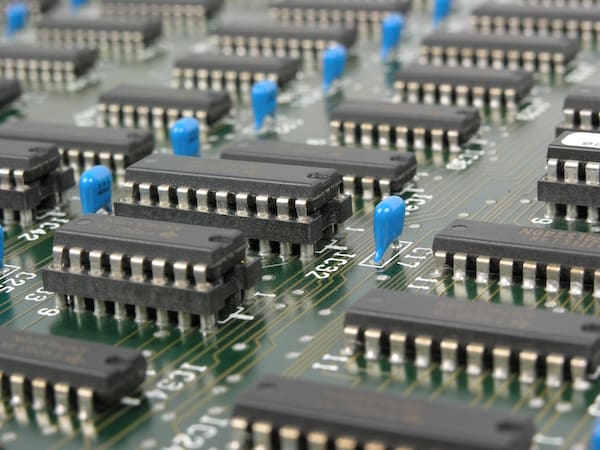
An Indiana University expert in the high-tech field of computer vision will collaborate with U.S. Navy engineers to improve the quality of microelectronic components used in critical military systems like communication and navigation. David Crandall, a professor in the IU School of Informatics and Computing, has received $450,000 from the Naval Engineering Education Consortium to conduct research in collaboration with the Crane, Ind.-based Naval Surface Warfare Center Crane Division on new methods to guarantee the integrity of the electronic circuitry used in U.S. Navy platforms.
"Our project will apply the principles of computer vision to improve the inspection of these technologies, which currently require quality control conducted by people painstakingly examining circuits underneath microscopes," explained Crandall.
Computer vision uses machine learning to "train" machines in the creation of algorithms that recognize patterns like faces, scenes and actions. The technology is familiar, as the same basic methods power Google's image search or the motion sensors in Microsoft's Xbox Kinect. The IU-NSWC Crane project will work to apply this pattern-recognition power to spotting microscopic flaws in electronic circuits and semiconductors.
"Today's military employs devices with immensely complicated integrated circuits whose logic gates are less than 25 nanometers wide and feature upwards of 20 billion individual transistors," said Robert Templeman, lead engineer on the project at NSWC Crane and a graduate of the IU School of Informatics and Computing. "What once could be inspected by the naked eye, and later optical magnification, now requires state-of-the-art instruments that create images from sophisticated imaging technology, challenging the limits of human inspection."
The IU-NSWC Crane collaboration will take place in three phrases. The first year will investigate the project's primary challenges and explore solutions. The second two years will be "operation periods" that "expand the scope and ambition of the previous year's goals," Crandall said.
More From SAE Media Group
Electronics & Sensors INSIDER
Next-Gen Automotive Semiconductors Are Critical for Level 5 Driverless Cars
Electronics & Sensors INSIDER
Integrating Dimensions to Get More Out of Moore’s Law
Electronics & Sensors INSIDER
Advancing Semiconductor Devices for Artificial Intelligence

Embedded Computing INSIDER
Chaos-Based Microchips Offer Possible Solution to Moore’s Law
Electronics & Sensors INSIDER
Built For AI, This Chip Moves Beyond Transistors for Huge Computational Gains
Electronics & Sensors INSIDER
This LED Can Be Integrated Directly Into Computer Chips

Tech Briefs
Thin-Film Electronics for Flexible Chip Design

Tech Briefs
A Two-in-One Storage and Computing Device
Electronics & Sensors INSIDER
New Transistor Design Disguises Key Computer Chip Hardware to Protect Against Hackers
Aerospace & Defense Tech Briefs
SHIP Prototype Computer Chip
Defense INSIDER
MIT Report Finds US Lead in Advanced Computing is Almost Gone
Tech Briefs
Integrating Fragile 2D Materials into Devices
Electronics & Sensors INSIDER
A Ferroelectric Transistor That Stores and Computes at Scale
Electronics & Sensors INSIDER
Analog and Digital: Best of Both Worlds in One Energy-Efficient System
Electronics & Sensors INSIDER
Engineers “Grow” Atomically Thin Transistors on Top of Computer Chips
Electronics & Sensors INSIDER
A New Magnetic Transistor for More Energy-Efficient Electronics

Embedded Computing INSIDER
Complex Materials Can Self-Organize Into Circuits
Electronics & Sensors INSIDER
Researchers Demonstrate Cutting-Edge Chip Technology for Ultra-Low Power AI Connected Devices
Aerospace Manufacturing and Machining INSIDER
Army Launches CMOSS Prototyping Competition for Computer Chassis and Cards
Electronics & Sensors INSIDER
Opening Up the Potential of Thin-Film Electronics for Flexible Chip Design
Tech Briefs
Turning Edible Fungi into Organic Memristors



Electronics & Sensors INSIDER
Soft, Bioelectronic Sensor Implant
Top Stories
NewsSensors/Data Acquisition
 Microvision Aquires Luminar, Plans Relationship Restoration, Multi-industry Push
INSIDERRF & Microwave Electronics
 A Next Generation Helmet System for Navy Pilots
INSIDERWeapons Systems
 New Raytheon and Lockheed Martin Agreements Expand Missile Defense Production
NewsAutomotive
 Ford Announces 48-Volt Architecture for Future Electric Truck
INSIDERAerospace
 Active Strake System Cuts Cruise Drag, Boosts Flight Efficiency
ArticlesTransportation

Webcasts
Aerospace
 Cooling a New Generation of Aerospace and Defense Embedded...
Energy
 Battery Abuse Testing: Pushing to Failure
Power
 A FREE Two-Day Event Dedicated to Connected Mobility
Automotive
 Quiet, Please: NVH Improvement Opportunities in the Early Design Cycle
Electronics & Computers
 Advantages of Smart Power Distribution Unit Design for Automotive &...
Unmanned Systems
 Sesame Solar's Nanogrid Tech Promises Major Gains in Drone Endurance