




Process Approach to Determining Quality Inspection Deployment
New tool measures quality control system effectivity.
As new technologies are implemented in manufacturing areas, inspection processes will be affected. Often because product quality has increased or automated inspection equipment has been introduced, the inspection activity may be reduced or eliminated. In many cases a disciplined process is needed to evaluate performance data against risk to determine if this change is warranted.

A tool has been developed using an Excel® spreadsheet with an imbedded checklist, which will guide users through a series of decision points to make a determination if a change is warranted. The approach attempts to answer the question: How can inspection practices be identified, reviewed, and updated to keep up with technological changes, trend results, facility changes, etc.?
Inspection is often considered a non-value-added expense and therefore subject to budget constraints that usually try to reduce the inspection footprint. If these arguments lead to a reduction in inspection without proper analysis, the organization may be faced with significant risk that will materialize in the future. The inadequacies of inspection can be traced to either improperly applying an inspection system, or the problems with the individual inspection process as shown in Figure 1. Aside from inexperience in designing an inspection system, external forces such as cost and schedule constraints or lack of funding to implement proper inspection processes and tools can increase risks.
The inspection system is the approach for deploying inspectors and the assignment of tasks to these inspectors. Depending on the nature of the process to be inspected and the quality level of the particular process, the inspection system may choose to use 100% inspection, sampled inspection, operator inspection, patrol inspection (inspector moves from station to station), automated inspection, or a combination of multiple types. Inspector capability is dependent upon training to standards, the capability of the inspection tools in use, the time allowed for inspection, and the record keeping provided.
The inspection result is dependent upon the interaction of the inspection system and the capability of the individual inspector. When either the inspector or the inspection system is poor, then inspection results are erratic as shown in Figure 1. Only when both are good will the inspection result be good. Before significant and potentially expensive changes are made to the manufacturing or inspection processes, it should be determined that the ineffective inspection process isn’t simply the result of a mismatch between inspection system and inspector deployment.
The level of inspection is dependent upon the capability of the underlying manufacturing process, which in turn can be affected by design tolerances and key characteristics. In general, process variability should be independent of the people performing the process. The process should have business or product requirement goals which are met. Ancillary controls should be in place such as adequate worker training, use of calibrated equipment, and appropriate raw materials presented to the process.
When the manufacturing process changes, the inspection approach should be re-evaluated. These changes include introduction of new manufacturing technologies, significant process or facilities changes, and design changes. On the other hand, inspection techniques may improve because of the introduction of inspection technologies or improved inspection techniques. Finally, inspection may be affected by changes in specifications and customer requirements, cost and schedule drivers noted by management, or defect analysis and other anomaly investigations.
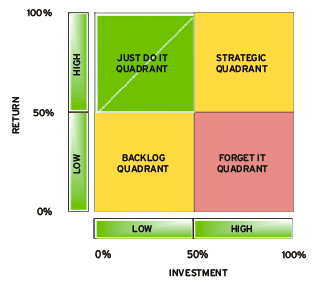
Each of these conditions requires an appropriate analysis of the relevant manufacturing, inspection, or stakeholder requirements changes. The tools presented here evaluate the return on investment of an inspection change vs. the investment to implement the change. Investment includes both the effort to conduct the analyses, as well as the effort to modify inspection. As shown in Figure 2, if the return on investment is high and the investment is low, then it is a natural inspection change to make (Just do it). On the other hand, if the return is low and the investment is high, then it’s best to avoid the change (Forget it). When the return on investment is low and the investment is low, most likely these are second in line to tackle and there may be many of these changes to make (Backlog). Finally, when the return on investment is high and the investment is also high, a strategy must be chosen to determine which inspection approach to change (Strategic).
This work was done by Eric S. Richter and Arthur L. McClellan for National Reconnaissance Office. NRO-0001
This Brief includes a Technical Support Package (TSP).
Process Approach to Determining Quality Inspection Deployment
(reference NRO-0001) is currently available for download from the TSP library.
Don't have an account?
More From SAE Media Group
Aerospace & Defense Tech Briefs
Quality Management Experts Provide Guidance on AS9100 Standard, Equipment Calibration
Aerospace & Defense Tech Briefs
Industry Invited to Participate in AeroTech Aerospace and Defense Technical Program
Aerospace & Defense Tech Briefs
SAE International Debuts AS13006, Process Control Methods Aerospace Standard
Aerospace & Defense Tech Briefs
SAE International Extends Call for Abstracts, Seeks Submissions for AeroTech Conference
Tech Briefs
Calibration System for Automated Fiber Placement
Aerospace & Defense Tech Briefs
Advances in Adhesive Joining of Structural Components Focus of New Book from SAE International
Aerospace & Defense Tech Briefs
Additive Manufacturing: How 3D Printing Will Transform the A&D Support Chain
Aerospace & Defense Tech Briefs
New AFRL Chamber Enhances Equipment Performance in Extreme Environments

Aerospace & Defense Tech Briefs
SAE International Anti-Counterfeit Standards Integral to Obsolescence Management
Automotive Engineering
Enterprise Battery-Analysis Pioneer Voltaiq Partners with Siemens

Aerospace & Defense Tech Briefs
Additive Manufacturing Adoption Up, Growing Rapidly in Aerospace
Aerospace & Defense Tech Briefs
SAE International Issues, Revises Technical Reports for Aerospace Engineering
Aerospace & Defense Tech Briefs
SAE International Issues First Technical Standards for Aerospace Additive Manufacturing
Aerospace Manufacturing and Machining
Applying Augmented Reality Technology to Aerospace Manufacturing
Aerospace INSIDER
F-35 Proves Nuke Drop Performance in Stockpile Flight Testing
Medical Design Briefs
More than Just Measurement: Dimensional Inspection FAQs
Aerospace & Defense Tech Briefs
Testing Reality in an Increasingly Complex Design Space

Aerospace Manufacturing and Machining
Getting the Most Out of Industrial CT Scanning
Aerospace & Defense Tech Briefs
Reverse Engineering Technology


Aerospace Manufacturing and Machining INSIDER
Counter UAS Systems Tested Against Swarms of 50 Drones in Latest Yuma Exercise
Aerospace INSIDER
Germany's New Military Surveillance Jet Completes First Flight
Aerospace INSIDER
Archer Delivers First Midnight eVTOL to US Air Force
Medical Design Briefs
Design for Inspection: The Key to Lower Cost and Higher Profit Margins
Aerospace & Defense Tech Briefs
Cold Spray Technology
Overview
The document titled "Process Approach to Determining Quality Inspection Deployment" (Report No. TOR-2015-02544) presents a systematic methodology for evaluating and improving inspection processes in the aerospace industry. Authored by Eric S. Richter and Arthur L. McClellan, the report was developed through a collaborative effort involving multiple organizations, including major aerospace companies and government agencies.
The primary focus of the report is to provide a tool and guidance for assessing the value of reducing inspection efforts when introducing new inspection technologies or modifying existing ones. This is particularly relevant in the context of modern manufacturing methods, where efficiency and cost-effectiveness are paramount. The document outlines a generic evaluation methodology that can be applied across various inspection processes, allowing organizations to systematically compare and assess their inspection strategies.
A key feature of the report is the Excel®-based tool developed by a cross-industry team. This tool enables users to input specific parameters, such as investment costs and expected returns, to generate scores that help determine the feasibility and value of proposed inspection modifications. The tool is designed to adapt to different scenarios, including changes in manufacturing processes, inspection processes, and data-driven decision-making. It emphasizes that while the tool provides valuable insights, it should not replace management experience and sound business judgment.
The report also includes examples in an appendix that illustrate the application of the tool in real-world scenarios, demonstrating its practical utility. Additionally, it highlights the importance of thorough analysis and decision-making processes in determining the acceptability of inspection modifications.
Overall, the document serves as a comprehensive resource for aerospace professionals seeking to enhance their inspection processes. It emphasizes the need for a consistent and data-driven approach to quality assurance, ultimately aiming to improve mission success and operational efficiency in aerospace projects. The collaborative nature of the report underscores the collective expertise of the contributors, reflecting a commitment to advancing best practices in the industry.
Top Stories
NewsRF & Microwave Electronics
 Microvision Aquires Luminar, Plans Relationship Restoration, Multi-industry Push
INSIDERAerospace
 A Next Generation Helmet System for Navy Pilots
INSIDERDesign
 New Raytheon and Lockheed Martin Agreements Expand Missile Defense Production
INSIDERMaterials
 How Airbus is Using w-DED to 3D Print Larger Titanium Airplane Parts
NewsPower
 Ford Announces 48-Volt Architecture for Future Electric Truck
ArticlesAR/AI

Webcasts
Electronics & Computers
 Cooling a New Generation of Aerospace and Defense Embedded...
Automotive
 Battery Abuse Testing: Pushing to Failure
Power
 A FREE Two-Day Event Dedicated to Connected Mobility
Unmanned Systems
 Quiet, Please: NVH Improvement Opportunities in the Early Design Cycle
Automotive
 Advantages of Smart Power Distribution Unit Design for Automotive &...
Energy
 Sesame Solar's Nanogrid Tech Promises Major Gains in Drone Endurance