




Engineers Use Cyborg Insects as Biorobotic Sensing Machines
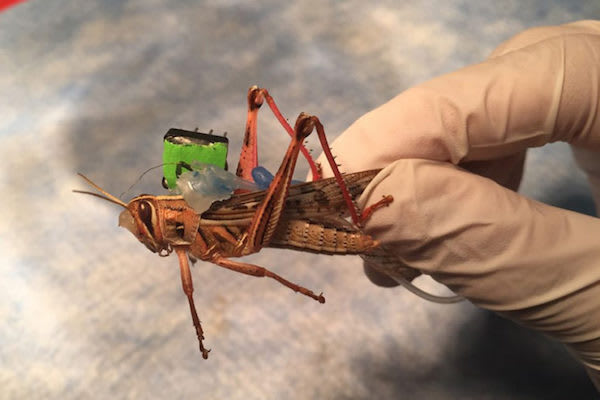
A team of engineers from Washington University in St. Louis is looking to capitalize on the sense of smell in locusts to create new biorobotic sensing systems that could be used in homeland security applications.
Baranidharan Raman, associate professor of biomedical engineering in the School of Engineering & Applied Science, has received a three-year, $750,000 grant from the Office of Naval Research (ONR) to use the highly sensitive locust olfactory system as the basis to develop a bio-hybrid nose. Biological sensing systems are far more complex than their engineered counterparts, including the chemical sensing system responsible for our sense of smell, Raman said. Although the sense of smell is a primitive sense, it is conserved across many vertebrate and invertebrate species.
For several years and with prior funding from the ONR, Raman has been studying how sensory signals are received and processed in the relatively simple brains of locusts. He and his team have found that odors prompt dynamic neural activity in the brain that allow the locust to correctly identify a particular odor, even with other odors present. In other research, his team also has found that locusts trained to recognize certain odors can do so even when the trained odor was presented in complex situations, such as overlapping with other scents or in different background conditions.
“Why reinvent the wheel? Why not take advantage of the biological solution?” Raman said. “That is the philosophy here. Even the state-of-the-art miniaturized chemical sensing devices have a handful of sensors. On the other hand, if you look at the insect antenna, where their chemical sensors are located, there are several hundreds of thousands of sensors and of a variety of types.”
The team intends to monitor neural activity from the insect brain while they are freely moving and exploring and decode the odorants present in their environment. Such an approach will also require low power electronic components to collect, log and transmit data. Shantanu Chakrabartty, an expert in developing miniature electronics in his Adaptive Integrated Microsystems Laboratory, will collaborate with Raman to develop this component of the work.
The team also plans to use locusts as a biorobotic system to collect samples using remote control. Srikanth Singamaneni, an expert in multifunctional nanomaterials, will develop a plasmonic “tattoo” made of a biocompatible silk to apply to the locusts’ wings that will generate mild heat and help to steer locusts to move toward particular locations by remote control. In addition, the tattoos, studded with plasmonic nanostructures, also can collect samples of volatile organic compounds in their proximity, which would allow the researchers to conduct secondary analysis of the chemical makeup of the compounds using more conventional methods.
“We expect this work to develop and demonstrate a proof-of-concept, hybrid locust-based, chemical-sensing approach for explosive detection,” said Raman.
More From SAE Media Group
Electronics & Sensors INSIDER
A Lighter, Smarter Magnetoreceptive Electronic Skin
Electronics & Sensors INSIDER
Soft, Bioelectronic Sensor Implant
Electronics & Sensors INSIDER
Scientists Amplify Superconducting Sensor Array Signals Near the Quantum Limit
Tech Briefs
Wearable Strain Sensor Using Light Transmittance
Tech Briefs
Breathable Electronics for Wearable Technologies
Electronics & Sensors INSIDER
Self-Powered Sensor Automatically Harvests Magnetic Energy
Electronics & Sensors INSIDER
Careful Heating Unlocks Unprecedented Sensitivity to Pressure in Semiconductor Materials
Sensor Technology
Smart Batteries Include Force and Pressure Sensing
Sensor Technology
New Products
Electronics & Sensors INSIDER
New Photonic Effect Could Speed Drug Development
Tech Briefs
New on the Market: July 2020
Tech Briefs
Facility Focus: NASA Goddard Space Flight Center
Tech Briefs
5 Ws of 3D-Printing Piezoelectric Materials

Tech Briefs
Obstacle-Avoiding Drone Uses Live Moth Antenna
Tech Briefs
New on the Market: March 2019
Electronics & Sensors INSIDER
Making Headway in Precision Therapeutics with a Fully Organic Bioelectronic Device
Electronics & Sensors INSIDER
New Nanowire Sensors Are the Next Step in the Internet of Things
ADAS & Autonomous Vehicle Engineering
The Olfactory Factor in AV Interiors
Medical Design Briefs
New Products & Services
Electronics & Sensors INSIDER
Novel Miniaturized Organic Semiconductor Will Support Flexible Electronic Devices
Tech Briefs
5 Ws of the SARS-CoV-2 RapidPlex Sensor
Tech Briefs
Cell-Sized Robots Sense Their Environment
Electronics & Sensors INSIDER
NIST Sensor Experts Invent Super-Cold Mini-Thermometer

Medical Design Briefs
AI-Enabled Optical Fiber Sensor Device Monitors Brain Injury
Tech Briefs
Product of the Month
Tech Briefs
New on the Market: March 2020
Top Stories
INSIDERDefense
 New Raytheon and Lockheed Martin Agreements Expand Missile Defense Production
NewsAutomotive
 Ford Announces 48-Volt Architecture for Future Electric Truck
INSIDERManufacturing & Prototyping
 Active Strake System Cuts Cruise Drag, Boosts Flight Efficiency
ArticlesTransportation
 Accelerating Down the Road to Autonomy
INSIDERMaterials
 How Airbus is Using w-DED to 3D Print Larger Titanium Airplane Parts
Road ReadyTransportation

Webcasts
Electronics & Computers
 Cooling a New Generation of Aerospace and Defense Embedded...
Power
 Battery Abuse Testing: Pushing to Failure
Connectivity
 A FREE Two-Day Event Dedicated to Connected Mobility
Automotive
 Quiet, Please: NVH Improvement Opportunities in the Early Design Cycle
Transportation
 Advantages of Smart Power Distribution Unit Design for Automotive &...
Aerospace
 Sesame Solar's Nanogrid Tech Promises Major Gains in Drone Endurance