




Supersonic Laser-Propelled Rockets Could Help Aircraft Exceed Mach 10
A new method for improving the thrust generated by laser-propulsion systems may bring them one step closer to practical use. The method, developed by physicists Yuri Rezunkov of the Institute of Optoelectronic Instrument Engineering, Russia, and Alexander Schmidt of the Ioffe Physical Technical Institute in Saint Petersburg, Russia, integrates a laser‑ablation propulsion system with the gas‑blasting nozzles of a spacecraft. Combining the two systems can increase the speed of the gas flow out of the system to supersonic speeds, while reducing the amount of burned fuel.
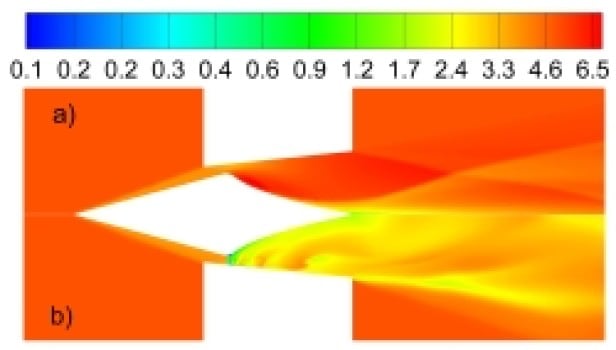
The effectiveness of current laser-propulsion techniques is limited by factors including the instability of supersonic gases as they flow through the gas nozzle, as well as the production of shock waves that "choke" the inlet of the nozzle, reducing thrust. But those effects can be reduced with the help of a laser‑ablation plasma plume that is redirected so that it will flow close to the interior walls of the nozzle. Coupling the ablation jet with supersonic gas flow through the nozzle, they find, significantly improves the overall thrust generated by the nozzle.
More From SAE Media Group
Tech Briefs
How Jet Engine Flow Can Be Controlled Optically
Tech Briefs
UCF’s Hypersonic Technology Advances

Aerospace INSIDER
Scientists Work to Enhance Faster-Than-Sound Jet Engines
Tech Briefs
Outer Aileron Yaw Damper
Aerospace INSIDER
NASA’s Quiet Supersonic Demonstrator Jet Completes First Flight
Tech Briefs
Novel Turboelectric Aircraft Design
Aerospace INSIDER
Propulsion System Could Enable Mach 17 Speed

Aerospace & Defense Tech Briefs
New Research on Noise Reduction for Next Generation Aircraft Engines
Aerospace INSIDER
NASA Tests Engines That Reduce Drag and Fuel Burn
Aerospace & Defense Tech Briefs
Updated High-Pressure Turbine Kit for A320neo Engine
Tech Briefs
AUVSI XPONENTIAL 2019: A Real Thrill Ride
Aerospace & Defense Tech Briefs
Microturbine Propulsion for UAVs


Aerospace INSIDER
Electra Starts Proving Blown Lift eSTOL Technology
Aerospace INSIDER
Jet Propulsion Without Fossil Fuel
Motion Design INSIDER
Plane Flies with No Moving Parts
Tech Briefs
Improved Fixed-Wing Gust Load Alleviation Device
Tech Briefs
Multirotor Aircraft Noise Reduction
Aerospace INSIDER
Purdue Strengthens National Security Focus with New Propulsion Lab



Tech Briefs
Fixed-Wing Angle eVTOL
Top Stories
INSIDERManufacturing & Prototyping
 How Airbus is Using w-DED to 3D Print Larger Titanium Airplane Parts
INSIDERManned Systems
 FAA to Replace Aging Network of Ground-Based Radars
NewsTransportation
 CES 2026: Bosch is Ready to Bring AI to Your (Likely ICE-powered) Vehicle
NewsSoftware
 Accelerating Down the Road to Autonomy
EditorialDesign
 DarkSky One Wants to Make the World a Darker Place
INSIDERMaterials
 Can This Self-Healing Composite Make Airplane and Spacecraft Components Last...
Webcasts
Defense
 How Sift's Unified Observability Platform Accelerates Drone Innovation
Automotive
 E/E Architecture Redefined: Building Smarter, Safer, and Scalable...
Power
 Hydrogen Engines Are Heating Up for Heavy Duty
Electronics & Computers
 Advantages of Smart Power Distribution Unit Design for Automotive...
Unmanned Systems
 Quiet, Please: NVH Improvement Opportunities in the Early Design...
