




Covert Infrared Battlefield Combat Taggants
Modern warfare often involves poorly defined battle lines accompanied by multilevel fire support systems that can deliver firepower with high precision and devastating lethality from a long distance. The ability to immediately and accurately discriminate through sight between friend and foe is of great importance to military operations for effectively destroying hostile forces while preventing fratricide. This ability is even more crucial for irregular and unconventional warfare such as anti-terrorism operations where US forces often engage enemy combatants well entrenched in urban settings or rugged terrains at night. In such battlefield conditions, using conventional daylight and thermal imagery often exceeds the ability to accurately identify targets as friend or foe, and more reliable battlefield identification methods are needed.
Tagging, Tracking and Locating
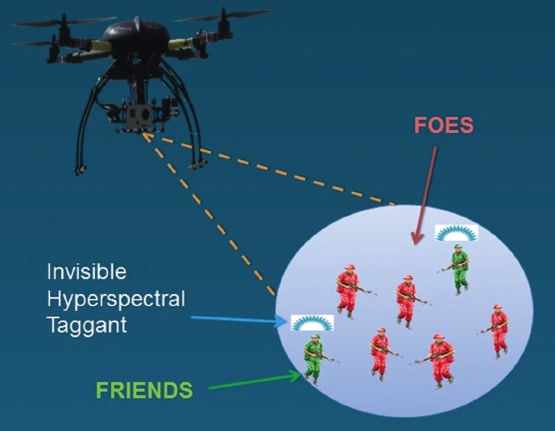
Materials and devices emitting in the infrared region represent an important class of covert optical taggants. Infrared (IR) light (from 0.75 μm to 1000 μm) is electromagnetic radiation with wavelengths longer than those operating in the visible region. For military applications, the IR wavelength is usually limited to 15 μm. An integrated infrared tagging system consists of three essential parts: infrared emitting (or absorbing) taggants, photodetectors, and an intelligence interface. Certain materials can emit infrared light through chemiluminescence, photoluminescence or electroluminescence.
There are three general groups of infrared emitting materials: organic IR emitting dyes, lanthanide IR emitters, and semiconductor IR emitters. Many pure organic dyes have been developed especially for NIR bimolecular imaging. The use of NIR fluorophores will eliminate background noise caused by the autofluorescence of biosubstrates. Common organic NIR fluorophores include cyanine, oxazine and rhodamine dyes. The fluorescence maxima of these dyes are between 700-850 nm. Organic near IR dyes can be used to make glowstick-type IR light sources through chemiluminescence.

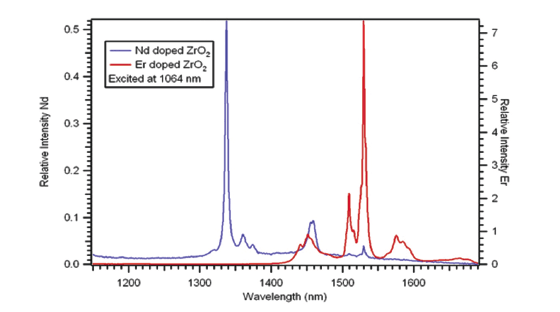
Infrared emissions of lanthanide are often achieved through photoluminescence. Photoluminescence of lanthanide cations are due to their abundance of 4f–4f and 4f–5d transitions. Well known IR emission wavelengths from lanthanide ions are generally in the 1-3 μm regions, and this has led lanthanide ions to become active centers in laser gain medium materials. It is also known that several trivalent lanthanide ions possess possible emission transitions in the MWIR spectral region (3-5 μm).
Semiconductor Materials
Semiconductors are important optical materials. Unlike organic fluorophores or lanthanide ions whose optical properties are mainly determined by molecular or atomic structures and are usually un-tunable, optical emission and absorption of semiconductors are due to their unique band gap, which often falls into the infrared energy region. Their wavelengths can be further adjusted, either by forming compound semiconductors or reducing the size to cover a broad wavelength range. Semiconductors are the foundation materials for modern infrared detectors as well as infrared light emitting diodes (LEDs) and laser diodes. LEDs and laser diodes are commercially available for infrared light emission at wavelengths from near IR to mid IR (1-5 μm).
LEDs and laser diodes both have their advantages and disadvantages. Compared to LEDs, laser diodes produce much narrower band emissions, but they may require cooling features such as heat sinks, especially when operating at high-energy densities, while for LEDs no cooling is needed. Light emissions from LEDs and especially laser diodes are highly directional. This not only raises concerns about eye safety, but also limits wide-angle visibility. Therefore, light scattering/diffusing media are often integrated with LEDs and laser diodes. Examples of these optical media include side-emitting fibers/strips and light scattering lenses/coatings.
A new class of semiconductor-based infrared absorbers and emitters are semiconductor quantum dots. Quantum dots (QDs) are tiny semiconductor particles usually below 20 nm in diameter. Quantum confinement occurs when the size of a semiconductor crystallite is reduced below its exciton bohr radius. These small semiconductor crystallites, commonly referred to as quantum dots, have properties between those of bulk materials and of molecules.
For smaller quantum dots (usually below 10nm), quantum confinement dominates the electronic properties leading to highly discreet energy levels. In this region, the band gap and splitting of energy levels are highly dependent on the size and shape of the quantum dot, and in general the band gap is inversely related to size. Therefore, the electronic and optical properties of quantum dots can be easily tuned by varying the size during synthesis.
The high versatility of quantum dots for wide spectrum infrared absorption and emission is also due to the availability of many types of narrow bandgap semiconductors. Compared with quantum well structures grown with either molecular beam epitaxy or chemical vapor deposition, colloidal synthesized semiconductor quantum dots are much cheaper to make. With this low-cost factor, combined with the capability of highly efficient narrow wavelength photon absorption and emission spanning a broad spectrum, quantum dots show promise for revolutionizing infrared detection and emission applications including low-cost infrared detectors and infrared emitting devices such as LEDs, laser diodes, and electroluminescent displays (ELDs).
Taggants based on electrically powered emitters such as LEDs and laser diodes can be encoded with sequenced flashing algorithms to achieve a stroboscopic effect. The design of taggant emission spectra can also be tailored for specific detector/imager systems. Most infrared detectors/imagers are only effective with certain wavelength ranges. Therefore, taggant systems emitting signals that cannot be fully detected with a single type of detector are more covert.
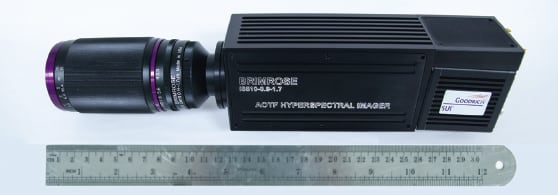
Multispectral and hyperspectral tunable optical filters, such as MEMS optical modulators and Acousto-Optic Tunable Filters (AOTFs), can greatly enhance an infrared detector’s capability for detecting and de-convoluting complex optical signals such as clustered emission peaks. Unlike other optical filter systems, AOTFs do not suffer from the mechanical constraints, speed limitations, image shift, and vibration associated with rotating filter wheels, and can easily accommodate multiple wavelengths. They are mechanically robust and lightweight, and are ideal for field and handheld applications.
Acousto-optic technology can expand the capability of common infrared detectors in many aspects. When an AOTF is integrated with an IR camera, they together become a hyperspectral imager. With an AOTF-based hyperspectral imager, multiple LEDs with different wavelengths can be used in the taggant. This allows the taggant to emit messages coded with algorithms such as wavelength hopping and scrambling, enabling covert optical communication. Such signals can only be correctly recognized by the hyperspectral imager, while a broadband infrared imager cannot receive the valid message. Full-duplex communications between the taggant and AOTF imager can be achieved when a simple photodetector is added to the taggant, and an AO deflector (AOD) is added to the AOTF imager. The AOD can direct an eye-safe laser beam to the taggant’s photodetector and send a message by modulating the laser. This modulation function is an intrinsic feature of AOD. The AOD can also point a narrow laser beam on to an individual taggant to deliver a coded message.
Optical taggants emitting in the near infrared range have been deployed for battlefield operations. These include infrared light sticks and the LED-based Tron system. However, with the global availability of 3G IR goggles capable of seeing up to 1 μm, they lose their covertness. Future taggants should operate in an IR wavelength that cannot be detected with common night vision scopes or human body thermal imaging devices such as FLIR. Currently shortwave IR (SWIR) between 1-3 μm is a very attractive range for several reasons. First, it cannot be detected by either near IR wavelength night vision scopes or long wavelength IR FLIR systems. Secondly, IR cameras in this range are lightweight, compact, and operate at room temperature, not requiring cryogenic cooling. Finally, IR emitters (such as LEDs and laser diodes) with various SWIR wavelengths are available at relatively low cost. Although taggants in the mid-infrared region (3-8 μm) are also highly desirable, their development has been hindered by the lack of low-cost detectors and scarcity of available emitters in this range.
This article was written by Dajie Zhang, PhD, Senior Scientist, Brimrose Corporation (Sparks Glencoe, MD). For more information, Click Here .
More From SAE Media Group
Aerospace & Defense Tech Briefs
3D Meta-Optics for High-Energy Lasers
Photonics & Imaging Technology
Researchers Generate Terahertz Laser with Laughing Gas
Photonics & Imaging Technology
Ultrafast Beam-Steering Breakthrough at Sandia Labs
Aerospace & Defense Tech Briefs
MOVPE Growth of LWIR AlInAs/GaInAs/InP Quantum Cascade Lasers: Impact of Growth and Material Quality on Laser Performance
Aerospace & Defense Tech Briefs
Integration of Adaptive Optics Into High-Energy Laser Modeling And Simulation
Aerospace & Defense Tech Briefs
On the Pulsed Laser Ablation of Metals and Semiconductors
Aerospace & Defense Tech Briefs
Using Forensic Lasers in Modern Warfare
Photonics & Imaging Technology
SPIE Photonics WEST 2018 Preview
Photonics & Imaging Technology
SPIE Photonics West 2022 Preview
Photonics Tech Briefs
Ring-Resonator/Bragg-Grating Laser-Feedback Elements
Photonics Tech Briefs
SPIE Photonics West 2015 Preview
Photonics & Imaging Technology
A First-Of-Its-Kind Integrated Optical Isolator
Photonics & Imaging Technology
How to Innovate and Overcome the Challenges of Blue Laser Beam Shaping
Medical Design Briefs
Scientists Create Continuously Emitting Microlasers With Nanoparticle-Coated Beads
Aerospace & Defense Tech Briefs
Ultrafast Optics: Vector Cavity Lasers — Physics and Technology
Tech Briefs
Products of Tomorrow
Aerospace & Defense Tech Briefs
Frequency Agile Plasmonic Antennas and Sensors
Photonics & Imaging Technology
SPIE Photonics West 2016 Preview
Photonics & Imaging Technology
Essential Principles for Designing and Specifying Laser Optics
Photonics & Imaging Technology
How Indium Gallium Arsenide (InGaAs) Improves SWIR Sensing
Tech Briefs
Nanoscale LED Also Functions as a Laser
Photonics & Imaging Technology
Using Magnets to Toggle Nanolasers Leads to Better Photonics
Photonics Tech Briefs
Design of High-Brightness, Fiber-Coupled Diode Laser Modules
Photonics Tech Briefs
Thermal Light Valve Brings IR Imaging to the Masses
Photonics Tech Briefs
Scanning Tunneling Optical Resonance Microscopy
Photonics Tech Briefs
DFM Your Device? Simulation Is the Answer
Photonics & Imaging Technology
SPIE Photonics West 2020 Preview
Photonics & Imaging Technology
Researchers Create World’s Smallest LED And Holographic Microscope

Photonics & Imaging Technology
Harnessing SWIR Line Scan Imaging Technology
Top Stories
INSIDERDefense
 New Raytheon and Lockheed Martin Agreements Expand Missile Defense Production
NewsAutomotive
 Ford Announces 48-Volt Architecture for Future Electric Truck
INSIDERManufacturing & Prototyping
 Active Strake System Cuts Cruise Drag, Boosts Flight Efficiency
ArticlesTransportation
 Accelerating Down the Road to Autonomy
INSIDERMaterials
 How Airbus is Using w-DED to 3D Print Larger Titanium Airplane Parts
Road ReadyTransportation

Webcasts
Electronics & Computers
 Cooling a New Generation of Aerospace and Defense Embedded...
Power
 Battery Abuse Testing: Pushing to Failure
Connectivity
 A FREE Two-Day Event Dedicated to Connected Mobility
Automotive
 Quiet, Please: NVH Improvement Opportunities in the Early Design Cycle
Transportation
 Advantages of Smart Power Distribution Unit Design for Automotive &...
Aerospace
 Sesame Solar's Nanogrid Tech Promises Major Gains in Drone Endurance