




Virtual Reality Immerses Passengers in "See-Through" Cabin
In the VR-Hyperspace project, Fraunhofer IAO has teamed up with eight partners from six European countries to investigate how flight journeys can be made into a more pleasant experience using virtual reality. As part of the project, Fraunhofer IAO has employed state-of-the-art lighting and display technologies to develop an airplane cabin in which test subjects can immerse themselves in their own preferred personal environment.
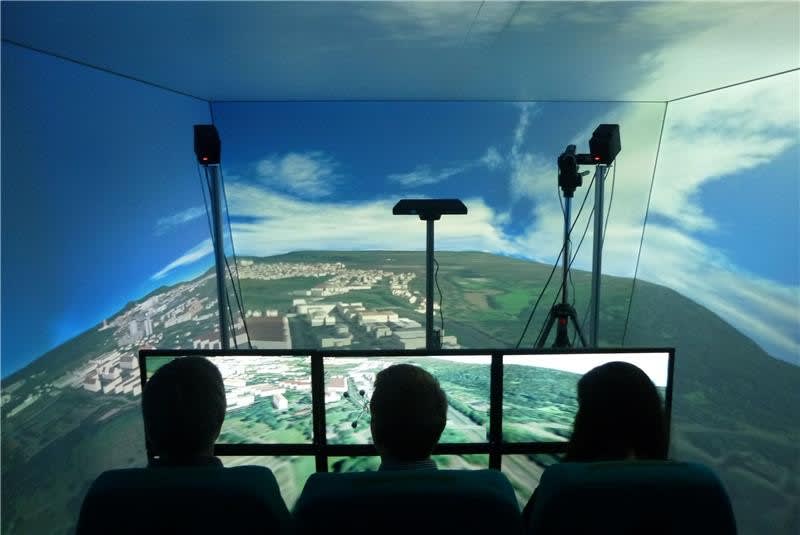
Fraunhofer IAO has developed an airplane cabin mock-up whereby test subjects wearing 3D glasses sit in real airplane seats and can immerse themselves almost completely in virtual worlds: the backs of the seats are covered in display surfaces, flat-screen televisions are fitted in the floor, and 14 projectors can display images on the cabin walls. In combination with head tracking, this means passengers can experience the flight as if they were on a flying carpet.
At the push of a button, travelers can make the airplane walls transparent or bring up images of the palm-lined beach they are traveling to. If they are bothered by the seats in front of them, they can make those transparent, too. They can block out the sound of screaming kids, and nervous flyers can display images of tropical islands or of a gentle stream flowing through a wood. The virtual environment allows business travelers to work with standard office applications while enjoying the sunshine on a desert island.
The subjects of the first test flights responded positively to the transparent airplane cabin. The scenarios permitted them to endure an uncomfortable situation for longer, and time seemed to pass quicker for them.
More From SAE Media Group
Aerospace & Defense Tech Briefs
T-45 Virtual/Augmented Reality Training Technology

Aerospace & Defense Tech Briefs
How to Get Advanced Air Mobility into the Sky
Aerospace INSIDER
Production Ready B-21 Bomber on Track for First Flight This Year

Aerospace & Defense Tech Briefs
MUSHER Demonstrates Manned-Unmanned Aircraft Teaming Applications

Photonics & Imaging Technology
Making VR a NASA Reality
Tech Briefs
Algorithms Improve Quadrotor Drone Performance
Aerospace INSIDER
"Fused Reality" Combines Simulation and Flying to Train Pilots
Autonomous Vehicle Engineering
The Electric, Autonomous Revolution Lifts Off
Aerospace & Defense Tech Briefs
Digitalization in the Aerospace Sector
Aerospace Manufacturing and Machining INSIDER
Virtual Flight-Test Campaign Paving Way for A321XLR’s First Flight
Off-Highway Engineering
Virtual Factories Accelerate Collaboration, Advance Technologies
Aerospace INSIDER
UAV Software Prioritizes Human Safety
Aerospace & Defense Tech Briefs
The Future of Aircraft Electrification
Aerospace INSIDER
Turbulence Model Could Enhance Rotorcraft
Aerospace INSIDER
NASA Software Sets Stage for Future Flights

Aerospace Manufacturing and Machining INSIDER
How Airbus is Leveraging Digital Twins for a Smarter Approach to Manufacturing


Tech Briefs
The Future of AI for Aerospace Manufacturing
Tech Briefs
Products of Tomorrow

Aerospace INSIDER
Optimizing Winglets for More Efficient Flight

Aerospace INSIDER
Aircraft Arrival Technology Will Reduce Flight Delays

Top Stories
INSIDERManufacturing & Prototyping
 How Airbus is Using w-DED to 3D Print Larger Titanium Airplane Parts
INSIDERManned Systems
 FAA to Replace Aging Network of Ground-Based Radars
NewsTransportation
 CES 2026: Bosch is Ready to Bring AI to Your (Likely ICE-powered) Vehicle
NewsSoftware
 Accelerating Down the Road to Autonomy
EditorialDesign
 DarkSky One Wants to Make the World a Darker Place
INSIDERMaterials
 Can This Self-Healing Composite Make Airplane and Spacecraft Components Last...
Webcasts
Defense
 How Sift's Unified Observability Platform Accelerates Drone Innovation
Automotive
 E/E Architecture Redefined: Building Smarter, Safer, and Scalable...
Power
 Hydrogen Engines Are Heating Up for Heavy Duty
Electronics & Computers
 Advantages of Smart Power Distribution Unit Design for Automotive...
Unmanned Systems
 Quiet, Please: NVH Improvement Opportunities in the Early Design...
