




Carbon Nanotube Technology Promises a Revolution in Electrical Cabling
While carbon nanotube technology (CNT) has generated widespread interest for applications ranging from semiconductors to medical, one area that is a focus of research at TE Connectivity is high-performance electrical cables. TE has been actively researching CNT for wire and cable, including cooperative efforts with universities and industry leaders, and has prototype samples for evaluation. While there is still much progress to be made before CNT cables become main stream, we believe the technology is sufficiently advanced to meet specific niche applications such as satellites.
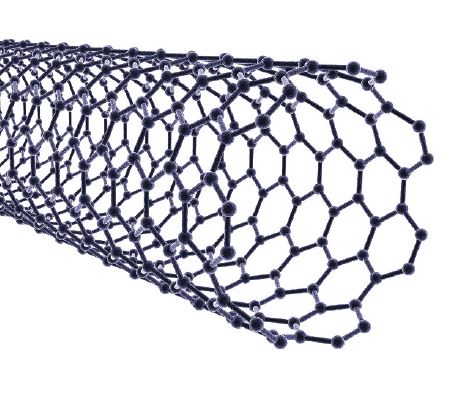
Satellites: Launch costs to put a satellite in orbit can range from $5000 to $50,000 per pound of payload. Any reduction in weight can significantly influence costs or allow extra weight for additional scientific and engineering equipment or more maneuvering fuel to extend the life of the mission.
UAVs: Lower weight means longer times aloft. Consider that the Global Hawk UAV contains about 850 pounds of cable. Using a CNT shield in place of a metallic one could save 300 pounds. An all-CNT cable might save an additional 100 pounds, cutting the overall weight from 850 to 450 pounds.
Manned aircraft: Weight savings translate into greater fuel efficiency or higher payloads.
The benefits of CNT cable goes beyond aerospace applications. Weight savings can also be important to ground vehicles and even soldier-worn equipment.
Nanotube Properties
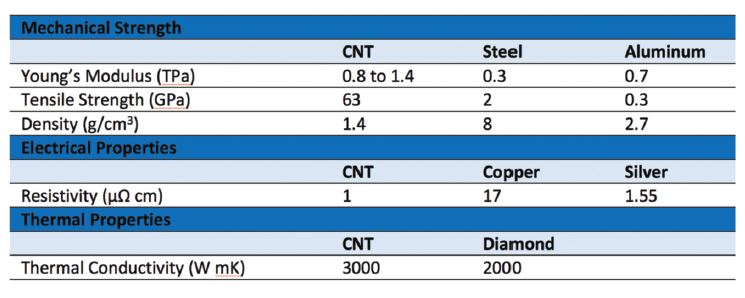
The long aspect ratio of a single carbon nanotube, only a few nanometers in diameter but several millimeters in length, gives it remarkable properties in the nanoscale: tensile strength greater than steel’s, conductivity greater than copper’s, thermal dissipation greater than diamond’s, and resistance to corrosion and fatigue. Figure 2 gives typical properties of a single carbon nanotube.
From Nanoscale to Macroscale CNTs are grown by thermal processing and arranged into yarns for conductors and into tapes, sheets, and yarns for shields.
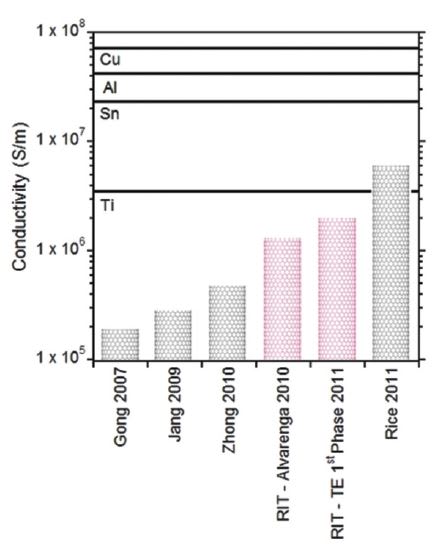
Bundling CNT strands into yarns or sheets to achieve practical sizes alters the properties of the material. A single carbon nanotube has a conductivity thirty percent higher than copper but a yarn composed of a network of CNTs is orders of magnitude less conductive than copper. Figure 3 shows recent efforts in CNT yarn conductivity improvement since 2007.
Practical Applications Involve Tradeoffs
To date, CNT technology has been more about potential than practical solutions. For wire and cable, an ideal CNT-based product would have the same or better electrical properties in a significantly lighter, more rugged form. The reality today is that such an ideal is not yet achievable.
What is achievable today are CNT products that can offer significant weight reductions with electrical performance adequate to the application.
CNT Shields
CNT cables are now being actively developed for MIL-STD-1553B and IEEE 1394 applications for aerospace and satellite applications—with a transition from prototypes to production happening in the next few years. Initial IEEE 1394 cables will use CNT shielding, while MIL -STD-1553B cables will likely be the first all-CNT construction.
CNT-based shields combine high shielding effectiveness with significant weight savings. A two-layer CNT tape offers roughly the same shielding as a copper braid at high frequencies— roughly 50 dB at 4 GHz—but weighs less than 2 percent of the braid it replaces.
The high resistivity of CNT shields, however, means poor shielding performance below 100 MHz and an inability to provide protection against lightning strikes. For the double-braided cables common in aerospace applications, replacing one of the braids with CNT allows the remaining braid to handle low-frequency noise and lightning, while the CNT shield handles the higher frequencies. Weight savings are 25 to 30 percent for hybrid shield constructions.
All-CNT Cables
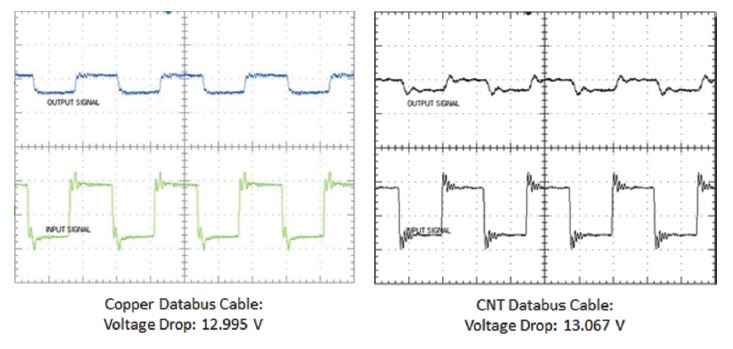
As shown in Figure 4, performance of the CNT data bus cable is comparable to the copper version. A 1-MHz MIL-STD- 1553B signal through three meters of cable showed comparable performance for each cable type.
Further reductions in CNT yarn resistivity will be necessary before CNT conductors are practical for high-speed signals in longer lengths or for power. Prototypes of an RG-316-equivalent coaxial cable demonstrate the need for higher conductivity to make CNT cable practical for general-purpose applications. Both CNT shield-only and all-CNT constructions offer insertion losses higher than specified MIL-STD-17C.
Real-World Practicalities
As progress is made toward enabling the use of CNT materials in cables, two other issues deserve mention. The first is how to terminate CNT cables. CNT conductors are compatible with existing contacts and can be terminated with standard crimping techniques, albeit with slightly modified crimp tool settings. Testing of the mechanical strength of the crimps suggests that the CNT yarns fail before the crimp fails. Shields can be terminated to backshells with steel bands and other compression techniques. Tapes and yarns are also compatible with soldering, although they require modification of the CNT surface.
The second issue is moving from prototypes to production. CNT yarns, sheets, and tapes are available in commercial quantities, but challenges remain in volume production of long parts needed for cable. The production capabilities of CNT suppliers are rapidly increasing but the supply chain today typically has long lead times. Many applications today— such as semiconductors or composite enclosures—use CNTs measured in microns or millimeters. Cables represent a completely different scale from those applications, requiring tens of meters.
Ready for Prime Time?
Building on the knowledge gained from these initial, weight-sensitive applications, the industry will learn how to address cost, high volume demands, and electrical performance.
This article was written by Stefanie Harvey, PhD, Advanced Development Group, Aerospace, Defense & Marine, TE Connectivity (Berwyn, PA). For more information, Click Here .
More From SAE Media Group
Aerospace & Defense Tech Briefs
Shielding Aerospace Systems from Electromagnetic Interference
Aerospace Manufacturing and Fabrication
Designing With MIL-STD-1553B Components
Aerospace & Defense Tech Briefs
Evaluation of the Effects of Hydrogen Peroxide on Common Aircraft Electrical Materials
Aerospace & Defense Tech Briefs
Design Guidelines for Military and Aerospace PCBs
Tech Briefs
Fully Recyclable Printed Electronics
Tech Briefs
Polymer-Based Electrical Insulation for Circuits
Aerospace & Defense Tech Briefs
Taming the Thermal Behavior of Solid-State Military Lasers
Aerospace & Defense Tech Briefs
Thermal Management Techniques in Avionics Cooling
Tech Briefs
Coaxial Electric Heaters
Embedded Technology
Designing Flexible Printed Circuit Boards
Tech Briefs
Integrating Fragile 2D Materials into Devices



Tech Briefs
New Way to Create Stretchable Electronic Tattoos
Tech Briefs
New on the Market
Electronics & Sensors INSIDER
Researchers Develop Recyclable, Healable Electronics
Aerospace & Defense Tech Briefs
The Future of EMI Shielding Is Lightweight, Flexible, and Ready for Flight
Tech Briefs
Rolled 2D Heterostructures


Aerospace & Defense Tech Briefs
Radiation Effects on Electronics in Aligned Carbon Nanotube Technology (RadCNT)
Embedded Computing INSIDER
Thin Film, Miniaturized Components

Tech Briefs
How to Make a Transistor – From Thread
Embedded Technology INSIDER
Thermal Invisibility Cloak Actively Redirects Heat
Embedded Technology INSIDER
New Thermal Conductivity Technique Could Cool Computer Chips
Top Stories
INSIDERAerospace
 How Airbus is Using w-DED to 3D Print Larger Titanium Airplane Parts
NewsAutomotive
 Microvision Aquires Luminar, Plans Relationship Restoration, Multi-industry Push
INSIDERManned Systems
 A Next Generation Helmet System for Navy Pilots
INSIDERDesign
 New Raytheon and Lockheed Martin Agreements Expand Missile Defense Production
ArticlesManned Systems
 Accelerating Down the Road to Autonomy
NewsPower
 Ford Announces 48-Volt Architecture for Future Electric Truck
Webcasts
Electronics & Computers
 Cooling a New Generation of Aerospace and Defense Embedded...
Test & Measurement
 Battery Abuse Testing: Pushing to Failure
Internet of Things
 A FREE Two-Day Event Dedicated to Connected Mobility
Unmanned Systems
 Quiet, Please: NVH Improvement Opportunities in the Early Design Cycle
Transportation
 Advantages of Smart Power Distribution Unit Design for Automotive &...
Aerospace
 Sesame Solar's Nanogrid Tech Promises Major Gains in Drone Endurance