




Researchers Use Graphene to Make Wireless Communications More Flexible
Michael Lekas and Sunwoo Lee, electrical engineering Ph.D. candidates, have been awarded a Qualcomm Innovation Fellowship (QInF) and the accompanying $100,000 prize. They were one of eight teams from across the U.S. to win the fellowship. Their project —“CMOS Compatible Graphene Nanoelectromechanical Systems for Next Generation RF Design”— focuses on addressing the increasing congestion of the wireless spectrum created by the growing number of people using wireless devices and the enormous volume of data they are moving every day.
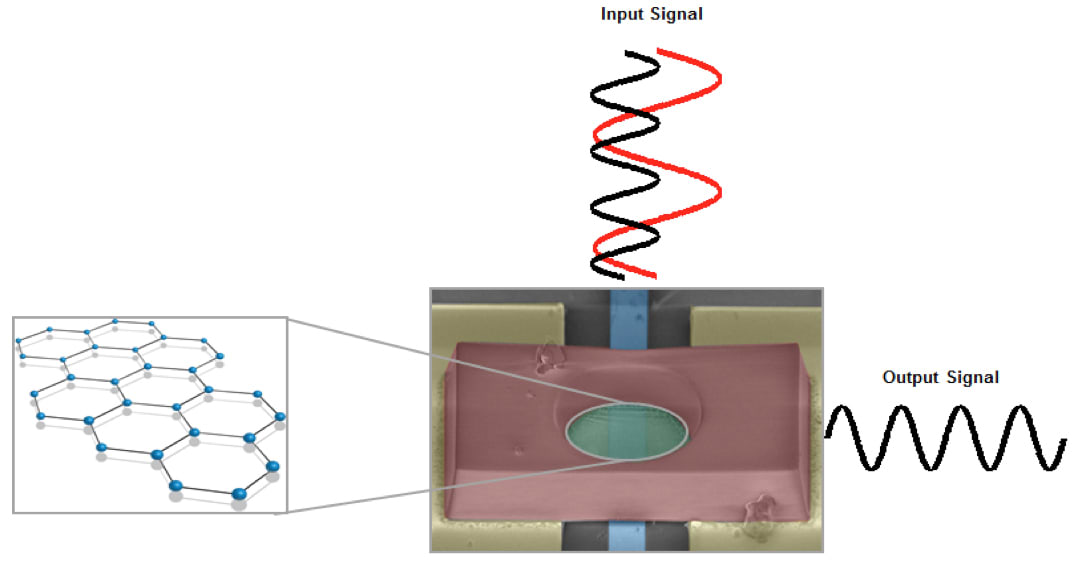
One potential solution is to make wireless devices flexible enough to operate at different frequencies throughout the wireless spectrum so that they may take advantage of unoccupied bandwidth. But that level of flexibility is very difficult to achieve in current wireless technologies, explain Lekas and Lee.
Working with Mechanical Engineering Associate Professor James Hone and Electrical Engineering Professor Ken Shepard on ways to solve this problem, the students are developing one crucial element of such a system: tunable electromechanical filters that use the vibration of graphene to pick out electrical signals only at a desired frequency. These devices will enable more versatile wireless circuits that can operate at many different frequencies while also being integrated with existing silicon chip technology.
“The device we are designing is essentially a sheet of carbon—about 10,000 times thinner than human hair—suspended like a bridge between two electrodes,” says Lee. “When electrical signals like the ones that come to and from your cell phone are applied to a third electrode located underneath the ‘bridge,’ then only the signal at a particular frequency (the resonant frequency, or RF) can make the graphene vibrate. This vibration changes the electrical properties of the graphene ‘bridge,’ in effect amplifying the desired signal and blocking out interfering signals and noise.”
Lekas adds that their device is unique because the resonant frequency of the suspended graphene can be tuned electrically by as much as 400 percent, in contrast to existing technologies which are only tunable by 1 percent. This tunability will enable wireless devices to ‘search’ over a much wider range of the spectrum to find unused bandwidth. “Plus it’s much smaller and, therefore, easier to integrate onto a conventional silicon chip, compared to the existing filter technologies,” he explains. “This device could substantially improve the flexibility, miniaturization, and integration of wireless transceivers, which would make devices such as cell phones smaller, faster, and more energy efficient.”
“Qualcomm views Graphene resonators, pioneered by the Columbia team, as an important element in next generation wireless technology,” says Abramsky, who has extensive experience in commercializing RF products and will guide the team to help take the technology closer to implementation.
More From SAE Media Group


Aerospace & Defense Tech Briefs
RF FPGAs for Multi-Function Systems

Aerospace & Defense Tech Briefs
90° Hybrid Coupled Power Amplifier – Pros and Cons
Aerospace & Defense Tech Briefs
Compact Power Amplifier Solution for Electronic Warfare
Aerospace & Defense Tech Briefs
Radio Relays Improve Wireless Products
Aerospace & Defense Tech Briefs
Ghoul Tool: The Weapon-Mountable Counter UAS Transmitter
Defense INSIDER
Defense Leaders Receive First Intel SHIP Multi-Chip Prototype
Aerospace & Defense Tech Briefs
Solid-State Microwave Power Module


Aerospace & Defense Tech Briefs
What is Pulse Shaping?
Aerospace & Defense Tech Briefs
True DC Switch and X-Band Core Chip
Aerospace & Defense Tech Briefs
New Products
Aerospace & Defense Tech Briefs
Heterogeneous Integration and SiPs Benefit SWaP-C Reduction
Aerospace & Defense Tech Briefs
Key Measurements to Maintain Performance of Critical Electronic Systems on Military Aircraft and Warships
Aerospace & Defense Tech Briefs
A New Record for Optical Power Beaming
Defense INSIDER
New Technology May Double Radio Frequency Data Capacity
Aerospace & Defense Tech Briefs
Making AESA Radar More Flexible
Tech Briefs
Test Strategies to Track Hypersonic Threats
Aerospace & Defense Tech Briefs
How to Specify and Select RF Filters
Aerospace & Defense Tech Briefs
Bringing RF into the Embedded World: It's Time

Aerospace & Defense Tech Briefs
Qualification of Multi-Channel Direction Finding Radar Receivers in The Lab
Aerospace & Defense Tech Briefs
Optoelectronic Analog Signal Transmission Takes Center Stage Amidst Aerospace and Defense Innovation
Aerospace & Defense Tech Briefs
Broadband 1.2- and 2.4-mm Gallium Nitride (GaN) Power Amplifier Designs


Aerospace & Defense Tech Briefs
Electronic Warfare Technology
Top Stories
INSIDERDesign
 How Airbus is Using w-DED to 3D Print Larger Titanium Airplane Parts
NewsSensors/Data Acquisition
 Microvision Aquires Luminar, Plans Relationship Restoration, Multi-industry Push
INSIDERManned Systems
 A Next Generation Helmet System for Navy Pilots
NewsAR/AI
 Accelerating Down the Road to Autonomy
INSIDERDefense
 New Raytheon and Lockheed Martin Agreements Expand Missile Defense Production
ArticlesAR/AI
 CES 2026: Bosch is Ready to Bring AI to Your (Likely ICE-powered) Vehicle
Webcasts
Semiconductors & ICs
 Advantages of Smart Power Distribution Unit Design for Automotive...
Unmanned Systems
 Quiet, Please: NVH Improvement Opportunities in the Early Design...
Electronics & Computers
 Cooling a New Generation of Aerospace and Defense Embedded...
Automotive
 Battery Abuse Testing: Pushing to Failure
Transportation
 A FREE Two-Day Event Dedicated to Connected Mobility
