




Fabrication of Novel Transparent PMMA Composites for Optical Tagging
Optically clear composites are used in tags and decals to easily identify vehicles from a distance.
The emerging threats caused by improvised explosive devices (IEDs) have drastically increased concerns about soldier survivability. The ability to identify “friend vs. foe” of any approaching vehicles clearly, quickly, and from a distance, is invaluable to ensure a soldier’s safety, as well as critical to providing protection of facilities at strategic locations. The current state-of-the-art uses externally applied coatings or markings onto vehicles that are not seen in the visible light spectrum, yet are detectable with the use of an ultraviolet (UV) or infrared (IR) interrogation device. However, coatings can wear off or wash off, and are susceptible to being counterfeited or tempered.
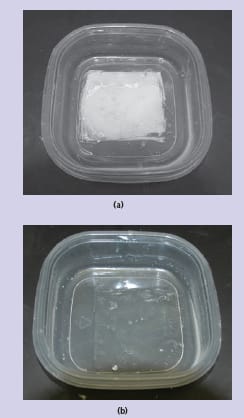
The approach for making optically clear, fiber-modified polymer composites is based on the match of refractive index of selected fiber and matrix polymers. PMMA has been used widely in many transparent materials applications. Poly(vinyl butyral) (PVB) has an attractive combination of chemical, mechanical, and optical properties, and it has been used in a wide array of commercial applications, such as structural adhesives for glass laminates, coatings, and matrix polymer for fiber-reinforced thermoset composites. PVB has the same refractive index as PMMA, and is, therefore, selected for the production of electrospun fibers. PVB, however, has extremely high melt viscosity and is generally not melt spun into fibers.
Electrospinning offers a simple and robust method to produce submicron PVB fibers. In addition, electrospinning has the following advantages: (1) it can produce very fine fibers (average diameter ranging from 100 nm to 500 nm) that can minimize the scattering of light if there is a slight mismatch in the refractive indices; (2) it can produce a fibrous mat that has a large surface area to mass ratio for better bonding to the matrix material; (3) it allows the dye to disperse in the spin solution; and (4) it does not compromise the chemical stability of the dye during spinning and composite fabrication.
The scope of this work is to demonstrate the feasibility of making transparent composites that possess chromatic functionalities capable of changing color and/or optical clarity, reversibly, upon exposure to an external irradiation. In-situ polymerization/cast process is used for fabrication of PMMA PVBfiber composites. This study examines the stability of an embedded fluorescent dye within the electrospun fibers and their capability of patterning for optical tagging.
In-situ polymerization/cast was used for preparation of PMMA PVB-fiber composites. The electrospun PVB mat was cut into 4 × 4" pieces. Then several layers of PVB pieces were compacted in a hydraulic press. The stack of PVB mats was soaked in the PMMA-MMA-AIBN solution for 5 hours. The degassed resinimpregnated fiber mat was then transferred to an aluminum mold. The interior dimensions of the mold are 4 × 4 × 0.02". The inner surfaces of the aluminum mold have a mirrorpolished finish. The mold surfaces were sprayed with a release agent (LPS, Dry Film Silicon Lubricant). First, the PVB mat was laid flat into the mold, then an excess amount of PMMA-MMA-AIBN solution was added to the mold. The mold was placed in a hot press for curing. The pressure was set at 1000 kPa and the temperature was set to 55 ºC. The curing process lasted for 12 hours, and then cooled down slowly to room temperature.
PVB has the same refractive index as PMMA, and as a result, the PMMA PVBfiber composites were completely optically clear. The stability of the selected UV-dye within the electrospun fibers appeared to be excellent, even long after fabrication.
This work was done by Jian H. Yu and Alex J. Hsieh of the Army Research Laboratory, and Gregory C. Rutledge of MIT. ARL-0121
This Brief includes a Technical Support Package (TSP).
Novel Transparent PMMA Composites for Optical Tagging
(reference ARL-0121) is currently available for download from the TSP library.
Don't have an account?
More From SAE Media Group
Tech Briefs
High-Color-Purity 3D Printing


Photonics & Imaging Technology
Manufacturing Wafer-Level Optics Using UV Adhesives and Polymers

Medical Design Briefs
Benefits of LED Cured Adhesives in Medical Applications
Automotive Engineering
Linking Embroidery and Carbon Fiber to save Weight and Cost
Tech Briefs
4D Printing of Shape Memory Polymers
Tech Briefs
Automated Tow/Tape Placement System
Photonics & Imaging Technology
Micro Molding and Micro-Optics
Tech Briefs
Conductive Carbon Fiber Polymer Composite
Aerospace & Defense Tech Briefs
Quantitative Diagnostics of Multilayered Composite Structures with Ultrasonic Guided Waves
Medical Design Briefs
Controlling Heat Curing Adhesive Processes Using Infrared Spot Curing
Tech Briefs
Precision CNT Cutting Mechanism
Tech Briefs
Controlled Manufacture of Porous Silicon Carbide
Tech Briefs
3D-Printed Composites for High-Temperature Uses
Aerospace & Defense Tech Briefs
‘Nanostitches’ Enable Lighter and Tougher Composite Materials
Automotive Engineering
Battle for the Box
Tech Briefs
Fiber Metal Laminates Made by the VARTM Process
Photonics & Imaging Technology
Optical Coatings Technology
Medical Design Briefs
Particle Distribution on Webs or Cloths
Tech Briefs
Nanotip Carpets as Antireflection Surfaces
Aerospace & Defense Tech Briefs
How to Select the Right Silicone for Space Applications
Aerospace & Defense Tech Briefs
Using Thermoplastic Composites for Aerospace Applications
Medical Design Briefs
Medical Plastics: Understanding Ultrasonic Welding, Part 1
Medical Design Briefs
UV Plastic Adhesive
Overview
The document titled "Novel Transparent PMMA Composites for Optical Tagging" presents research focused on developing advanced materials for optical tagging, particularly in military applications. The authors, Jian H. Yu, Alex J. Hsieh, and Gregory C. Rutledge, highlight the increasing need for effective identification methods in combat scenarios, especially in light of the threats posed by improvised explosive devices (IEDs) in conflict zones like Iraq and Afghanistan.
The introduction outlines the critical importance of distinguishing between friendly and enemy vehicles from a distance to enhance soldier safety and operational effectiveness. Current methods rely on external coatings or markings that are invisible in the visible light spectrum but detectable using ultraviolet (UV) or infrared (IR) devices. However, these coatings have significant drawbacks, including susceptibility to wear, washing off, and potential counterfeiting, which can compromise their effectiveness in the field.
The document details the material and methods used in the research, particularly focusing on the electrospinning of polyvinyl butyral (PVB) fibers and in-situ polymerization/cast processing techniques. These methods aim to create transparent fiber composites that can be integrated into various applications, providing both optical functionality and durability.
Results and discussions in the report emphasize the design approach for transparent fiber composites, showcasing their optical properties and potential for chromatic functionality. The findings suggest that these composites can offer a more reliable and practical solution for optical tagging, addressing the limitations of existing methods.
The summary concludes with a call for further exploration and development of these materials, as they hold promise for enhancing soldier survivability and operational capabilities in complex environments. The research underscores the importance of innovation in materials science to meet the evolving challenges faced by military personnel.
Overall, the document serves as a comprehensive overview of the advancements in transparent PMMA composites, highlighting their potential applications in military operations and the need for continued research in this critical area.
Top Stories
INSIDERDefense
 New Raytheon and Lockheed Martin Agreements Expand Missile Defense Production
NewsAutomotive
 Ford Announces 48-Volt Architecture for Future Electric Truck
INSIDERManufacturing & Prototyping
 Active Strake System Cuts Cruise Drag, Boosts Flight Efficiency
ArticlesTransportation
 Accelerating Down the Road to Autonomy
INSIDERMaterials
 How Airbus is Using w-DED to 3D Print Larger Titanium Airplane Parts
Road ReadyTransportation

Webcasts
Electronics & Computers
 Cooling a New Generation of Aerospace and Defense Embedded...
Power
 Battery Abuse Testing: Pushing to Failure
Connectivity
 A FREE Two-Day Event Dedicated to Connected Mobility
Automotive
 Quiet, Please: NVH Improvement Opportunities in the Early Design Cycle
Transportation
 Advantages of Smart Power Distribution Unit Design for Automotive &...
Aerospace
 Sesame Solar's Nanogrid Tech Promises Major Gains in Drone Endurance