




Optical Properties of Aligned Carbon Nanotube Mats for Photonic Applications
Optical properties of semiconducting carbon nanotube mats enable potential applications in electro-optical devices in the infrared energy region.
Carbon nanotubes possess unique electronic properties that are very useful for building electro-optical devices at nanometer scales. In optoelectronic applications, a large number of carbon nanotubes will be assembled in a desired form.
Single-walled carbon nanotubes (SWCNTs) are self-assembled in a triangular lattice in bundles, strands, or mats. The photonic devices based on carbon nanotubes can take advantage of the strong anisotropy of optical properties of SWCNTs under polarized light. This can be achieved by aligning the SWCNTs in a certain direction to form carbon nanotube mats. In this work, the aim was to study the optical properties of aligned carbon nanotube mats (CNTMs) using ab initio density functional calculations. The computational method of the linear combination of atomic orbital (LCAO) formalism was utilized. The optical properties of various CNTMs that were constructed from semiconducting SWCNTs were calculated. As a further pursuit of the applications of nanodevices, it is demonstrated that the aligned carbon nanotube mats will have relevant properties for photonic applications.
The carbon nanotube mat was constructed utilizing SWCNT (16, 0) as the basic building block. The diameter of individual SWCNT (16, 0) is 1.25 nm. The electronic structure of individual SWCNT (16, 0) was calculated. There are 64 atoms in the tube unit cell of SWCNT (16, 0). The large number of atoms per unit cell that enter into the ab initio calculations presents some technical challenges. A real space approach of LCAO calculations was utilized.
The physical factors for the strong anisotropy in the optical properties of the aligned carbon nanotube mat were studied further. Particularly, a strong anisotropy is observed in the first peaks of the imaginary parts of the dielectric function when the polarization of the light is parallel or perpendicular to the tube axis. It is noted that the first absorption peak in E2, in the aligned CNTM, is associated with the van Hove singularities that are located just above and below the Fermi level. A joint density of states (JDOS) was calculated that is based on the same calculation formula as that of the computation of E2, but without the inclusion of the electron excitation matrix elements in the calculation.
The optical properties of the aligned carbon nanotube (16, 0), (10, 0), and (8, 4) mats were studied for photonic device applications. Ab initio density functional potentials were studied, and the linear combination of atomic orbital formalism was utilized. The electronic structure of the carbon nanotube mats and the real and imaginary parts of the dielectric functions as functions of the photon energy were calculated. The calculated dielectric functions of the aligned carbon nanotube mats show a strong anisotropy when the electric field of the light is parallel or perpendicular to the tube axes. Especially, there are strong peaks in the imaginary part of the dielectric function near the absorption edges, when the electric field of the light is parallel to the carbon nanotube axes. The unusual optical properties of the semiconducting carbon nanotube mats present an opportunity for applications in electro-optical devices in the infrared energy region.
This work was done by G. L. Zhao and D. Bagayoko of Southern University and A & M College, and L. Yang of NASA Ames Research Center for the Office of Naval Research. ONR-0023
This Brief includes a Technical Support Package (TSP).
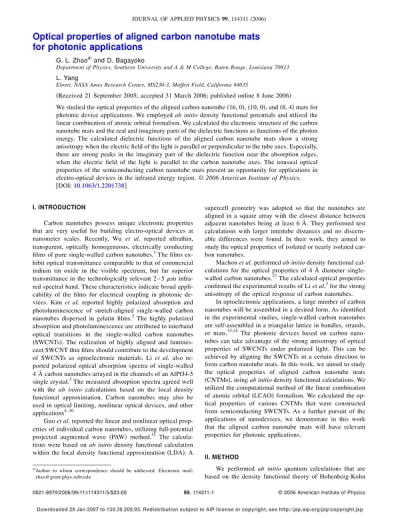
Optical properties of aligned carbon nanotube mats for photonic applications
(reference ONR-0023) is currently available for download from the TSP library.
Don't have an account?
More From SAE Media Group
Photonics & Imaging Technology
New Blue Light Technique Could Enable Advances in Understanding Nanoscale Technologies
Photonics & Imaging Technology
Nanoscale Machines Convert Light into Work

Photonics & Imaging Technology
Light-Analyzing ‘Lab on A Chip’ Opens Door to Widespread Use of Portable Spectrometers
Photonics & Imaging Technology
Continuous and Stable Lasing Achieved From Low-Cost Perovskites at Room Temperature
Tech Briefs
Nanoscale 3D Structure to Control Light
Tech Briefs
A Near-Perfect Blackbody Calibration Target
Photonics & Imaging Technology
Rice ‘Metalens’ Could Disrupt Vacuum UV Market

Tech Briefs
Nanoimaging of Perovskite Solar Cell Materials
Tech Briefs
Turning Diamond into Metal
Tech Briefs
Material Increases Efficiency of LED Devices
Photonics & Imaging Technology
A New Optical Metamaterial Makes True One-Way Glass Possible
Tech Briefs
Superlattice for Sustainable Quantum Electronics

Tech Briefs
University of Pennsylvania School of Engineering

Tech Briefs
Synthesizing Complex Optical Materials
Photonics & Imaging Technology
Deformation Fingerprints Will Help Researchers Identify, Design Better Metallic Materials




Photonics & Imaging Technology
A Sharper Look at the Interior of Semiconductors
Tech Briefs
5 Ws of a Wearable Metamaterial


Medical Design Briefs
Complex Nanomachines Could Carry Pharmaceuticals, Detect Disease
Overview
The document discusses the optical properties of aligned carbon nanotube mats (CNTMs) and their potential applications in photonic devices. Carbon nanotubes, particularly single-walled carbon nanotubes (SWCNTs), exhibit unique electronic and optical characteristics that make them suitable for various optoelectronic applications. The study utilizes ab initio density functional calculations to analyze the optical properties of these materials, confirming previous experimental findings regarding their strong anisotropy in optical response.
The research highlights that carbon nanotubes can be self-assembled into triangular lattice structures in bundles, strands, or mats, which can be aligned to enhance their optical properties under polarized light. This alignment is crucial for maximizing the performance of photonic devices, as it allows for better control over the light-matter interaction. The study specifically examines the optical properties of aligned CNTMs constructed from semiconducting SWCNTs, demonstrating their relevance for applications in photonics.
Key findings include the strong anisotropy observed in the dielectric functions of the CNTMs, particularly when the electric field of light is oriented parallel to the tube axis. The calculations reveal significant peaks in the imaginary part of the dielectric function, indicating strong absorption characteristics at specific photon energies. For instance, a notable peak occurs around 0.89 eV, showcasing the potential for these materials in applications requiring precise optical control.
The document also references previous studies that have reported on the optical transmittance of carbon nanotube films, which exhibit comparable performance to traditional materials like indium tin oxide, especially in the infrared spectrum. This suggests that carbon nanotubes could serve as effective alternatives in transparent conducting films for photonic devices.
In conclusion, the research underscores the importance of aligned carbon nanotube mats in advancing photonic technologies. By leveraging their unique optical properties, these materials can contribute to the development of innovative devices in areas such as optical limiting, nonlinear optics, and other advanced applications. The findings pave the way for further exploration of carbon nanotubes in the field of nanotechnology, emphasizing their potential to revolutionize optoelectronic materials.
Top Stories
INSIDERManufacturing & Prototyping
 How Airbus is Using w-DED to 3D Print Larger Titanium Airplane Parts
NewsAutomotive
 Microvision Aquires Luminar, Plans Relationship Restoration, Multi-industry Push
INSIDERAerospace
 A Next Generation Helmet System for Navy Pilots
INSIDERDesign
 New Raytheon and Lockheed Martin Agreements Expand Missile Defense Production
ArticlesAR/AI
 CES 2026: Bosch is Ready to Bring AI to Your (Likely ICE-powered) Vehicle
Road ReadyDesign

Webcasts
Semiconductors & ICs
 Advantages of Smart Power Distribution Unit Design for Automotive...
Unmanned Systems
 Quiet, Please: NVH Improvement Opportunities in the Early Design...
Electronics & Computers
 Cooling a New Generation of Aerospace and Defense Embedded...
Power
 Battery Abuse Testing: Pushing to Failure
AR/AI
 A FREE Two-Day Event Dedicated to Connected Mobility
