




Forehead-Mounted Sensor Measures Oxygen Saturation for Hypoxia Early Detection and Warning
A reliable hypoxia early detection and warning system would allow aircrew to initiate counter-measures before their performance is significantly degraded.
Symptoms of hypoxia – a deficiency in the amount of oxygen reaching body tissues - have been documented among rotary-wing pilots and aircrew flying at altitudes as low as 8,000 feet. Effective hypoxia-related mishap prevention relies upon rapid recognition of hypoxia symptoms and expeditious execution of emergency procedures. This is particularly challenging in rotary wing aircraft, where the lack of adequate training makes reliance on hypoxia self-detection an ineffective solution. An automated warning would be preferable, but currently no military aviation platform is outfitted with a physiological monitoring system to alert pilots and aircrew of impending hypoxic episodes.

This work compared the sensitivity of, and agreement between, a forehead-mounted pulse oximeter and a finger-mounted pulse oximeter for application in a hypoxia early-warning detection system, and determined if the forehead reflectance sensor could be mounted within an aviation helmet. Nineteen active-duty military personnel participated in the study. After appropriate medical screening, all subjects donned an aviation flight mask connected to the Reduced Oxygen Breathing Device (ROBD), and were then instrumented with a forehead reflectance pulse oximeter, a finger pulse oximeter, a blood pressure cuff, and a skin temperature sensor.
Following instrumentation, subjects breathed ambient air for 10 minutes through the ROBD to allow for acclimation. This was followed with one of two counterbalanced ascent profiles used to model rapid exposures to altitude. Each profile consisted of 8,000-feet and 18,000-feet altitude plateaus for 12 minutes and 30 minutes, respectively, with a recovery period of 12 minutes between exposures. Data were collected at 1 Hz from both sensors for the duration of the protocol. In addition, the viability of mounting the reflectance sensor in the interior of a standard flight helmet was tested. The sensor was successfully integrated inside the helmet; however, after the subject donned the helmet, there was considerable motion artifact due to pressure fluctuations.
Results from the altitude exposure protocol indicate an exceptionally strong agreement between the forehead and finger sensors at all ranges of desaturation. The sensitivity analyses revealed that the forehead sensor was significantly faster, when responding to rapid changes in SpO2, than the finger sensor, especially during the 18,000-foot exposure.
While the data may seem to suggest that the forehead sensor is accurate and sensitive to altitude-induced changes in SpO2, major drawbacks exist for the technology utilized in the study. Motion artifacts significantly limited the ability to collect useful data, and the in-helmet portion of the study had to be discontinued due to sensor incompatibility issues. Reflectance technology remains promising, but significant improvements aimed at diminishing noise, curbing motion artifact, and improving reliability with advancements such as read-through technology are required.
This work was done by Rita G. Simmons, Joseph F. Chandler, and Dain S. Horning of the Naval Aerospace Medical Research Laboratory for the Army Aeromedical Research Laboratory. For more information, download the Technical Support Package (free white paper) at www.defensetechbriefs.com/tsp under the Physical Sciences category. NRL-0045
This Brief includes a Technical Support Package (TSP).
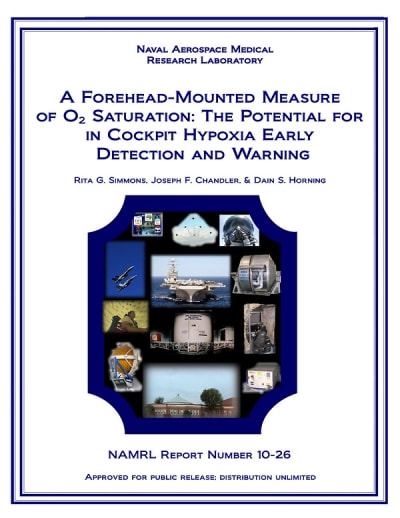
Forehead-Mounted Sensor Measures Oxygen Saturation for Hypoxia Early Detection and Warning
(reference NRL-0045) is currently available for download from the TSP library.
Don't have an account?
More From SAE Media Group
Medical Design Briefs
VA Developing New Heat-Enhanced Pulse Ox Device
Sensor Technology
Oxygen Sensor for Sick Infants
Medical Design Briefs
Advanced Tactile Sensors Drive the Next Generation of Blood Pressure Devices
Electronics & Sensors INSIDER
Your Skin Is Breathing — This New Wearable Device Can Measure It.
Tech Briefs
Growing a Whole-Brain Organoid
Motion Design
Flexible Conductive Skin Gives Robots the Human Touch
Tech Briefs
Skin-Like Sensor Maps Blood-Oxygen Levels

Medical Design Briefs
Health & Wellbeing
Aerospace & Defense Tech Briefs
Localization of Head-Mounted Vibrotactile Transducers
Tech Briefs
A Color-Based Sensor Emulates Skin’s Sensitivity
Tech Briefs
Cryogenic Oxygen Storage Modules (COSM)
Tech Briefs
Cryogenic Flux Capacitor

Tech Briefs
When Mushrooms Control Robots
Aerospace & Defense Tech Briefs
Multifunctional Vehicle Structural Health Monitoring with Piezoelectric Wafer Active Sensors

Medical Design Briefs
Noninvasive Fetal Oxygen Monitor Could Enable Safer Deliveries
Aerospace & Defense Tech Briefs
Humanlike Articulated Robotic Headform for Respirator Fit Testing
Aerospace & Defense Tech Briefs
Robust Quantum Sensors Program
Photonics & Imaging Technology
The Latest Advancements in Optics
Photonics & Imaging Technology
New Frequency Comb Can Identify Molecules in 20-Nanosecond Snapshots
Medical Design Briefs
Custom Finger Clip Offers New Way to Measure Blood Pressure, Other Vitals
Medical Design Briefs
Researchers Develop Long-Lasting Disposable Health Patch
Tech Briefs
Products of Tomorrow
Tech Briefs
Thin Film Sensor for Ultra High-Temp Measurement
Motion Design INSIDER
A New Window into Earth’s Upper Atmosphere
Overview
The document is a technical report from the Naval Aerospace Medical Research Laboratory, authored by Rita G. Simmons, Joseph F. Chandler, and Dain S. Horning, focusing on a novel forehead-mounted measure of oxygen saturation (O₂) designed for early detection and warning of hypoxia in cockpit environments. The study was conducted between January and April 2009 and was approved by the Institutional Review Board, ensuring compliance with federal regulations regarding human subject protection.
The report outlines the methodology used in the study, which involved excluding pregnant women and utilizing a compliance questionnaire to minimize confounding variables. Participants were instrumented with various sensors, including pulse oximeters and blood pressure cuffs, to monitor physiological responses during controlled hypoxia exposure. The subjects experienced rapid altitude changes, simulating conditions that could lead to hypoxia, with two counterbalanced ascent profiles to assess the effectiveness of the forehead-mounted oximeter.
Key findings indicated that there was excellent agreement between the readings of different sensors during periods of high oxygen saturation, as well as strong correlation and precision at low saturation levels. This suggests that the forehead-mounted device could reliably monitor oxygen levels, providing critical data for pilots and aircrew in real-time.
The report emphasizes the importance of early hypoxia detection in aviation, as it can significantly impact pilot performance and safety. The forehead-mounted oximeter represents a potential advancement in cockpit safety technology, allowing for continuous monitoring without the need for cumbersome equipment.
In conclusion, the document highlights the potential of the forehead-mounted O₂ saturation measure as a valuable tool for enhancing pilot safety and performance. By providing timely alerts about hypoxic conditions, this technology could play a crucial role in preventing accidents and ensuring the well-being of aircrew in high-altitude environments. The findings contribute to ongoing efforts to improve aviation safety through innovative monitoring solutions.
Top Stories
INSIDERManned Systems
 How Airbus is Using w-DED to 3D Print Larger Titanium Airplane Parts
INSIDERAerospace
 FAA to Replace Aging Network of Ground-Based Radars
NewsUnmanned Systems
 Microvision Aquires Luminar, Plans Relationship Restoration, Multi-industry Push
NewsDesign
 CES 2026: Bosch is Ready to Bring AI to Your (Likely ICE-powered) Vehicle
NewsSoftware
 Accelerating Down the Road to Autonomy
INSIDERManned Systems
 Can This Self-Healing Composite Make Airplane and Spacecraft Components Last...
Webcasts
Power
 Hydrogen Engines Are Heating Up for Heavy Duty
Transportation
 Advantages of Smart Power Distribution Unit Design for Automotive...
Automotive
 Quiet, Please: NVH Improvement Opportunities in the Early Design...
Power
 A FREE Two-Day Event Dedicated to Connected Mobility
Connectivity
 E/E Architecture Redefined: Building Smarter, Safer, and Scalable Vehicles
Manufacturing & Prototyping
 How Sift's Unified Observability Platform Accelerates Drone Innovation