




Humanlike Articulated Robotic Headform for Respirator Fit Testing
These prototypes can replace humans in testing of respiratory protection devices.
The testing of individual respiratory protection (IRP) devices is now accomplished with panels of human wearers. Historical at tempts to simulate the human face and head have been unsuccessful for a variety of reasons that include imprecision in reproduction of facial dimensions and unrepresentative textures of the surfaces applied to headforms.

The static headform was built first as a prototype to work out many of the details of material composition and configuration. Skin thickness was specified to reproduce a set of ultrasound measurements reported for a panel of young adult male Caucasians. This was accomplished by an inverse forensic reconstruction technique in which a mold of the NIOSH medium headform was cast and clay was applied to the (negative) surface of the mold in a layer whose local thicknesses matched the measured skin thickness. Pins inserted into the negative surface guided the clay thickness. The skull form was then cast to the clay negative surface, and used subsequently as a complementary mold surface to cast the polydimethylsiloxane (PDMS) skin (Frubber™) with anatomically accurate thickness (see Figure 1). For this, the molds were oriented with locating pins, and for assembly, the skull form and skin included locating dimples in areas noncritical to respirator fitting.
A simplified fit test under static conditions at NIOSH showed this head to achieve fit factors (FFs) slightly better than average values measured for the complete protocol, which includes movement. The result was considered completely successful for the first stage, and a process of design refinement and construction of an articulated, robotic headform in the same dimensions was undertaken.
Feedback that the skin thickness near the top of the head was a bit too thin led to a jig that has since been used to verify dimensions during assembly. The temples and back of the head also were too small (see Figure 2), which resulted from deformation of the surface during the assembly process. Jigs were devised to control the surface form during assembly, and to verify dimensions prior to shipment.

The stiffest challenge was achieving an airtight seal around the electronic and mechanical components enclosed in the skull form from aerosolized water and salts in both the external environment and the breathing tube, through which the same aerosol was drawn through a test respirator and eventually delivered to sampling equipment. After several false starts, this was accomplished by inverting the physiology of the oral cavity in an elastomeric casting that was sealed with an adhesive to the lips of the Frubber™ skin, and that engaged the breathing tube on its upper face.
Initial fit testing results suggest that the static headform accurately reproduces the dimensions and textures of the NIOSH medium head. The first application targeted is upgrading N95 respirator certification under 42 CFR 84 to a basis of protection factor (PF) rather than particle exclusion by the medium; however, markets to support respirator design, leak testing, use of hazardous challenges, and PF measurements during extreme exercise/stress are anticipated.
This work was done by Joseph Wander of the Air Force Research Laboratory, and David Hanson and Richard Margolin of Hanson Robotics. AFRL-0224
More From SAE Media Group
Medical Design Briefs
Humanlike Articulated Robotic Headform for Respirator Fit Testing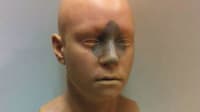

Aerospace & Defense Tech Briefs
Multifunctional Vehicle Structural Health Monitoring with Piezoelectric Wafer Active Sensors
Photonics & Imaging Technology
The Latest Advancements in Optics
Aerospace & Defense Tech Briefs
Gesture-Directed Sensor-Information Fusion Gloves
Motion Design
Flexible Conductive Skin Gives Robots the Human Touch
Tech Briefs
A Color-Based Sensor Emulates Skin’s Sensitivity
NASA Spinoff
Toxin-Eating Plants

Photonics & Imaging Technology
Leveraging CAD for Precision in Wide Field Star Imaging and Spectroscopy
Tech Briefs
Victim Simulator for Victim Detection Radar

Motion Design INSIDER
Are Shapeshifting “Soft Machines” In Our Future?
Motion Design
Miniature 3D-Printed Actuators to Control Soft Robots
Tech Briefs
Thin Film Sensor for Ultra High-Temp Measurement

Electronics & Sensors INSIDER
Careful Heating Unlocks Unprecedented Sensitivity to Pressure in Semiconductor Materials
Tech Briefs
Fighting Fire with Electrically Assisted Wind
Battery & Electrification Technology
New Products

Power Electronics INSIDER
Continuously Tunable Thermal Regulators for Batteries and Electronic Devices

Tech Briefs
First Transformable Nanoscale Electronic Devices
Aerospace & Defense Tech Briefs
Beyond Boundaries: Elevating Aerospace Design with Fluorosilicones
Aerospace & Defense Tech Briefs
Scientists Fuse Simulations and Machine Learning to Accelerate Novel Additively Manufactured Materials
Motion Design INSIDER
First Toroidal Micro-Robot to Swim Autonomously in Viscous Liquids
Photonics Tech Briefs
Instruments for Imaging From Far to Near


Top Stories
INSIDERManufacturing & Prototyping
 How Airbus is Using w-DED to 3D Print Larger Titanium Airplane Parts
INSIDERManned Systems
 FAA to Replace Aging Network of Ground-Based Radars
NewsTransportation
 CES 2026: Bosch is Ready to Bring AI to Your (Likely ICE-powered) Vehicle
NewsSoftware
 Accelerating Down the Road to Autonomy
EditorialDesign
 DarkSky One Wants to Make the World a Darker Place
INSIDERMaterials
 Can This Self-Healing Composite Make Airplane and Spacecraft Components Last...
Webcasts
Defense
 How Sift's Unified Observability Platform Accelerates Drone Innovation
Automotive
 E/E Architecture Redefined: Building Smarter, Safer, and Scalable...
Power
 Hydrogen Engines Are Heating Up for Heavy Duty
Electronics & Computers
 Advantages of Smart Power Distribution Unit Design for Automotive...
Unmanned Systems
 Quiet, Please: NVH Improvement Opportunities in the Early Design...
