




16-bit Sensor Signal Conditioner
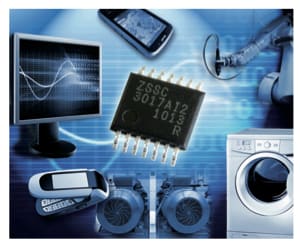 ZMDI (Dresden, Germany) has introduced a new 16-bit sensor signal conditioning IC (SSC). Developed for resistive bridge sensors, the ZSSC3017 combines high accuracy amplification, 16-bit precision analog-to-digital conversion, and an 18-bit DSP for linearization and calibration functions.
The ZSSC3017 operates on supply voltages from 2.7 to 5.5 volts and over a temperature range of -40°C to +85°C. Accuracy is ±0.50% FSO over the full temperature range. Noise performance of far less than 1.5μV (rms, input-referred) is possible. Power consumption during sleep mode is below 2 μA at 25°C. The layout of the ZSSC3017 is customized for die bonding with a sensor.
An on-chip 18-bit DSP implements the calibration math and sophisticated second-order error correction for temperature offset, drift, and non-linearity. Calibration data is stored in on-chip EEPROM, and calibration is accomplished with a PC-based program using a two-wire, I2C-based interface. It operates on supply voltages from 2.7 to 5.5 volts. Noise performance of less than 1.5μV (rms, input-referred) is possible. Power consumption during sleep mode is below 2μA at 25°C. The layout is customized for die bonding with a sensor.
For Free Info Click Here
More From SAE Media Group
Embedded Technology
Sensor Signal Conditioner
Embedded Technology
Booth 213-Multichannel LVDT Signal Conditioner
Aerospace & Defense Tech Briefs
New Products


Tech Briefs
How Much Do You Know About Analog Electronics?
Embedded Technology INSIDER
Power Monitoring IC
Embedded Technology
Understanding the Unique Requirements of Portable Data Acquisition Systems
Tech Briefs
How Much Do You Know About Oscilloscopes?
Tech Briefs
New on the Market
Embedded Technology
6U VPX Load Board
Embedded Technology INSIDER
Oscilloscope in a DIP Module
Embedded Technology
14-Bit Analog-to-Digital Converter
Embedded Technology
Wireless Electronic Patches Improve Medical Data and Patient Mobility
Embedded Technology
PCI Filter and Amplifier Module
Embedded Technology INSIDER
New Circuits Can Function at Temperatures Above 650°F
Embedded Technology
Sensor Interface Design Demystified
Tech Briefs
New on the Market: June 2021
Tech Briefs
Capacitive Pressure Sensor System and Packaging
Electronics & Sensors INSIDER
This LED Can Be Integrated Directly Into Computer Chips
Tech Briefs
New on the Market: November 2018
Embedded Technology INSIDER
Microcontrollers
Tech Briefs
New on the Market: July 2020
Embedded Technology
Booth 709-Customizable Mixed-Signal Chips for Printers
Tech Briefs
Hyper-Distributed RFID Antenna (HYDRA) System
Embedded Technology INSIDER
Piezoelectric Signal Conditioner

Tech Briefs
New on the Market: May 2019
Top Stories
NewsSensors/Data Acquisition
 Microvision Aquires Luminar, Plans Relationship Restoration, Multi-industry Push
INSIDERRF & Microwave Electronics
 A Next Generation Helmet System for Navy Pilots
INSIDERWeapons Systems
 New Raytheon and Lockheed Martin Agreements Expand Missile Defense Production
NewsAutomotive
 Ford Announces 48-Volt Architecture for Future Electric Truck
INSIDERAerospace
 Active Strake System Cuts Cruise Drag, Boosts Flight Efficiency
ArticlesTransportation

Webcasts
Aerospace
 Cooling a New Generation of Aerospace and Defense Embedded...
Energy
 Battery Abuse Testing: Pushing to Failure
Power
 A FREE Two-Day Event Dedicated to Connected Mobility
Automotive
 Quiet, Please: NVH Improvement Opportunities in the Early Design Cycle
Electronics & Computers
 Advantages of Smart Power Distribution Unit Design for Automotive &...
Unmanned Systems
 Sesame Solar's Nanogrid Tech Promises Major Gains in Drone Endurance