




Compact Superconducting Power Systems for Airborne Applications
New power generators meet larger onboard demands for aircraft electrical power.
In the development of future airborne megawatt-class power generation, it is important to minimize both the size and the weight of the system. The primary means of increasing the power density within the generator, as for all rotating machinery such as motors and alternators, is to maximize the magnetic flux density. This can be achieved by using a higher current-carrying capacity wire to increase the ampere-turns in the windings without adding more turns via a longer length of wire. This has already been accomplished through the incorporation of superconducting wire in magnetic resonance imaging (MRI) magnets used in the medical field.
In addition to cryogenic systems, a new class of high-temperature superconducting (HTS) wire, made from an yttrium barium copper oxide (YBCO) coated conductor, is available. The wire typically takes the form of a thin, flat tape, as opposed to a round wire. The YBCO wire allows a much higher operating temperature than the previous generations of superconducting wire made from the bismuth strontium calcium copper oxide (BSCCO) family, thereby requiring a significantly smaller cryocooler to function. Depending on the magnetic field of the application, the operational temperature of YBCO is typically 20-40 K higher than for BSCCO wires.
Recent efforts by the Air Force have been advancing power technologies using superconductors for airborne high-power applications (HPA). Large onboard demands for electrical power are projected for future military aircraft, making it necessary to develop not only suitable power generators, but power distributors and conditioning technologies as well.
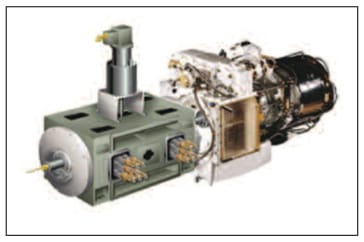
The Megawatt-level Electric Power System (MEPS) program was begun to develop and test superconducting power systems for airborne HPA. The objective for the MEPS generator was to demonstrate HTS machine designs yielding power ratios in excess of the Air Force’s initial goal of 4.0 kW/lb. Using this figure as a starting point, future systems could be driven to much higher power ratios, since the initial machine configuration was a homopolar inductor alternator (HIA). A prototype one-megawatt generator produced 1.3 MW output at its design speed of 10,000 rpm, and achieved 97% overall efficiency, even taking into account cryocooler losses.
Another superconductor candidate for HPA is the gyrotron magnet. A gyrotron is a high-field magnet necessary to generate high-power electromagnetic radiation. Similar to the MRI magnet, this can be accomplished with superconducting wire, but uses older, low-temperature superconductors (LTS). Developing an HTS magnet with the newer HTS wire to replace the LTS windings could substantially reduce the refrigeration load. The new YBCO conductor operates at 60-77 K (as opposed to 4.2 K for LTS wire), and requires a cryocooler that is more than an order of magnitude smaller (by output) than that used for LTS materials.
For airborne applications, operating voltages are typically fixed at 270V to minimize arc discharges at lower atmospheric pressures. However, this also causes problems with power supplies and power electronics. The output or operating power of a device is known from basic principles, specifically Ohm’s law (P = IV, where I is the applied current, and V is the operating voltage). Thus, it is not practical to increase the operating voltage to increase the power output substantially for airborne applications, as would be typical for ground-based transmission systems. Consequently, it would only be practical to increase the operating current. Since voltage will not be increased, the device design may benefit by reducing the amount of electrical insulation needed.
The energy densities afforded by superconductor power transmission devices over their copper counterparts are tremendous, which demonstrates how higher-current-density wires can be incorporated into power systems, thus greatly reducing the size and weight required for airborne applications. Also, heat losses can be substantially reduced. It should be noted that these improvements are realized for power transmission between devices operating at 50-77 K, such as superconducting generators and gyrotron magnets, as described above. If one of the devices was to operate at room temperature, a significant number of additional high-current power leads would be required to deliver the equivalent electrical power as at 77 K.
This work was done by LaMarcus Hampton, Paul N. Barnes, T. J. Haugan, George A. Levin, and Edward B. Durkin of the Air Force Research Laboratory. For more information, download the Technical Support Package (free white paper) at www.defensetechbriefs.com/tsp under the Electronics/Computers category. AFRL-0188
This Brief includes a Technical Support Package (TSP).
Compact Superconducting Power Systems for Airborne Applications
(reference AFRL-0188) is currently available for download from the TSP library.
Don't have an account?
More From SAE Media Group


Tech Briefs
High Field Superconducting Magnets
Power Electronics INSIDER
Superconducting Diode Bridge Efficiently Converts AC to DC for Quantum Circuits


Aerospace & Defense Tech Briefs
How High-Reliability Capacitors Support Electrical Power in Military Vehicles
Tech Briefs
Solid-State Thermal Transistor

Tech Briefs
Nanotransistors Stay Cool at High Voltages
Power Management INSIDER
New Wearable Device Turns the Body Into a Battery


Tech Briefs
Biofilm Harvests Energy in Evaporation
Tech Briefs
Ultra-Wide-Bandgap Power Electronics
Tech Briefs
OMRON’s G9KB PCB Relay
Tech Briefs
5 Ws of the Electronics-Powering Finger Wrap
Aerospace & Defense Tech Briefs
Taming the Thermal Behavior of Solid-State Military Lasers
Tech Briefs
Pyroelectric Sandwich Thermal Energy Harvester
Automotive Engineering
Tula DMD Aims for More-Efficient E-Machines
Aerospace & Defense Tech Briefs
From DC to Daylight — How Innovations in Microwave Absorbers Shield the Warfighter

Tech Briefs
Supercapacitors for Wearable Devices
Tech Briefs
Turning Diamond into Metal
Sensor Technology
How to Engineer Intrinsically Safe Hazardous Duty Wireless Sensors

Tech Briefs
Cathodoluminescent Source of Intense White Light
Overview
The document discusses advancements in superconducting power systems for airborne applications, emphasizing the need to minimize size and weight while maximizing power density in megawatt-class power generation. It highlights the critical role of superconducting wires, particularly the YBCO (Yttrium Barium Copper Oxide) coated conductor, which operates at higher temperatures than previous superconductors, offering improved stability and efficiency.
Superconductors allow for higher current densities compared to traditional copper wires, significantly reducing the size and weight of power transmission devices. This is particularly beneficial for airborne applications, where weight is a critical factor. The document notes that superconducting systems can operate effectively at temperatures between 50-77 K, which reduces heat losses and enhances overall system performance. However, if devices were to operate at room temperature, the need for additional high-current power leads would increase heat losses, complicating the cooling requirements and diminishing the advantages of superconducting technology.
The document also outlines the successful testing of superconducting wire in various advanced components, indicating that while further improvements are anticipated, the YBCO conductor is ready for advanced demonstrations. The future of superconducting technology appears promising, with potential applications extending beyond current limitations.
Key contributors to this research include Dr. Timothy J. Haugan, a Technical Leader for Cryogenic Power Research, and Dr. George A. Levin, a physicist with a focus on condensed matter physics. Their work, along with that of Mr. Edward B. Durkin, who has experience in developing technologies for electric generators, underscores the collaborative effort in advancing superconducting technologies.
In conclusion, the document presents a comprehensive overview of the state of superconducting power systems, highlighting their potential to revolutionize airborne power generation by enhancing efficiency, reducing weight, and minimizing heat losses. The ongoing research and development in this field are expected to lead to significant breakthroughs, paving the way for innovative applications in various technological domains.
Top Stories
NewsRF & Microwave Electronics
 Microvision Aquires Luminar, Plans Relationship Restoration, Multi-industry Push
INSIDERAerospace
 A Next Generation Helmet System for Navy Pilots
INSIDERDesign
 New Raytheon and Lockheed Martin Agreements Expand Missile Defense Production
INSIDERMaterials
 How Airbus is Using w-DED to 3D Print Larger Titanium Airplane Parts
NewsPower
 Ford Announces 48-Volt Architecture for Future Electric Truck
ArticlesAR/AI

Webcasts
Electronics & Computers
 Cooling a New Generation of Aerospace and Defense Embedded...
Automotive
 Battery Abuse Testing: Pushing to Failure
Power
 A FREE Two-Day Event Dedicated to Connected Mobility
Unmanned Systems
 Quiet, Please: NVH Improvement Opportunities in the Early Design Cycle
Automotive
 Advantages of Smart Power Distribution Unit Design for Automotive &...
Energy
 Sesame Solar's Nanogrid Tech Promises Major Gains in Drone Endurance