




Photorefractive Polymers for Updatable 3D Displays
Photorefractive (PR) polymer composites developed for 3D display applications contain a copolymer as the hole-transporting host matrix. The copolymer approach is followed to reduce the phase separation typical in guest-host polymer systems with low glass transition temperature (Tg), thus allowing increased loading of functional components such as NLO chromophores. The copolymer consists of a polyacrylate backbone with pendant groups tetraphenyldiaminobiphenyltype (TPD) and carbaldehyde aniline (CAAN) attached through an alkoxy linker (PATPD-CAAN). A fluorinated dicyanostyrene (FDCST) NLO chromophore was added to provide sufficient refractive index change and charge generation at the wavelength of interest (532 nm). The plasticizer Nethyl carbazole (ECZ) was also used to reduce the Tg to room temperature. In some composites, a fullerene derivative [6,6]-Phenyl C61 butyric acid methyl ester (PCBM) was used to provide improved sensitization.

The PR thin-film devices (C1) showed almost 90% diffraction efficiency at an applied voltage of 4kV using 532-nm writing beams and a 633-nm reading beam in a typical four-wave mixing (FWM) measurement. Using the same irradiance, the two-beam coupling (TBC) gain coefficient for the samples at 5kV is around 200 cm-1. Large-area devices made of the composite showed no degradation or dielectric breakdown for extended periods of usage (several months) under very harsh conditions such as high applied fields and high-power, focused laser beams.
The holograms recorded in the thin-film devices can persist for several hours in the dark (without writing beams) at an applied voltage of 4 kV while continuously being probed with a red (633-nm) laser beam for which the samples are transparent. The total recording time of a 3D display that employs this material needs to be brought to around a few minutes to achieve a high FOM. A new technique was developed to improve the writing speed of organic PR materials based on manipulation of the applied voltage, called the “voltage kick-off.”
In conventional recording of PR polymers, a fixed external voltage is usually applied across the polymer to pole the NLO chromophores. In the kick-off approach, an increased voltage (i.e. 9kV) is applied across the polymer to increase the writing speed during the hologram recording, and then the voltage is reduced to its optimum value of 4kV after recording is complete. The temporarily increased voltage facilitates efficient separation of electron-hole pairs and improves the drift characteristics, forcing them to travel faster, and increasing the orientational order parameter and speed of the NLO chromophores. The reduction of the voltage to its optimum value after recording ensures hologram persistency. The overall benefit of the voltage kick-off is the reduction of the writing time per hologram to less than a second by fine-tuning of the applied voltage.
A high diffraction efficiency of 55% was achieved with a total writing time of 0.5 second and several hours of hologram persistency in this composite using voltage kick-off. 3D displays (4×4" in size) were recorded with complex and high-quality images within a few minutes using horizonatal parallax only (HPO) imaging. The 3D display exhibits a total horizontal viewing angle of 45 degrees. The images are viewable up to three hours directly on the photorefractive thin-film device without the need for intermediate projection tools or magnification between the recorded image and the viewer. The images can be completely erased within minutes by uniform illumination of the display using a 532-nm beam, and new images can be recorded when desired. There is no technological limit to the achievable display size, as large thin-film devices can be fabricated and even tiled together. For larger, full parallax displays a short pulsed recording can be employed.
This work was done by Nasser Peyghambarian and Robert A. Norwood of the University of Arizona for the Air Force Office of Scientific Research and the Office of Naval Research. For more information, download the Technical Support Package (free white paper) at www.defensetechbriefs.com/tsp under the Photonics category. AFRL-0161
This Brief includes a Technical Support Package (TSP).
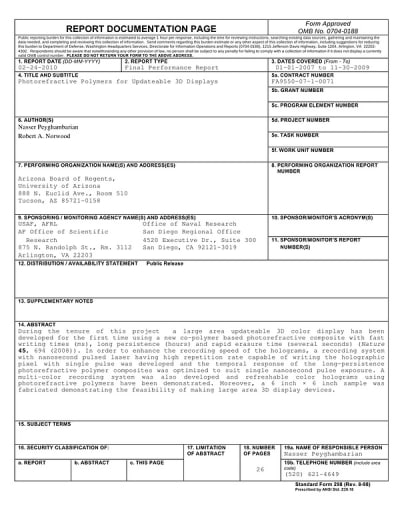
Photorefractive Polymers for Updatable 3D Displays
(reference AFRL-0161) is currently available for download from the TSP library.
Don't have an account?
More From SAE Media Group
Photonics & Imaging Technology
Bringing Precision Anamorphic Micro-Optics to Consumer-Level Laser Applications
Photonics & Imaging Technology
Manufacturing Wafer-Level Optics Using UV Adhesives and Polymers
Photonics & Imaging Technology
Hydrophobic & Oleophobic Coating Technologies for Polymer Optics
Photonics & Imaging Technology
Researchers Develop Flexible, Stretchable Photonic Devices
Photonics & Imaging Technology
New “Metalens” Shifts Focus Without Tilting or Moving
Photonics & Imaging Technology
500°C-Rated Optical Fiber for High Temperature Applications

Tech Briefs
New Family of Glass for Lens Applications
Photonics & Imaging Technology
Researchers Create World’s Smallest LED And Holographic Microscope
Photonics & Imaging Technology
A First-Of-Its-Kind Integrated Optical Isolator
Photonics & Imaging Technology
Tiny Optical Elements Could One Day Replace Traditional Refractive Lenses
Aerospace & Defense Tech Briefs
Cleaning and Protecting Large Mirrors Using a Polymer Solution
Photonics & Imaging Technology
Upside-Down Design Expands Wide-Spectrum Super-Camera Abilities
Photonics Tech Briefs
A Polymeric Optical Correlator for Security Verification
Photonics & Imaging Technology
A Sharper Look at the Interior of Semiconductors
Photonics & Imaging Technology
A New Optical Metamaterial Makes True One-Way Glass Possible
Photonics & Imaging Technology
New Technology Uses Light to Engrave Erasable 3D Images
Medical Design Briefs
Optical Fiber Performance in High-Power Applications
Photonics Tech Briefs
Precise Stabilization of the Optical Frequency of WGMRs
Aerospace & Defense Tech Briefs
3D Meta-Optics for High-Energy Lasers
Photonics & Imaging Technology
How to Innovate and Overcome the Challenges of Blue Laser Beam Shaping
Photonics & Imaging Technology
X-Ray Study of Low-Density Materials

Photonics & Imaging Technology
Using Magnets to Toggle Nanolasers Leads to Better Photonics
Photonics Tech Briefs
Nonvolatile Holographic Storage in Doubly Doped LiNbO₃
Photonics & Imaging Technology INSIDER
Unique Nanodisk Holds Major Potential for Future of Photonic Research
Aerospace & Defense Tech Briefs
On the Pulsed Laser Ablation of Metals and Semiconductors

Overview
The document presents a final performance report on a project focused on the development of photorefractive polymers for updateable 3D displays, conducted by researchers Nasser Peyghambarian and Robert A. Norwood at the University of Arizona from January 2007 to November 2009. The project aimed to create a large-area, updateable 3D color display using a novel co-polymer based photorefractive composite.
Key accomplishments of the project include the development of photorefractive copolymers that exhibit image persistence ranging from several minutes to hours, and the establishment of a holographic image recording setup capable of writing and displaying 3D images. Notably, the team demonstrated the first updateable 3D display utilizing these photorefractive polymers. They optimized the temporal response of the long-persistence polymer composites to accommodate single nanosecond pulse exposure, which is crucial for high-speed recording.
The report details the technical aspects of the holographic 3D display system, including the writing and erasing dynamics of the holograms. The writing process involves using a 532 nm laser beam with specific irradiance and voltage settings to achieve high diffraction efficiency. The researchers found that the maximum diffraction efficiency increases with longer writing times, and they developed a system that allows for new images to be recorded as needed.
Additionally, the project explored faster recording systems by increasing continuous wave (CW) laser power, which significantly reduced the write/erase cycle time from 230 seconds to 150 seconds while maintaining diffraction efficiency. The report emphasizes the potential for large thin-film devices to be fabricated and tiled together, indicating no technological limits to the achievable display size.
The document concludes by highlighting the successful demonstration of refreshable color holograms and the feasibility of creating large area 3D display devices, with a specific example of a 6-inch by 6-inch sample. This work represents a significant advancement in the field of photorefractive materials and their application in dynamic 3D displays, paving the way for future innovations in visual technology.
Top Stories
INSIDERManufacturing & Prototyping
 How Airbus is Using w-DED to 3D Print Larger Titanium Airplane Parts
INSIDERManned Systems
 FAA to Replace Aging Network of Ground-Based Radars
NewsTransportation
 CES 2026: Bosch is Ready to Bring AI to Your (Likely ICE-powered) Vehicle
NewsSoftware
 Accelerating Down the Road to Autonomy
EditorialDesign
 DarkSky One Wants to Make the World a Darker Place
INSIDERMaterials
 Can This Self-Healing Composite Make Airplane and Spacecraft Components Last...
Webcasts
Defense
 How Sift's Unified Observability Platform Accelerates Drone Innovation
Automotive
 E/E Architecture Redefined: Building Smarter, Safer, and Scalable...
Power
 Hydrogen Engines Are Heating Up for Heavy Duty
Electronics & Computers
 Advantages of Smart Power Distribution Unit Design for Automotive...
Unmanned Systems
 Quiet, Please: NVH Improvement Opportunities in the Early Design...
