




Fire Resistance of Geopolymer Concretes
Geopolymer concrete is used in applications requiring high degrees of fire resistance.
Geopolymer concrete has been proposed as an alternative to Portland cement concrete in applications requiring high degrees of fire resistance, because the intrinsic chemistry of the geopolymer binder does not require the retention of water or hydration within gel phases to maintain structural integrity of the binder. Portland cement concrete contains a high level of chemically bound water, which is essential to the gel binder structure, and which is lost upon heating to several hundred degrees Celsius, whereas the water present within a geopolymer concrete is overwhelmingly present in pores and is not an essential part of the strength-generating phases. However, predictions of geopolymer concrete fire performance have up to this time been based on small-scale laboratory testing (usually on paste or mortar specimens), rather than the study of large concrete sections, which provides significance to this work.
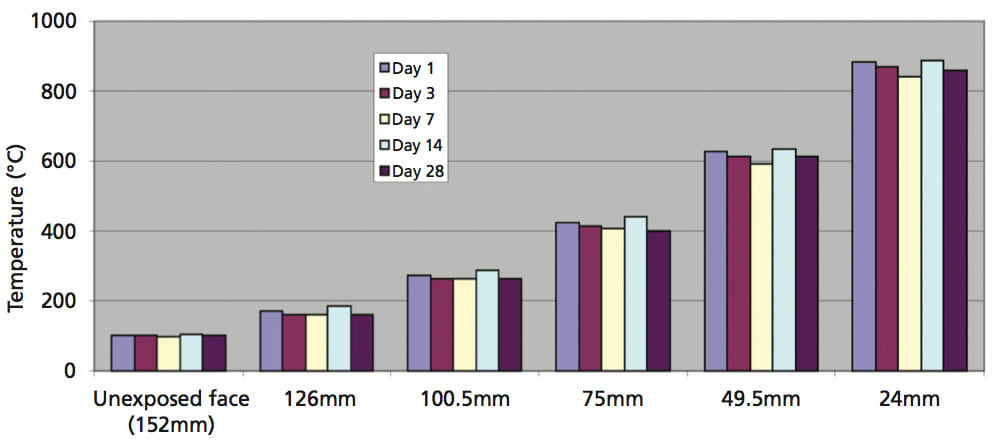
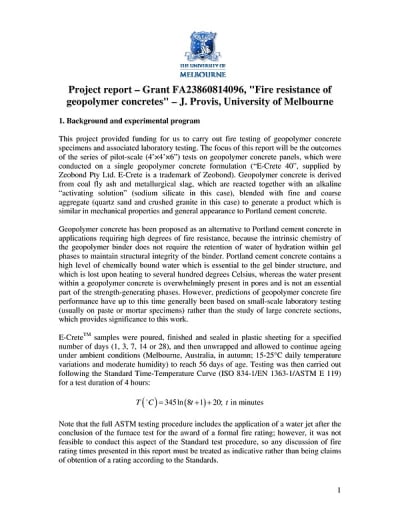
E-Crete samples were poured, finished, and sealed in plastic sheeting for a specified number of days (1, 3, 7, 14, or 28), and then unwrapped and allowed to continue aging under ambient conditions to reach 56 days of age. Testing was then carried out following the Standard Time-Temperature Curve for a test duration of four hours.
Each data set shows an apparent flattening of the rate of temperature increase at a temperature between 100- 160 °C, holding at this temperature for a period of time, and then an acceleration following this as the temperature starts to increase again. This can be associated with the passage of a boiling front through the material; the concrete initially contains a significant quantity of liquid water in its pores. As this begins to be heated (close to the inside face of the concrete), the water expands upon heating, and fairly soon localized boiling commences. This generates pressure within the pore network of the concrete, forcing the water to flow away from the heated face. This water carries thermal energy as it travels through the sample, causing additional heating of the parts of the sample close to the unexposed face on top of the heat transport due to conduction through the sample.
The presence of more water in the samples cured for longer durations provides two competing effects relating to heat transport. The specific heat capacity and the latent heat of vaporization of water are high, which means that the requirement to heat and then boil more water provides a heat sink effect, which reduces the rate of temperature increase of the sample. The change in specific heat upon removal of liquid water from the pore structure of the geopolymer can be clearly observed, as there is an obvious change in the gradient of the heating curves before and after the boiling regime.
Spalling is a result of water entering the concrete, and forcing the surface to peel, pop out, or flake off. A tendency towards explosive spalling has been noted in many concretes, and has been the subject of much investigation internationally over the past 20 years.
The first fire test trials of geopolymer concretes, using samples that had been cured under sealed conditions but not exposed to ambient conditions for a significant period after unsealing, showed a high degree of spalling as the high water content and very refined pore structure led to the buildup of very high pore pressures. However, the more realistic curing regimes utilized in this work (a period of ambient, unsealed curing replicating the concrete being placed in service for a period of time before being exposed to fire load) did not induce spalling in any of the samples tested.
This work was done by John Provis of the University of New South Wales, Australia, for the Asian Office of Aerospace Research and Development. For more information, download the Technical Support Package (free white paper) at www.defensetechbriefs.com/tsp under the Materials category. AFRL-0166
This Brief includes a Technical Support Package (TSP).
Fire Resistance of Geopolymer Concretes
(reference AFRL-0166) is currently available for download from the TSP library.
Don't have an account?
More From SAE Media Group

Medical Design Briefs INSIDER
Soft, Ultrathin Photonic Material Cools Wearable Electronic Devices
Medical Design Briefs
Thermally Engineering Templates for Highly Ordered Self-Assembled Materials



Medical Design Briefs
Powering Wearable Devices with High-Performing Carbon Nanotube Yarns
Aerospace & Defense Tech Briefs
Beyond Boundaries: Elevating Aerospace Design with Fluorosilicones

Aerospace & Defense Tech Briefs
New Cryogenic Shape Memory Alloy Designed for Outer Space
Tech Briefs
Replacing Thick Insulation with Thin MXenes
Aerospace & Defense Tech Briefs
Acceleration Resistant HiK Heat Spreader
Tech Briefs
Recyclable Feedstocks for Additive Manufacturing
Tech Briefs
Q&A: Refrigeration by Twisting Fibers

Tech Briefs
Product Spotlight: Master Bond EP39MAOHT
Tech Briefs
Self-Growing 3D Objects
Tech Briefs
How MXenes Can Improve Air Filtration

Tech Briefs
Aerogel-Reinforced Composites
Tech Briefs
A Novel Way to Convert Heat to Electricity
Medical Design Briefs
Medical Plastics: Understanding Ultrasonic Welding, Part 1

Tech Briefs
Liquid Metal Lattice
Tech Briefs
Glue Activated by Magnetic Field
Aerospace & Defense Tech Briefs
Phonon Confinement Effect in TiO₂ Nanoparticles as Thermosensor Materials

Medical Manufacturing and Machining
Research Collaboration Could Reshape Injection Molding
Overview
The document is a project report titled "Fire resistance of geopolymer concretes," authored by John Provis from the University of Melbourne, and funded under Grant FA23860814096. The primary focus of the project was to investigate the fire performance of geopolymer concrete, a sustainable alternative to traditional Portland cement concrete, which is derived from industrial by-products such as coal fly ash and metallurgical slag.
The report details a series of pilot-scale fire tests conducted on geopolymer concrete panels, specifically using a formulation known as "E-Crete 40," supplied by Zeobond Pty Ltd. The geopolymer concrete is created by reacting coal fly ash and slag with an alkaline activating solution, primarily sodium silicate, and is mixed with fine and coarse aggregates like quartz sand and crushed granite. This process results in a material that exhibits mechanical properties and appearance similar to conventional concrete.
The experimental program included fire testing to assess the temperature profiles within the geopolymer concrete specimens during exposure to high temperatures. The results indicated that the maximum temperature recorded at the unexposed face of the samples was 105.3°C for the 14-day cured sample. According to ASTM E 119 standards, the maximum allowable temperature rise for a 4-hour fire rating is 250°F (139°C). The observed temperature rises in all tested samples were well within this limit, demonstrating the effective fire resistance of the geopolymer concrete.
The report emphasizes the potential of geopolymer concrete in construction applications where fire resistance is critical. The findings suggest that geopolymer concrete not only meets but exceeds the fire safety requirements, making it a viable option for modern building materials. The research contributes to the growing body of knowledge on sustainable construction practices and the use of industrial by-products in creating environmentally friendly materials.
Overall, this project highlights the innovative use of geopolymer technology in enhancing fire resistance, paving the way for further research and development in the field of sustainable construction materials. The report is approved for public release, indicating its relevance and potential impact on the construction industry and fire safety standards.
Top Stories
INSIDERManufacturing & Prototyping
 How Airbus is Using w-DED to 3D Print Larger Titanium Airplane Parts
INSIDERManned Systems
 FAA to Replace Aging Network of Ground-Based Radars
NewsTransportation
 CES 2026: Bosch is Ready to Bring AI to Your (Likely ICE-powered) Vehicle
NewsSoftware
 Accelerating Down the Road to Autonomy
EditorialDesign
 DarkSky One Wants to Make the World a Darker Place
INSIDERMaterials
 Can This Self-Healing Composite Make Airplane and Spacecraft Components Last...
Webcasts
Defense
 How Sift's Unified Observability Platform Accelerates Drone Innovation
Automotive
 E/E Architecture Redefined: Building Smarter, Safer, and Scalable...
Power
 Hydrogen Engines Are Heating Up for Heavy Duty
Electronics & Computers
 Advantages of Smart Power Distribution Unit Design for Automotive...
Unmanned Systems
 Quiet, Please: NVH Improvement Opportunities in the Early Design...
