




Characterizing Turbulent Wind Flow Near a Wind Barrier Using Sonic Anemometers
The resulting data analyses can be used to design and develop future computer models of microscale wind flows.
The Holloman High Speed Test Track (HHSTT) facility at Holloman Air Force Base (HAFB), NM, has a test section of 1.8 km that contains an artificial rain field generation capability over the track. The raindrops produced can be excessively deflected when the cross-track wind speed is greater than 1 m/s. To extend testing times to days when moderate wind conditions (1 to 5 m/s) are present, the HHSTT plans to construct a wind barrier for cross-track wind reduction. Before the construction of a complete wind barrier, an observational study was carried out to characterize the mean and turbulent wind fields using a small prototype section of the wind barrier.
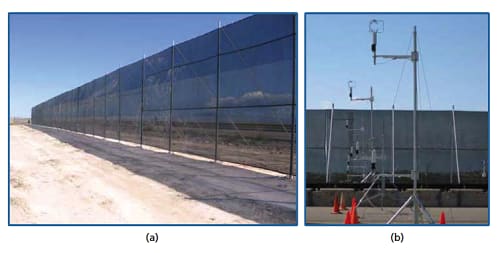
Five additional tripods, with eight additional sonic anemometers, were located to the east of the wind barrier using alternating anemometer arrangements; three tripods with two sonic anemometers were set up at distances of 5 m, 17 m, and 36 m from the barrier; and two tripods with one sonic anemometer were set up at distances of 10 m and 24 m from the barrier. Each of these tripods had a 2-m anemometer attached at the end of a 1-m boom extension, while the three tripods had an additional sensor at 4-m height. The sonic anemometers were oriented such that their V axis was parallel to the track and wind barrier for the convenience of instrumentation setup and data analysis. The sampling time for all instruments was synchronized with a sampling frequency of 20 Hz.
The data were collected on two laptop computers running the Linux operating system. The data were collected continuously over the observational period and were stored hourly for each instrument. Data files for each instrument were coded according to their instrument position relative to the tower plus the hour and date of collection for ease of use in post-test data processing.
The screen material for the wind break consists of a vinyl-coated polyester, which has 30% porosity. The material was tightly attached, using a series of metal clips, to an array of metal poles with additional metal strut reinforcements.
The average behavior of turbulent winds in the vicinity of a wind barrier was tested. In order to achieve the objective, the continuous data sections used for analysis must be quasi-stationary in terms of wind speed and direction. Unlike controlled laboratory data collections such as in wind tunnel experiments, non-stationary winds are prevalent in atmospheric boundary layer flows and are functions of the wind speed, ground surface morphology, and atmospheric stability conditions. One technique to treat such non-stationary conditions is to sample the data, section by section, according to certain stationarity criteria.
First, the mean wind speed has to be greater than 1 m/s, for the reason that the wind barrier has very little effect at very low wind speeds. Second, the variance of the horizontal wind angle must be less than 10°. Third, the time span of any given stationary section must be at least 5 minutes long in order for the incoming wind flow to establish a roughly uniform pattern throughout the entire 80-m-long horizontal domain where the anemometers are located.
Based on these sampling criteria, data sections were categorized according to the wind speed and direction relative to the wind barrier and the atmospheric stability condition. Due to the placement of the leeward instruments on the east side of the wind barrier, the ambient wind must be upwind from the west side of the barrier where the reference tower was located. During the period of the data collections, most of the winds directed from the south or southwest occurred during the daytime hours, meaning the atmosphere was primarily unstable for most of the applicable cases for analyzing the barrier lee-side winds.
Field observations indicated that the wind barrier with 5-m height and oriented parallel to the test track is very effective in reducing the cross-track wind component, even with large oblique angles of wind. The 2-m cross-track wind speed component (where the raindrops start) was greatly reduced to 10% of the total wind speed of the undisturbed reference. The total wind speed at the lee-ward side of the barrier, however, is very much dependent on the wind oblique angle. The wind barrier lost its efficacy for total wind speed reductions when the wind angle became greater than 35 to 40° relative to the barrier normal vector.
This work was done by Yansen Wang, David Tofsted, Jimmy Yarbrough, David Quintis, Robert Brice, Sean D’Arcy, and Scott Elliott of the Army Research Laboratory; and Thomas Truong and Michael Davalos of Holloman Air Force Base. ARL-0078
More From SAE Media Group
Motion Design INSIDER
Nimble Dimples: Agile Underwater Vehicles Inspired by Golf Balls





Tech Briefs
Device Eliminates Vortices and Vibration
Tech Briefs
Fighting Fire with Electrically Assisted Wind
Aerospace & Defense Tech Briefs
Expanding Possibilities for Superconducting Qubits With Niobium
Tech Briefs
Acoustical-Sensor Assemblies for Use in Flows

Motion Design INSIDER
Dragonfly Wings Used to Study Motion
Tech Briefs
AI Helps UAVs Predict Oncoming Turbulence
Tech Briefs
Thin Film Sensor for Ultra High-Temp Measurement
Motion Design INSIDER
A New Window into Earth’s Upper Atmosphere
Power Electronics INSIDER
Diamond Quantum Imaging Can Enable Next-Gen Power Electronics
Tech Briefs
Products of Tomorrow
Photonics Tech Briefs
Wide-Field Optic for Autonomous Acquisition of Laser Link
Tech Briefs
When Mushrooms Control Robots

Photonics & Imaging Technology
New Frequency Comb Can Identify Molecules in 20-Nanosecond Snapshots

Motion Design INSIDER
The Skillful Skydiving of Wingless Springtails
Motion Design INSIDER
Computer Simulation Accurately Models Moving Cars
Electronics & Sensors INSIDER
New Tech May Lead to Smaller, More Powerful Wireless Devices
Top Stories
INSIDERManufacturing & Prototyping
 How Airbus is Using w-DED to 3D Print Larger Titanium Airplane Parts
INSIDERManned Systems
 FAA to Replace Aging Network of Ground-Based Radars
NewsTransportation
 CES 2026: Bosch is Ready to Bring AI to Your (Likely ICE-powered) Vehicle
NewsSoftware
 Accelerating Down the Road to Autonomy
EditorialDesign
 DarkSky One Wants to Make the World a Darker Place
INSIDERMaterials
 Can This Self-Healing Composite Make Airplane and Spacecraft Components Last...
Webcasts
Defense
 How Sift's Unified Observability Platform Accelerates Drone Innovation
Automotive
 E/E Architecture Redefined: Building Smarter, Safer, and Scalable...
Power
 Hydrogen Engines Are Heating Up for Heavy Duty
Electronics & Computers
 Advantages of Smart Power Distribution Unit Design for Automotive...
Unmanned Systems
 Quiet, Please: NVH Improvement Opportunities in the Early Design...
