




Medical Information Network Decision Support System
In order to facilitate a more rapid and systematic transfer of new medical knowledge and capabilities into mainstream clinical practice, a new Medical Information Network Decision Support (MINDS) system has been proposed. This system is intended to be a platform for storing and fusing medical data across all levels (e.g. from low-level genomic and proteomic data to higher level clinical data) in a standardized way.
The general software framework upon which the decision support architecture is built is a modular system that provides the ability to interface MINDS with other systems and tools. Each module may consist of several individual packages that can be included to form a particular application. Modules are reused among applications that have similar functions. The modules of the system are utilized within an application flow diagram that can be utilized in fusing data sources and generating appropriate data models.
The system architecture will support an initial prototype of both a research tool (used to support development models) and a support tool (used to provide decision support summaries to doctors). The modularity of the system is further enhanced by the definition of different software layers that allow higher level processing to be isolated from the lower level messaging and network interface protocols. This has the advantage of allowing the system to be more easily connected to other systems that may utilize different communications or messaging protocols without having to modify the basic data processing elements.
This work was done by H.K. (John) Armenian of TechFinity, Inc. for the Army Medical Research and Materiel Command. ARL-0058
This Brief includes a Technical Support Package (TSP).
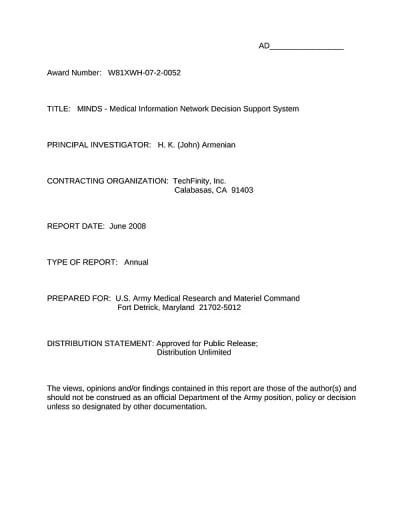
MINDS - Medical Information Network Decision Support System
(reference ARL-0058) is currently available for download from the TSP library.
Don't have an account?
More From SAE Media Group
Software Tech Briefs
Policy-Based Negotiation Engine for Cross-Domain Interoperability
Tech Briefs
Knowledge Base Editor (SharpKBE)
Tech Briefs
State Analysis Database Tool
Tech Briefs
Fused Analytic Desktop Environment (FADE)
Off-Highway Engineering
Upstream Devoted to Truck Cybersecurity Threats
Off-Highway Engineering
Making Machines Software-Defined No Simple Task
Air Force Research Laboratory Technology Horizons
Materials Knowledge Base
Aerospace & Defense Tech Briefs
FACE Technical Standard Offers MOSA Lessons for Safety-Critical Software in Any Sector
Automotive Engineering
No, Really, What’s an SDV?
Off-Highway Engineering
Making Software-Defined Vehicles Cyber-Secure
Embedded Technology
A Software Development Process for Small-Scale Embedded Systems
Tech Briefs
Open Software Options for Automation
Software Tech Briefs
Support for Systematic Code Reviews With the SCRUB Tool
Off-Highway Engineering
Securing CAN Networks in Commercial Vehicles
Automotive Engineering
SkillReal Signs Tier 1 Supplier for NVIDIA-Powered AI Inspection
Off-Highway Engineering
Big Data’s Benefits Keep A-Comin’
Tech Briefs
Modern Software Links Legacy Systems

Aerospace & Defense Tech Briefs
Deterministic and Modular Architecture for Embedded Vehicle Systems
Aerospace & Defense Tech Briefs
MISRA C:2012
Tech Briefs
NETMARK Fast Search
Off-Highway Engineering
Software Needs Security, and Security Needs Software: A Scientific Overview
Software Tech Briefs
Systems Maintenance Automated Repair Tasks (SMART)
Tech Briefs
Creating and Deploying a Drop-in Network
Automotive Engineering
Building Resilient SDVs: Secure by Design in the Automotive Industry
Automotive Engineering
Closing Gap to Leverage Enhanced Computational Power for SDV Advancement
Off-Highway Engineering
Increasing Connectivity in Construction
Automotive Engineering
CES 2024: VW, Cerence Integrate ChatGPT in IDA Voice Assistant
Overview
The document outlines the progress and objectives of the Medical Information Network Decision Support (MINDS) system, a proposed platform aimed at enhancing clinical decision-making in the medical field, particularly for breast cancer diagnosis and treatment. The MINDS system is designed to integrate and standardize various levels of medical data, from genomic and proteomic information to clinical data, facilitating a more systematic transfer of new medical knowledge into mainstream practice.
The project was initially envisioned as a three-year research initiative with a total funding goal of $10 million from congressional sources between 2006 and 2008. However, due to budgetary constraints, only $2 million has been secured to date, with approximately $850,000 allocated to TechFinity. This funding limitation has necessitated a scaling back of the project's original scope, focusing on a more targeted research program.
Key objectives of the MINDS project include the development of a robust system architecture and software framework that enhances interoperability among existing research technologies in breast cancer research. The project aims to identify and collaborate with research labs that possess advanced technologies relevant to breast cancer diagnostics and treatment, integrating their capabilities into a cohesive decision support framework.
The document details four primary tasks outlined in the MINDS contract. Task 1 focuses on enhancing clinical decision support initiatives by summarizing the current status of health information technology (HIT) and clinical decision support (CDS) tools relevant to the MINDS system. This includes evaluating existing standards and protocols in the medical industry to determine their applicability to the project.
The ultimate goal of the MINDS system is to provide probabilistic diagnostic and treatment models that can assist healthcare professionals in understanding and treating diseases more effectively. By leveraging advanced research techniques and integrating various data types, the MINDS system aims to facilitate a rapid introduction of the latest medical knowledge into clinical practice, thereby improving patient outcomes.
In summary, the MINDS project represents a significant effort to harness technology and data integration in the medical field, with a specific focus on breast cancer, while navigating the challenges of funding and resource allocation.
Top Stories
NewsRF & Microwave Electronics
 Microvision Aquires Luminar, Plans Relationship Restoration, Multi-industry Push
INSIDERAerospace
 A Next Generation Helmet System for Navy Pilots
INSIDERDesign
 New Raytheon and Lockheed Martin Agreements Expand Missile Defense Production
INSIDERMaterials
 How Airbus is Using w-DED to 3D Print Larger Titanium Airplane Parts
NewsPower
 Ford Announces 48-Volt Architecture for Future Electric Truck
ArticlesAR/AI

Webcasts
Electronics & Computers
 Cooling a New Generation of Aerospace and Defense Embedded...
Automotive
 Battery Abuse Testing: Pushing to Failure
Power
 A FREE Two-Day Event Dedicated to Connected Mobility
Unmanned Systems
 Quiet, Please: NVH Improvement Opportunities in the Early Design Cycle
Automotive
 Advantages of Smart Power Distribution Unit Design for Automotive &...
Energy
 Sesame Solar's Nanogrid Tech Promises Major Gains in Drone Endurance