




Aumovio’s Remote Temp Sensor Far More Accurate for E-mobility
Sensor can be placed closer to the main source of heat, the rotor, because it transmits its data wirelessly to a wired receiver placed outside of the motor.
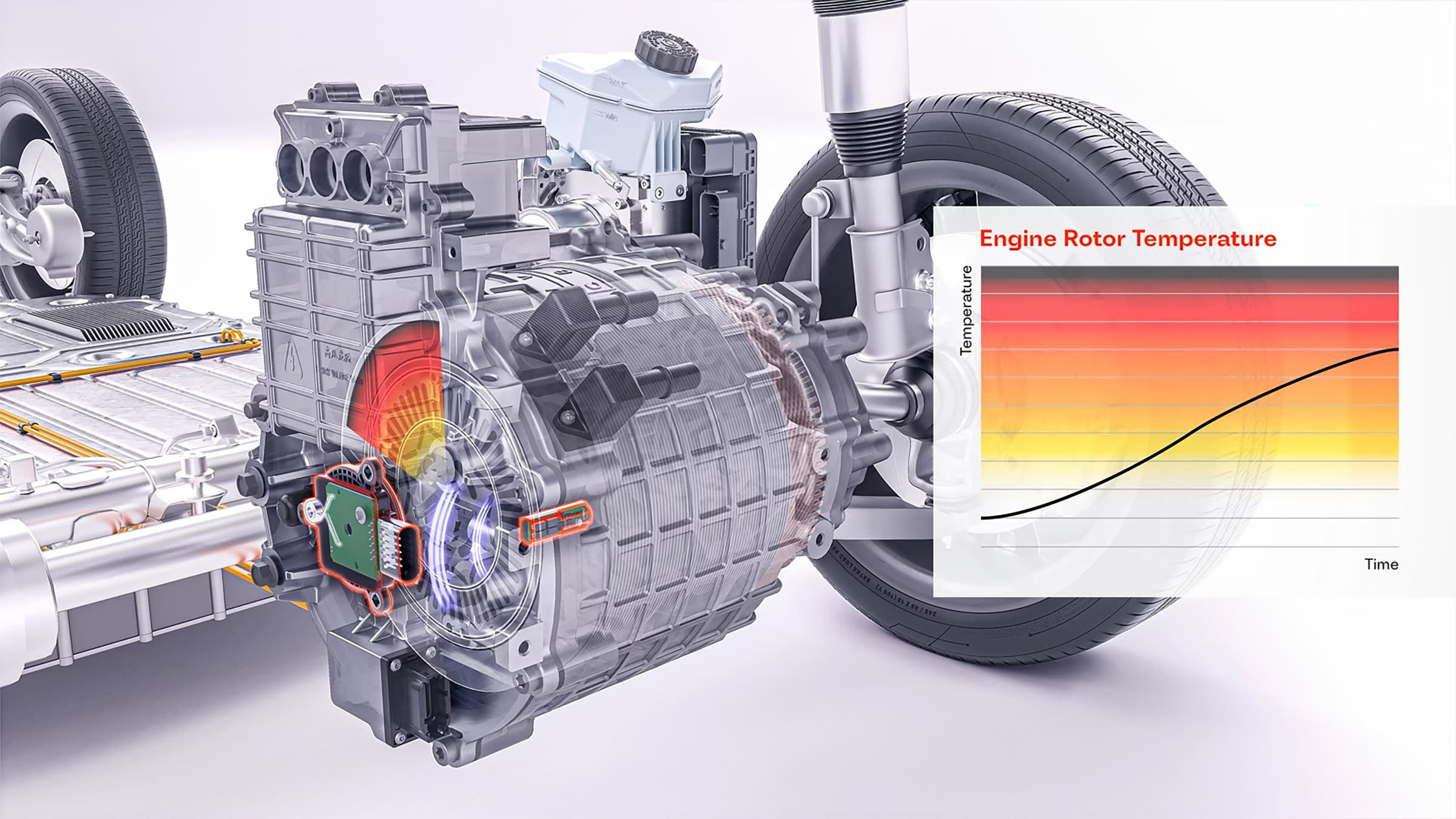
At the U.S. headquarters for Aumovio SE (formerly Continental Auto Group), the company showed its new remote temperature sensor for EV motors as part of its post-CES tech day presentations. The tech, which provides a more accurate reading of the rotor temperature of an EV motor, could lead to more sustainable motor designs by reducing the amount of rare earth materials used to increase the heat resistance of magnets. It can also improve potential motor performance.
The e-motor rotor temperature sensor (e-RTS) is placed directly near the rotor, improving its tolerance range from 15 degrees C (59 F) to 3 degrees C (37 F). It communicates wirelessly to a wired transceiver elsewhere on the motor module (it can be moved around for better packaging).
Alexander Fink, the company’s head of systems and architecture Americas, said the company believes it is the only wireless sensor currently in the market. He said that until now, temperatures had to be predicted by complicated models. Not having to estimate the temperature, and the resulting reduction of rare earth minerals used also translates to lower cost for motor modules.
He said a motor with the e-RTS would be safer due the ability to control torque more accurately.
The company also has a new rotor position sensor (e-RPS) that measures the angular position of the rotor shaft in synchronous electric motors. Aumovio says it provides amplified analog sine and cosine output signals for the motor inverter.
Autonomy-enabling tech
Aumovio was also showing off its foray into the ultra-powerful compute needed to reach true SAE Level 3 and 4 autonomy. A compact module carrying two NVIDIA Drive Thor SOCs capable of 2,000 TOPS each.
“This is our stack solution,” said Jerry Sumiec, head of high performance computing R&D. “One system could handle Level 3 and two together could get to Level 4.” He said the modules use PCIE 5.0 for data transfer, making them capable of 32 gigatransfers per second (GT/s).
The system has eight GMSL inputs for cameras and can accept up to 22 ethernet ports.
Sumiec said the complete system would be ready by late 2027, but that a developer kit is available now.
More From SAE Media Group

Off-Highway Engineering
Addressing Electromagnetic Compatibility in the Context of Aircraft Electrification
Sensor Technology
Sensors — Powering the Future of Transportation
Battery & Electrification Technology
The Future of Axial- and Radial-Flux Motors
Motion Design
Navigating the Challenges of Motor Commutation




Electronics & Sensors INSIDER
Next-Gen Automotive Semiconductors Are Critical for Level 5 Driverless Cars

Tech Briefs
Pseudo-Random Coding Technique for 3D Imaging
Motion Control & Automation Technology
Auto Crash Sensor
Tech Briefs
A Hack to Trick Automotive Radar

Tech Briefs
Product of the Month
Tech Briefs
Pyroelectric Sandwich Thermal Energy Harvester

Tech Briefs
EV vs. ICE: How Does Wire Harness Design Differ?
Off-Highway Engineering
Sensors Evolve to Satisfy CV Demands
Photonics & Imaging Technology
Photonic Communication Comes to Computer Chips
Off-Highway Engineering
Uhnder and Spartan to Partner on Hi-rez Radar
Aerospace & Defense Tech Briefs
Persistent Systems Auto-Tracking Antenna Adds Aircraft to Network, Enhances Data Sharing
Autonomous Vehicle Engineering
Sensors Step Out While Startups Stutter
Aerospace & Defense Tech Briefs
New Products

Tech Briefs
How Much Do You Know About Power Semiconductors?
Automotive Engineering
Power over Coaxial in Automotive: A Simplified Path to Advanced Vehicle Systems
Top Stories
INSIDERManufacturing & Prototyping
 How Airbus is Using w-DED to 3D Print Larger Titanium Airplane Parts
NewsUnmanned Systems
 Microvision Aquires Luminar, Plans Relationship Restoration, Multi-industry Push
INSIDERDesign
 A Next Generation Helmet System for Navy Pilots
ArticlesSoftware
 Accelerating Down the Road to Autonomy
INSIDERDesign
 New Raytheon and Lockheed Martin Agreements Expand Missile Defense Production
ArticlesTransportation
 CES 2026: Bosch is Ready to Bring AI to Your (Likely ICE-powered) Vehicle
Webcasts
Transportation
 Advantages of Smart Power Distribution Unit Design for Automotive...
Unmanned Systems
 Quiet, Please: NVH Improvement Opportunities in the Early Design...
Electronics & Computers
 Cooling a New Generation of Aerospace and Defense Embedded...
Automotive
 Battery Abuse Testing: Pushing to Failure
Communications
 A FREE Two-Day Event Dedicated to Connected Mobility
