




AI Breakthrough Unlocks ‘New’ Materials to Replace Lithium-Ion Batteries
Researchers have used artificial intelligence to tackle a critical problem facing the future of energy storage: finding affordable, sustainable alternatives to lithium-ion batteries.
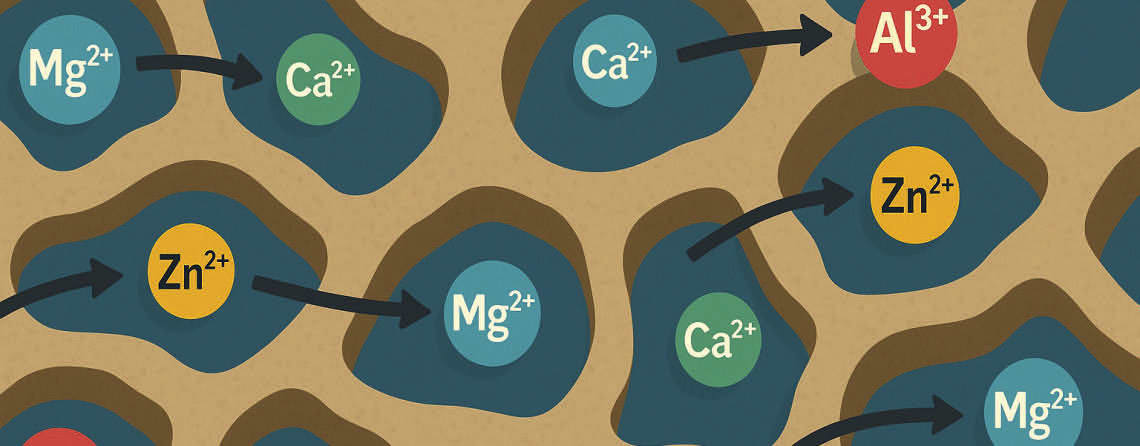
In research published in Cell Reports Physical Science, the NJIT team led by Professor Dibakar Datta successfully applied generative AI techniques to rapidly discover new porous materials capable of revolutionizing multivalent-ion batteries. These batteries, using abundant elements like magnesium, calcium, aluminum, and zinc, offer a promising, cost-effective alternative to lithium-ion batteries, which face global supply challenges and sustainability issues.
Unlike traditional lithium-ion batteries, which rely on lithium ions that carry just a single positive charge, multivalent-ion batteries use elements whose ions carry two or even three positive charges. This means multivalent-ion batteries can potentially store significantly more energy, making them highly attractive for future energy storage solutions.
However, the larger size and greater electrical charge of multivalent ions make them challenging to accommodate efficiently in battery materials — an obstacle that the NJIT team’s new AI-driven research directly addresses.
“One of the biggest hurdles wasn’t a lack of promising battery chemistries — it was the sheer impossibility of testing millions of material combinations,” Datta said. “We turned to generative AI as a fast, systematic way to sift through that vast landscape and spot the few structures that could truly make multivalent batteries practical.
“This approach allows us to quickly explore thousands of potential candidates, dramatically speeding up the search for more efficient and sustainable alternatives to lithium-ion technology.”
To overcome these hurdles, the NJIT team developed a novel dual-AI approach: a crystal diffusion variational autoencoder (CDVAE) and a finely tuned large language model (LLM). Together, these AI tools rapidly explored thousands of new crystal structures, something previously impossible using traditional laboratory experiments.
The CDVAE model was trained on vast datasets of known crystal structures, enabling it to propose completely novel materials with diverse structural possibilities. Meanwhile, the LLM was tuned to zero in on materials closest to thermodynamic stability, crucial for practical synthesis.
“Our AI tools dramatically accelerated the discovery process, which uncovered five entirely new porous transition metal oxide structures that show remarkable promise,” said Datta. “These materials have large, open channels ideal for moving these bulky multivalent ions quickly and safely, a critical breakthrough for next-generation batteries.”
The team validated their AI-generated structures using quantum mechanical simulations and stability tests, confirming that the materials could indeed be synthesized experimentally and hold great potential for real-world applications.
Datta emphasized the broader implications of their AI-driven approach: “This is more than just discovering new battery materials — it’s about establishing a rapid, scalable method to explore any advanced materials, from electronics to clean energy solutions, without extensive trial and error.”
With these encouraging results, Datta and his colleagues plan to collaborate with experimental labs to synthesize and test their AI-designed materials, pushing the boundaries further toward commercially viable multivalent-ion batteries.
For more information, contact Dibakar Datta at
More From SAE Media Group
Power Electronics INSIDER
World’s Strongest Battery Paves Way for Light, Energy-Efficient Vehicles
Battery & Electrification Technology
Enhancing the Performance of All-Solid-State Batteries
Battery & Electrification Technology
Improving and Increasing Energy Density of Batteries
Tech Briefs
A Better-Performing Sodium-Ion Cathode
Battery & Electrification Technology
A Triple-Layer Battery Resistant to Fire and Explosion
Battery & Electrification Technology
Cobalt-Free Batteries Could Power EVs of the Future
Battery & Electrification Technology
A Path to Safer, High-Energy Electric Vehicle Batteries
Battery & Electrification Technology
New Priming Method for Improving Battery Lifecycle
Battery & Electrification Technology
Recyclable ‘Water Batteries’ That Won’t Catch Fire
Battery & Electrification Technology
Cobalt-Free Electrodes Achieved with Nickel Ions
Battery & Electrification Technology
Thick Electrodes’ Chemistry Matters More Than Structure for Battery Performance
Battery & Electrification Technology
A Quick and Easy Way to Produce Anode Materials for Sodium-Ion Batteries Using Microwaves
Tech Briefs
A New Design for Lithium-Sulfur Batteries
Battery & Electrification Technology
Crafting Safe, Long-Cyclable Lithium Metal Batteries for High Temperatures
Battery & Electrification Technology
New Self-Assembling Material Could Be the Key to Recyclable EV Batteries
Power Electronics INSIDER
Carbon Nanotubes Store Energy

Battery & Electrification Technology
New Cathode Material for Sodium-Ion Batteries
Battery & Electrification Technology
Niobium: Magic Metal for Battery Anodes?
Battery & Electrification Technology
Diagnosing a Dud May Lead to a Better Battery
Battery & Electrification Technology
Designing Safer, Higher-Performance Lithium Batteries
Battery & Electrification Technology
Developing High-Energy, Stable All-Solid-State Lithium Batteries Using Aluminum-Based Anodes and High-Nickel Cathodes
Battery & Electrification Technology
Anode-Free Sodium Solid-State Battery
Tech Briefs
A New, Low-Cost Aluminum-Sulfur Battery
Battery & Electrification Technology
Increased Storage Capacity in Water-Based Batteries
Battery & Electrification Technology
New Polymer Coating Could Boost EV Batteries

Battery Technology
Nanostructured Alloy for Battery Anodes
Top Stories
NewsRF & Microwave Electronics
 Microvision Aquires Luminar, Plans Relationship Restoration, Multi-industry Push
INSIDERAerospace
 A Next Generation Helmet System for Navy Pilots
INSIDERDesign
 New Raytheon and Lockheed Martin Agreements Expand Missile Defense Production
INSIDERMaterials
 How Airbus is Using w-DED to 3D Print Larger Titanium Airplane Parts
NewsPower
 Ford Announces 48-Volt Architecture for Future Electric Truck
ArticlesAR/AI

Webcasts
Electronics & Computers
 Cooling a New Generation of Aerospace and Defense Embedded...
Automotive
 Battery Abuse Testing: Pushing to Failure
Power
 A FREE Two-Day Event Dedicated to Connected Mobility
Unmanned Systems
 Quiet, Please: NVH Improvement Opportunities in the Early Design Cycle
Automotive
 Advantages of Smart Power Distribution Unit Design for Automotive &...
Energy
 Sesame Solar's Nanogrid Tech Promises Major Gains in Drone Endurance