




MTA Expands Wireless Communication, EV Tech for Trucks
Truck connectivity and electrification the focus of MTA’s inaugural IAA tradeshow appearance.

Automotive electrical and electronics manufacturer MTA attended IAA Transportation for the first time, demonstrating its new range of wireless communication technologies for the truck industry. Earlier this year, the company acquired Calearo Antenne S.p.A, a company with a long history of producing antennas, amplifiers and cables.

MTA global sales director Davide Bonelli explained to SAE Media how that acquisition complements its business. “From a more strategic point of view, we see the world of antennas as complementary to what MTA does,” he said. “Often MTA products have an antenna as an interface, so this is one reason why we have done the deal. There are also a lot of synergies from an engineering standpoint. Historically, MTA is a company that uses many mechanical parts – plastics, metals – which we are very strong with so we can share them. And there are also some competences from Calearo Antenne that can be transferred to us.”
Bonelli gave the example of a radio interface, or alternatively, telematics data. “In addition to the traditional receivers’ antenna or the telematics antenna, there are also some technologies like foil antennas, where you do not have to make holes in the vehicle roof, or antennas that can be integrated into the vehicle structure, or maybe that can be integrated into the windscreen and then you just need an amplifier to amplify the signal.”
Signals that can be handled by the antennas include 5G mobile, V2X (vehicle-to-everything), precise GNSS (Global Navigation Satellite Systems), Wi-Fi up to 6 GHz as well as Bluetooth connectivity, analog communications and digital and satellite radio services. The company recently won a new order for Bluetooth antennas from a global truck producer for European and American production.

MTA also displayed some of its other products at the IAA tradeshow. The company recently developed high-voltage power distribution units (PDU) for electrified platforms produced by major truck OEMs. The PDUs use cast aluminum housings in place of plastic. MTA says this ensures insulation from external sources, robust construction, optimal heat dissipation and enhanced electromagnetic compatibility (EMC) shielding. Internally, aluminum also is used for the busbars in place of copper to save weight.
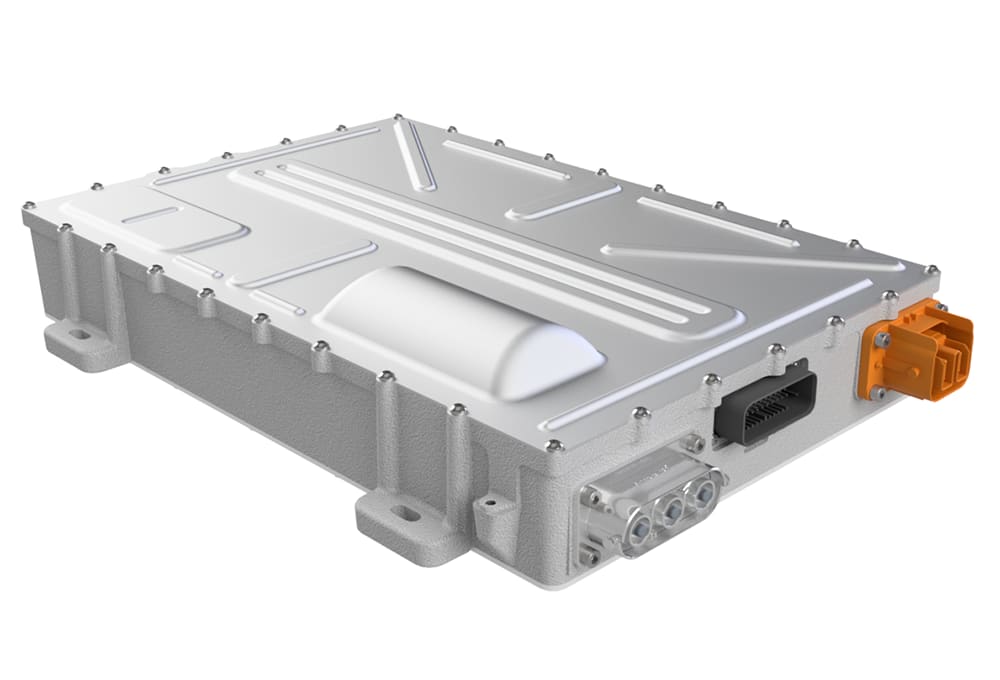
Onboard battery chargers (OBC) capable of handling up to 1,000 volts and up to 22 kW of power also were on display for heavy-duty electric vehicles. The latest models, the BHP 19 and BHP 22, are designed to handle 19.2 kW for U.S. applications and 22 kW for the European market, respectively. They offer low weight and bi-directional power handling, using the latest silicon carbide (SiC) and power converter technologies. The bi-directional capability permits charging from the grid and energy discharge from the battery pack back to the grid or other devices.
MTA also claims fast DC charging capability from the BHP chargers. The integration in the OBC is said to optimize the architecture, reducing complexity, cost and weight. They also include an electrical power takeoff (ePTO), a feature especially useful for off-highway applications. All the power components of the BHP chargers are liquid cooled. MTA’s OBCs are produced in Italy and Mexico.
More From SAE Media Group
Off-Highway Engineering
Addressing Electromagnetic Compatibility in the Context of Aircraft Electrification
Automotive Engineering
Proving out DC Fast Charging — in the Extreme
Automotive Engineering
Cox Automotive's One-Stop Shop for Repairing, Recycling EV Batteries
Autonomous Vehicle Engineering
TCU Testing at the Heart of Vehicle Connectivity
Automotive Engineering
A Resonant Solution for Fast, Flexible EV Charging
Automotive Engineering
Inside GM’s Expanded Electric-Vehicle Battery Lab
Off-Highway Engineering
Solving the Challenges of Megawatt Chargers
Automotive Engineering
Reducing the Weight of EV Batteries with Specialty Thermoplastics
Automotive Engineering
All (Robot) Hands on Deck
Automotive Engineering
New SAE Wireless Charging Standard Is EV Game-Changer
Automotive Engineering
BMW Plans Move to Structural Battery Packs and ‘46120’ Cells
Automotive Engineering
Clarios Sees Low-Voltage Electricals as Vital in EV, AV Future
Automotive Engineering
A Novel Materials Approach to EV Battery-Box Design
Automotive Engineering
Chattanooga Power Haus
Autonomous Vehicle Engineering
Creating Safe, Reliable Circuits for Next-Gen EVs

Off-Highway Engineering
Modine Targets Off-Highway EVs with ‘Plug-And-Play’ BTMS
Automotive Engineering
Eaton Debuts All-In-One Power Distribution for EVs
Automotive Engineering
Powering the IoT Without Batteries Using Energy Harvesting
Off-Highway Engineering
Filtering out Common Mode Noise with Monolithic EMI Filters
Aerospace & Defense Tech Briefs
Industry Invited to Participate in AeroTech Aerospace and Defense Technical Program
Tech Briefs
Method Recharges an Electric Car as it Drives
Automotive Engineering
The New Gas Tank: Constellium Preps Its First OEM Battery Tray
Automotive Engineering
Artificial Intelligence, Big Data Optimize EV Batteries
Automotive Engineering
Hyundai Details First EV-Dedicated Vehicle Architecture
Automotive Engineering
Engineering Flexibility into EV Powertrains
Autonomous Vehicle Engineering
Going the Last Mile
Aerospace & Defense Tech Briefs
SAE International Extends Call for Abstracts, Seeks Submissions for AeroTech Conference
Tech Briefs
RF Innovations Give Batteries New Life
Automotive Engineering
Kymco’s New Ionex BMU, BaaS Will Boost Electric Scooter Adoption
Top Stories
NewsRF & Microwave Electronics
 Microvision Aquires Luminar, Plans Relationship Restoration, Multi-industry Push
INSIDERAerospace
 A Next Generation Helmet System for Navy Pilots
INSIDERDesign
 New Raytheon and Lockheed Martin Agreements Expand Missile Defense Production
INSIDERMaterials
 How Airbus is Using w-DED to 3D Print Larger Titanium Airplane Parts
NewsPower
 Ford Announces 48-Volt Architecture for Future Electric Truck
ArticlesAR/AI

Webcasts
Electronics & Computers
 Cooling a New Generation of Aerospace and Defense Embedded...
Automotive
 Battery Abuse Testing: Pushing to Failure
Power
 A FREE Two-Day Event Dedicated to Connected Mobility
Unmanned Systems
 Quiet, Please: NVH Improvement Opportunities in the Early Design Cycle
Automotive
 Advantages of Smart Power Distribution Unit Design for Automotive &...
Energy
 Sesame Solar's Nanogrid Tech Promises Major Gains in Drone Endurance