




Perspective on Research in Laser Propulsion
A document summarizes the history of research on laser propulsion, starting with the first publication of the laser-propulsion concept in the year 1969, proceeding through studies of laser propulsion within the broader context of advanced propulsion systems in general, and culminating in proof-of-concept experiments and associated studies under the auspices of the Air Force Research Laboratory during the years 1996 through 2007. The document briefly discusses the basic physical principles and engineering concepts of laser propulsion as demonstrated in the proof-of-concept experiments, in which a model rocket denoted a laser lightcraft was lofted to altitudes exceeding 200 ft. (about 61 m). In these experiments, a CO2-laser beam of pulse energy of 400 J at a repetition rate of 25 Hz was used to vaporize a solid propellant (Delrin® polyoxymethylene) to generate thrust. There is a brief discussion of energy-conversion efficiency in laser propulsion. This is followed by an analysis of the concept of supplementing laser ablation energy, and thereby effectively increasing the energy-conversion efficiency, by incorporating a chemically energetic ingredient (ammonium nitrate) into the Delrin propellant. The document includes an extensive bibliography of research on laser propulsion.
This work was done by C. William Larson of the Air Force Research Laboratory.
AFRL-0077
This Brief includes a Technical Support Package (TSP).
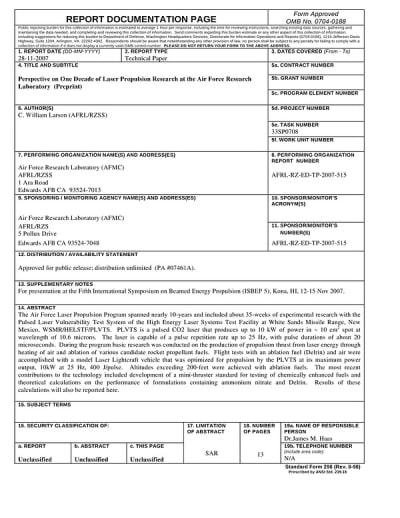
Perspective on Research in Laser Propulsion
(reference AFRL-0077) is currently available for download from the TSP library.
Don't have an account?
More From SAE Media Group
Photonics & Imaging Technology
New Upgrade Will Supercharge Atomic Vision of the World’s Most Powerful X-Ray Laser
Tech Briefs
Pneumatic Proboscis Heat-Flow Probe
Photonics & Imaging Technology
New Frequency Comb Can Identify Molecules in 20-Nanosecond Snapshots

Aerospace & Defense Tech Briefs
This Laser Clock Could Transform Satellite Navigation Accuracy
Tech Briefs
Tunable, Narrow Linewidth, Chip-Scale Lasers

Motion Design INSIDER
MIT Engineers Develop a Fully 3D-Printed Electrospray Engine
Tech Briefs
Levitating Objects with Light

Tech Briefs
Developing Durable Solar Panels Without Silicon
Tech Briefs
Products of Tomorrow
Tech Briefs
Thin Film Sensor for Ultra High-Temp Measurement
Aerospace & Defense Tech Briefs
New Drone Will Mimic Albatross Flight
Power Electronics INSIDER
Black Metal Could Give a Heavy Boost to Solar Power Generation
Electronics & Sensors INSIDER
A New Material That Could Change Electronics
Motion Design INSIDER
Programming Robots with Rubber Bands
Tech Briefs
New on the Market
Electronics & Sensors INSIDER
World's First Petahertz-Speed Phototransistor in Ambient Conditions

Battery & Electrification Technology
Cheaper and Safer Battery Storage
Motion Design INSIDER
Plasma Thrusters Used on Satellites Could be Much More Powerful
Power Electronics INSIDER
Perovskite Solar Cells — From the Lab to the Manufacturing Floor
Aerospace & Defense Tech Briefs
Scientists Fuse Simulations and Machine Learning to Accelerate Novel Additively Manufactured Materials
Aerospace & Defense Tech Briefs
A New Look at Ignition: Refining Our Understanding of Combustion Dynamics in Gun Chambers
Motion Design INSIDER
Jumping Robot Leaps to Record Heights
Electronics & Sensors INSIDER
New Tech May Lead to Smaller, More Powerful Wireless Devices
Overview
The document titled "Perspective on One Decade of Laser Propulsion Research at the Air Force Research Laboratory" provides an overview of the advancements and research conducted in the field of laser propulsion over nearly a decade. Authored by C. William Larson from the Electric Propulsion Laboratory at the Air Force Research Laboratory, the paper discusses the experimental research carried out using the Pulsed Laser Vulnerability Test System (PLVTS) at the High Energy Laser Systems Test Facility located at White Sands Missile Range, New Mexico.
The Air Force Laser Propulsion Program, which spanned approximately ten years, involved around 35 weeks of experimental research. The PLVTS is a pulsed CO2 laser capable of producing up to 10 kW of power in a spot size of about 10 cm², operating at a wavelength of 10.6 microns. It can achieve a pulse repetition rate of up to 25 Hz, with pulse durations of approximately 20 microseconds. The research focused on generating propulsion thrust from laser energy through the heating of air and the ablation of various candidate rocket propellant fuels.
One of the significant achievements highlighted in the document is the successful flight tests conducted with an ablation fuel known as Delrin, which, when combined with air, allowed a model Laser Lightcraft vehicle to reach altitudes exceeding 200 feet. The vehicle was optimized for propulsion using the PLVTS at its maximum output of 10 kW and 400 J per pulse.
Additionally, the paper discusses the development of a mini-thruster standard for testing chemically enhanced fuels and presents theoretical calculations regarding the performance of formulations containing ammonium nitrate and Delrin. These contributions are crucial for advancing the technology and understanding the potential applications of laser propulsion systems.
The document also notes the increasing frequency of peer-reviewed publications on laser propulsion, indicating a growing interest and investment in this area of research since 1973. Overall, the paper serves as a comprehensive summary of the progress made in laser propulsion technology, emphasizing its potential for future applications in aerospace and other fields.
Top Stories
NewsRF & Microwave Electronics
 Microvision Aquires Luminar, Plans Relationship Restoration, Multi-industry Push
INSIDERAerospace
 A Next Generation Helmet System for Navy Pilots
INSIDERDesign
 New Raytheon and Lockheed Martin Agreements Expand Missile Defense Production
INSIDERMaterials
 How Airbus is Using w-DED to 3D Print Larger Titanium Airplane Parts
NewsPower
 Ford Announces 48-Volt Architecture for Future Electric Truck
ArticlesAR/AI

Webcasts
Electronics & Computers
 Cooling a New Generation of Aerospace and Defense Embedded...
Automotive
 Battery Abuse Testing: Pushing to Failure
Power
 A FREE Two-Day Event Dedicated to Connected Mobility
Unmanned Systems
 Quiet, Please: NVH Improvement Opportunities in the Early Design Cycle
Automotive
 Advantages of Smart Power Distribution Unit Design for Automotive &...
Energy
 Sesame Solar's Nanogrid Tech Promises Major Gains in Drone Endurance