




Electrochromic Devices for Controlling Infrared Emissivity
Advanced devices of this type would be incorporated into adaptive infrared camouflage.
Electrochromic devices that exhibited adjustable infrared emissivity were developed in a research program that was part of a larger effort to develop adaptive infrared camouflage. Inasmuch as objects that one seeks to conceal by use of camouflage are generally hotter than their surroundings, the basic idea of adaptive infrared camouflage is to reduce the infrared emissivity of an object of interest by a controllable amount so that, as viewed via an infrared camera, the object blends into the background.
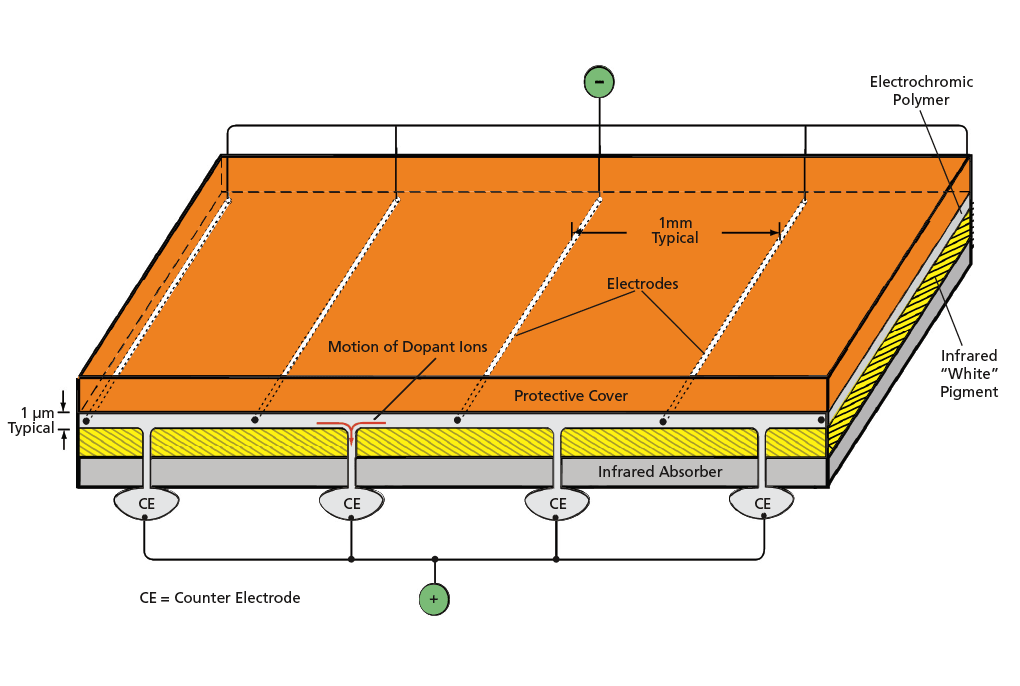
A basic conceptual electrochromic device of the type considered in this research is an electrochemical cell (see figure) that includes a electrochromic polymer, the back surface of which is coated with a pigment that is an infrared analog of common white visible pigments. The cell also includes electrodes for applying the bias potential to effect controlled doping or undoping. When the polymer is undoped, it transmits radiation that is reflected by the "white" pigment backing, resulting in low infrared emissivity. When the polymer is sufficiently doped, it strongly absorbs infrared (but not visible) light, resulting in high infrared emissivity.
Guided by the device concept described in the preceding paragraph, the research program included synthesis of suitable electrochromic polymers, fabrication of prototypes of infrared "white" pigments, and fabrication of electrochromic devices. The major accomplishments of this research program were the following:
- Fabrication and testing of a prototype infrared "white" pigment in the form of a photonic crystal comprising ordered layers of 3.9-μm-diameter silica microspheres;
- Fabrication of an electrochromic device that operated in the important atmospheric- transmission band of wavelength between 8 and 12 μm;
- Fabrication of an electrochromic cell that contained no metallic components;
- Demonstration of an infrared electrochromic cell that could be electrically adjusted to obtain an emissivity contrast of 80 percent; and
- Demonstration of electrochromic switching in a response time of 67 ms, which is comparable to a video frame time.
This work was done by Eli Yablonovitch, Fred Wudl, and Bruce Dunn of the University of California, Los Angeles; John R. Reynolds and David B. Tanner of the University of Florida; and Ray H. Baughman and Anvar A. Zakhidov of the University of Texas, Dallas for the U.S. Army Research Office.
ARL-0041
This Brief includes a Technical Support Package (TSP).
Electrochromic Devices for Controlling Infrared Emissivity
(reference ARL-0041) is currently available for download from the TSP library.
Don't have an account?
More From SAE Media Group
Photonics & Imaging Technology
Rice ‘Metalens’ Could Disrupt Vacuum UV Market
Aerospace & Defense Tech Briefs
3D Meta-Optics for High-Energy Lasers
Photonics & Imaging Technology
New Blue Light Technique Could Enable Advances in Understanding Nanoscale Technologies
Tech Briefs
Inkjet Printing of Metamaterials
Photonics & Imaging Technology
Sensitive Yet Tough Photonic Devices Are Now a Reality
Photonics & Imaging Technology
A Sharper Look at the Interior of Semiconductors
Photonics & Imaging Technology
Harnessing SWIR Line Scan Imaging Technology
Medical Design Briefs
Optical Design Considerations for Additive Manufacturing
Photonics & Imaging Technology
A First-Of-Its-Kind Integrated Optical Isolator
Photonics & Imaging Technology
New “Metalens” Shifts Focus Without Tilting or Moving
Photonics & Imaging Technology
A New Optical Metamaterial Makes True One-Way Glass Possible
Tech Briefs
Nanoimaging of Perovskite Solar Cell Materials



Sensor Technology
White Light Non-Contact Distance and Thickness Measurement
Photonics & Imaging Technology INSIDER
Quantum Dot Breakthrough Could Create Cheaper Infrared Sensors
Tech Briefs
A Near-Perfect Blackbody Calibration Target

Tech Briefs
Wavy Surfaces for Better Light Control
Tech Briefs
Twisted Moiré Photonic Crystals
Photonics & Imaging Technology
Essential Principles for Designing and Specifying Laser Optics
Photonics & Imaging Technology
How to Innovate and Overcome the Challenges of Blue Laser Beam Shaping
Photonics & Imaging Technology
OPO Lasers Put Optical Components to the Test
Photonics & Imaging Technology
T-Ray Camera Speed Boosted a Hundred Times Over
Overview
The "Electrochromic Adaptive Infrared Camouflage" report, authored by Eli Yablonovitch and covering the period from August 1999 to January 2005, presents significant advancements in the development of technology aimed at controlling infrared emissivity for camouflage applications. The research was conducted under the auspices of the U.S. Army Research Office and involved collaboration among several prominent universities, including the University of California, Los Angeles, and the University of Florida.
The primary objective of the research was to create surfaces that could artificially adjust their infrared emissivity, allowing objects, such as vehicles or personnel, to blend seamlessly into their surroundings and become less detectable by infrared cameras. This capability is particularly valuable in military contexts, where stealth and concealment are critical.
Key accomplishments highlighted in the report include the fabrication and testing of the first inverse opal infrared "white" pigment, which represents a novel approach to infrared camouflage. Additionally, the researchers developed the first electrochromic cell that operates within the crucial 8μm-12μm atmospheric transmission window, enhancing the effectiveness of the camouflage technology. They also achieved the creation of an all-polymer electrochromic cell that contains no metallic components, marking a significant step towards more versatile and lightweight camouflage solutions.
One of the standout achievements was the demonstration of 80% contrast in an infrared electrochromic cell, which can be electrically tuned to adapt to different environments. Furthermore, the research team successfully showcased electrochromic switching at a speed of 67 milliseconds, effectively achieving a video rate of response, which is essential for real-time adaptability in dynamic environments.
The report emphasizes the importance of electrochromics, a technology that allows materials to change color through electrochemical processes, thus enabling controlled reduction of infrared emissivity. This reduction is crucial since objects of interest, such as military assets, are typically warmer than their surroundings, and the ability to lower their infrared signature can enhance stealth capabilities.
Overall, the research outlined in this report represents a significant step toward practical applications of adaptive infrared camouflage, with the potential to revolutionize how military personnel and equipment can operate undetected in various environments. The findings contribute to the broader field of electrochromic materials and their applications in stealth technology.
Top Stories
NewsRF & Microwave Electronics
 Microvision Aquires Luminar, Plans Relationship Restoration, Multi-industry Push
INSIDERAerospace
 A Next Generation Helmet System for Navy Pilots
INSIDERDesign
 New Raytheon and Lockheed Martin Agreements Expand Missile Defense Production
INSIDERMaterials
 How Airbus is Using w-DED to 3D Print Larger Titanium Airplane Parts
NewsPower
 Ford Announces 48-Volt Architecture for Future Electric Truck
ArticlesAR/AI

Webcasts
Electronics & Computers
 Cooling a New Generation of Aerospace and Defense Embedded...
Automotive
 Battery Abuse Testing: Pushing to Failure
Power
 A FREE Two-Day Event Dedicated to Connected Mobility
Unmanned Systems
 Quiet, Please: NVH Improvement Opportunities in the Early Design Cycle
Automotive
 Advantages of Smart Power Distribution Unit Design for Automotive &...
Energy
 Sesame Solar's Nanogrid Tech Promises Major Gains in Drone Endurance