




SHIP Prototype Computer Chip
BAE Systems, Inc.
Arlington, VA
571-488-0456
www.baesystems.com
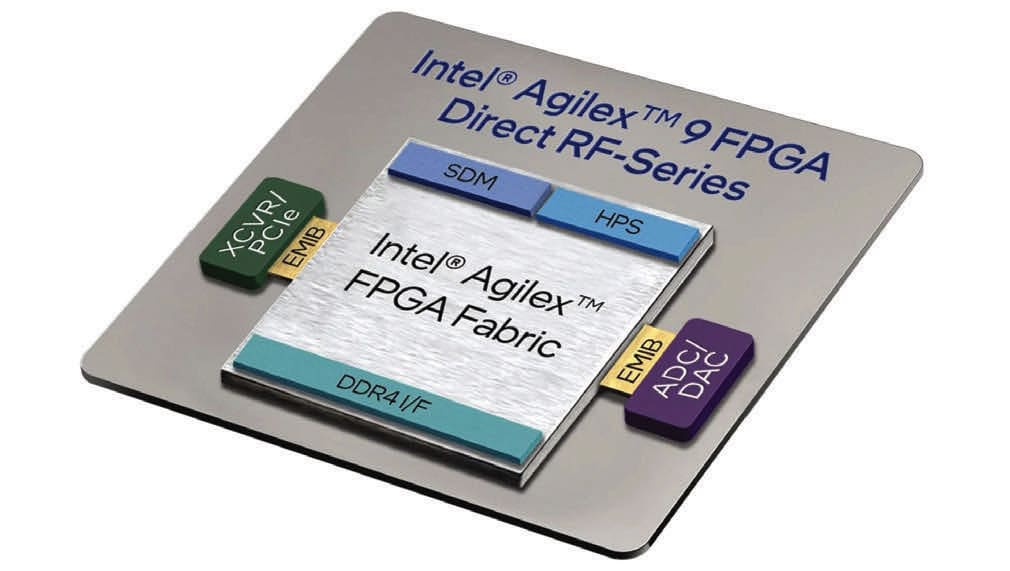
The U.S. Department of Defense (DoD) has celebrated a milestone achievement for the State-of-the-Art Heterogeneous Integrated Packaging (SHIP) program under the Office of the Under Secretary of Defense for Research and Engineering (OUSD(R&E)) with the delivery of the first SHIP prototype devices from Intel and Qorvo to BAE Systems.
The SHIP program was established to develop pathways for sustained DoD access to state-of-the-art (SOTA) microelectronics packaging capabilities by leveraging commercial industry production flow to meet the DoD’s requirement for highly customized parts. Utilizing the Strategic and Spectrum Missions Advanced Resilient Trusted Systems (S²MARTS) Other Transaction Agreement (OTA), the SHIP program has partnered with Intel and Qorvo to develop prototype devices that will be transitioned to DoD systems through the defense industrial base (DIB) to demonstrate enhanced capabilities and size, weight, and power (SWaP) savings beneficial to the warfighter.
The first two of these prototypes—Intel’s Multi-Chip Package (MCP-1) for SHIP Digital and Qorvo’s Multi-Chip Module (MCM-1) for SHIP RF — were delivered to the lead DIB demonstrator, BAE Systems, during a ceremonial gathering held by Heidi Shyu, Under Secretary of Defense for Research and Engineering (USD(R&E)) and the S2MARTS OTA Manager, National Security Technology Accelerator (NSTXL), at BAE Systems’ facility in Falls Church, Virginia.
Additional prototype devices are in development under the SHIP program. Under SHIP Digital, both MCP-1 and MCP-2 contain SOTA chiplets with advanced functionality, low power, smaller size, and cutting-edge performance along with Intel’s Agilex advanced field programmable gate array (FPGA) technology. As the next phase of the SHIP Digital effort, the DoD has initiated the Strategic Transition of Microelectronics to Accelerate Modernization by Prototyping and Innovating in the Packaging Ecosystem (STEAM PIPE) project to solidify pathways to transition of both devices to DoD systems.
Visit Here
More From SAE Media Group
Defense INSIDER
Defense Leaders Receive First Intel SHIP Multi-Chip Prototype


Aerospace Manufacturing and Machining INSIDER
Domestic Supply of Radiation Hardened by Design Microelectronics Technology to Expand
Aerospace & Defense Tech Briefs
New Products
Off-Highway Engineering
Shifting Design of Autonomous Architectures
Tech Briefs
Tiny Device Speeds up Memory While Saving Power
Aerospace & Defense Tech Briefs
Helicopter Cabin Computer
Tech Briefs
Four-Channel PC/104 MIL-STD-1553 Circuit Board
Tech Briefs
Essential Control and Visualization, Combined
Embedded Technology
Beamforming System Eases Crowded Wireless Spectrum
Automotive Engineering
Spelling Ford with an ‘E’

Aerospace & Defense Tech Briefs
Real-Time Simulation and Semiautomated Design of Complex ICs
Aerospace & Defense Tech Briefs
Deterministic and Modular Architecture for Embedded Vehicle Systems
Electronics & Sensors INSIDER
Opening Up the Potential of Thin-Film Electronics for Flexible Chip Design
Autonomous Vehicle Engineering
Daimler-Xilinx Linkup Spotlights Growing Use of FPGAs
Automotive Engineering
Real-Time Processors Key to the Zonal E/E Revolution
Aerospace & Defense Tech Briefs
FPGAs and HPC
Tech Briefs
Hardware-Command-Decoding ASIC
Tech Briefs
Radiation-Tolerant Dual Data Bus

Photonics & Imaging Technology
Rethinking FPGAs for Smart Cameras
Embedded Technology
Graphics Performance vs. Power Consumption in Embedded Systems Design
Embedded Computing INSIDER
Chaos-Based Microchips Offer Possible Solution to Moore’s Law
Aerospace & Defense Tech Briefs
New Products
Aerospace & Defense Tech Briefs
Radiation-Tolerant FPGAs Solve Spacecraft Design Challenges

Top Stories
INSIDERManned Systems
 How Airbus is Using w-DED to 3D Print Larger Titanium Airplane Parts
INSIDERAerospace
 FAA to Replace Aging Network of Ground-Based Radars
NewsUnmanned Systems
 Microvision Aquires Luminar, Plans Relationship Restoration, Multi-industry Push
NewsDesign
 CES 2026: Bosch is Ready to Bring AI to Your (Likely ICE-powered) Vehicle
NewsSoftware
 Accelerating Down the Road to Autonomy
INSIDERManned Systems
 Can This Self-Healing Composite Make Airplane and Spacecraft Components Last...
Webcasts
Power
 Hydrogen Engines Are Heating Up for Heavy Duty
Transportation
 Advantages of Smart Power Distribution Unit Design for Automotive...
Automotive
 Quiet, Please: NVH Improvement Opportunities in the Early Design...
Power
 A FREE Two-Day Event Dedicated to Connected Mobility
Connectivity
 E/E Architecture Redefined: Building Smarter, Safer, and Scalable Vehicles
Manufacturing & Prototyping
 How Sift's Unified Observability Platform Accelerates Drone Innovation