




Intelligent Machine Control the Focus for Doosan, Komatsu Equipment

Two construction-equipment manufacturers target increased productivity with their products by recently enhancing their machine-control features. Doosan Infracore North America now will offer the Trimble Earthworks Grade Control Platform for Excavators as an optional factory-installed grade-control solution for the North American market. Trimble Earthworks is designed to make grading faster and more accurate in a range of applications, including residential and commercial sites, trenches, embankments, ditches and finished slope work.
“Doosan crawler excavator customers can enhance their trenching accuracy with the increased technology, contributing to an improved ROI. And our dealers can now offer this directly from the factory to our customers,” said Jaeuk Kim, Doosan director of product management.
Doosan will offer integrated 2D grade control with automatics that includes a 10-inch Android tablet display running the Earthworks software application. It also includes Trimble hardware designed for harsh conditions. When the excavator is placed in Automatics mode, the operator controls the stick and Trimble Earthworks controls the boom and bucket to stay on grade, reducing overcut and increasing production.
Contractors can work with a Doosan dealer to upgrade their 2D system to 3D through a SITECH dealer. SITECH is Trimble’s global distribution network that provides installation services, training and technical support.
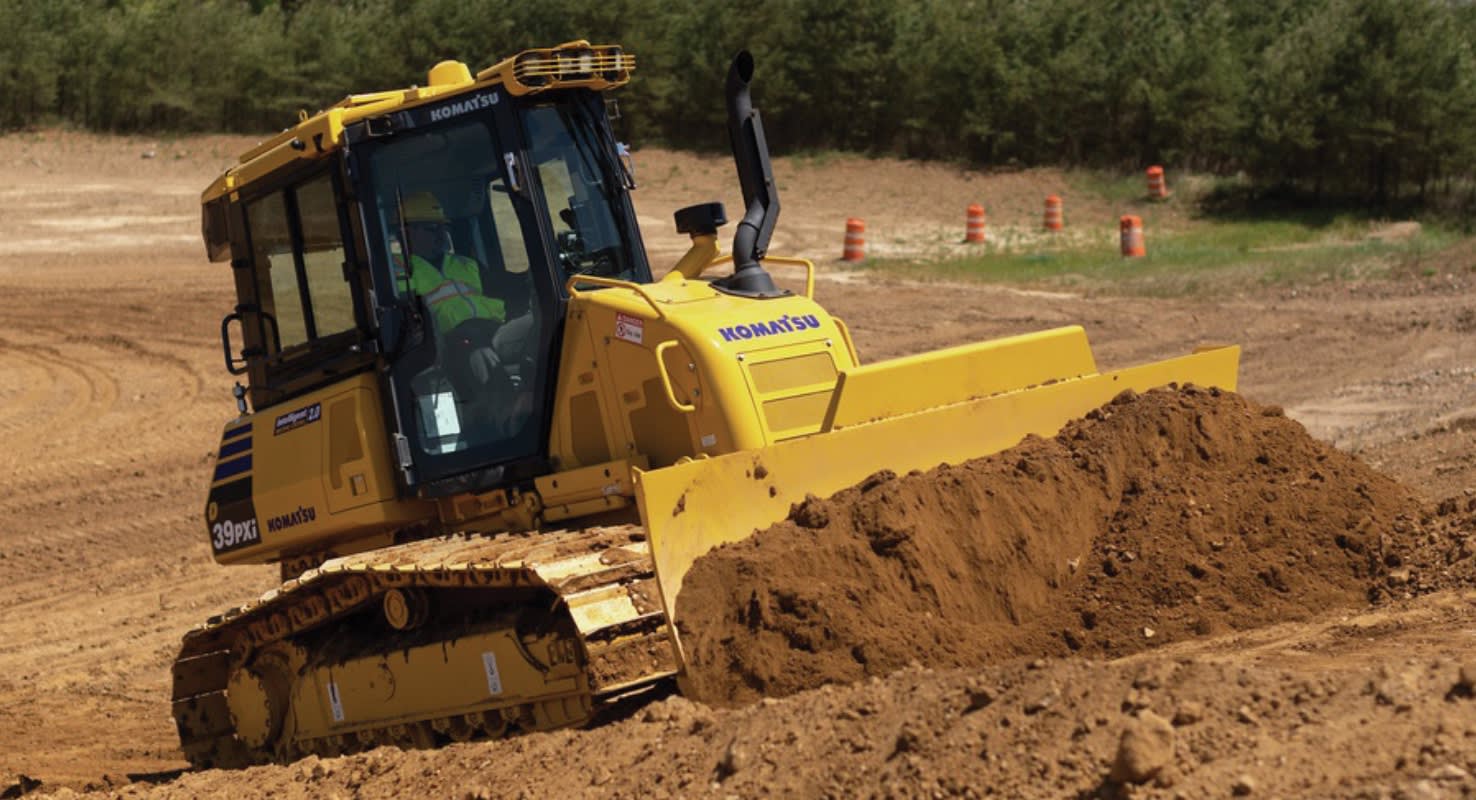
Enhanced automation also is the highlight of Komatsu’s “smallest intelligent dozer,” the D39i-24. With intelligent Machine Control (iMC 2.0), 3D design data can be programmed directly into the 105-hp (78-kW) machine. The factory-installed automatic dozing improves operators’ productivity from rough cut to finish grade.
The integrated system upgrades the D39i-24 with new intelligent features. With proactive dozing control, the dozer measures the terrain it tracks over and uses that data to plan the next pass so even less-experienced operators can automatically cut/strip from existing terrain. Productivity can improve by up to 60% compared to the previous generation, according to Komatsu.
The system spreads fill material automatically. With the press of a button, lift layer control puts in repeated consistent lifts. Time savings are realized, Komatsu said, by reducing or eliminating the need to rework for over-compaction or under-compaction. Operators also can create a temporary design surface at the press of a button with quick surface creation. Combined with other iMC 2.0 functions, crews can begin stripping or spreading using automated input while waiting for the finish grade model.
Reduced operator fatigue is another stated benefit. Tilt steering control automatically tilts the blade to maintain straight travel during rough dozing, reducing operator steering input by up to 80%.
More From SAE Media Group
Off-Highway Engineering
Komatsu Augments Intelligent Machine Control in New Excavator
Off-Highway Engineering
Off-highway Innovators to Demo Digital Prowess at CES 2026
Tech Briefs
Executive Forum: Sensors & the IoT
Autonomous Vehicle Engineering
Wired for Autonomy

Off-Highway Engineering
Monarch Unveils AI-Powered Autonomous Platform




Tech Briefs
Rising Star Awards 2025 Judges
Off-Highway Engineering
Komatsu America Expands Intelligent Machine Control Dozer Family
Off-Highway Engineering
Yanmar CE Adds to Growing Compact Track Loader Segment

Autonomous Vehicle Engineering
LiDAR Giant
Automotive Engineering
Volvo’s Rapid Strategy Aims at 20-Month Vehicle Development
Sensor Technology
Driverless Forklifts
Tech Briefs
Disrupting the Automobile Design Process
Tech Briefs
SAE WCX™ Digital Summit Preview
Off-Highway Engineering
Digital Transformation of the Construction Jobsite

Autonomous Vehicle Engineering
Lockered and Loaded
Motion Design
Multi-Axis Motion Controller Accelerates Gear Testing
Automotive Engineering
CES 2026: Qualcomm Expands Partnerships For More Snapdragons
Tech Briefs
2025 Rising Star Awards Winners

Automotive Engineering
Taiwan Suppliers Look Around the World for Solutions
Automotive Engineering
Manufacturers Must Take the Wheel to Scale SDV Success
Off-Highway Engineering
Autonomous Quarry Haulage in High Demand
Top Stories
INSIDERManufacturing & Prototyping
 How Airbus is Using w-DED to 3D Print Larger Titanium Airplane Parts
INSIDERManned Systems
 FAA to Replace Aging Network of Ground-Based Radars
NewsTransportation
 CES 2026: Bosch is Ready to Bring AI to Your (Likely ICE-powered) Vehicle
NewsSoftware
 Accelerating Down the Road to Autonomy
EditorialDesign
 DarkSky One Wants to Make the World a Darker Place
INSIDERMaterials
 Can This Self-Healing Composite Make Airplane and Spacecraft Components Last...
Webcasts
Defense
 How Sift's Unified Observability Platform Accelerates Drone Innovation
Automotive
 E/E Architecture Redefined: Building Smarter, Safer, and Scalable...
Power
 Hydrogen Engines Are Heating Up for Heavy Duty
Electronics & Computers
 Advantages of Smart Power Distribution Unit Design for Automotive...
Unmanned Systems
 Quiet, Please: NVH Improvement Opportunities in the Early Design...
