




AlxInyGa1-x-yN Ultraviolet Light-Emitting Triodes
Efficiency droop, heretofore observed in ultraviolet lightemitting diodes, can be overcome.
Light-emitting triodes (LETs) have been the focus of a program of research with a goal of increasing the quantum efficiencies of ultraviolet-lightemitting devices implemented in the AlxInyGa1-x-yN (0 ≤ x+y ≤ 1) material system. Heretofore, AlxInyGa1-x-yN-based light-emitting diodes (LEDs) have exhibited "efficiency droop" — decreasing quantum efficiency with increasing injection current. LETs can be used as means of studying and overcoming efficiency droop.
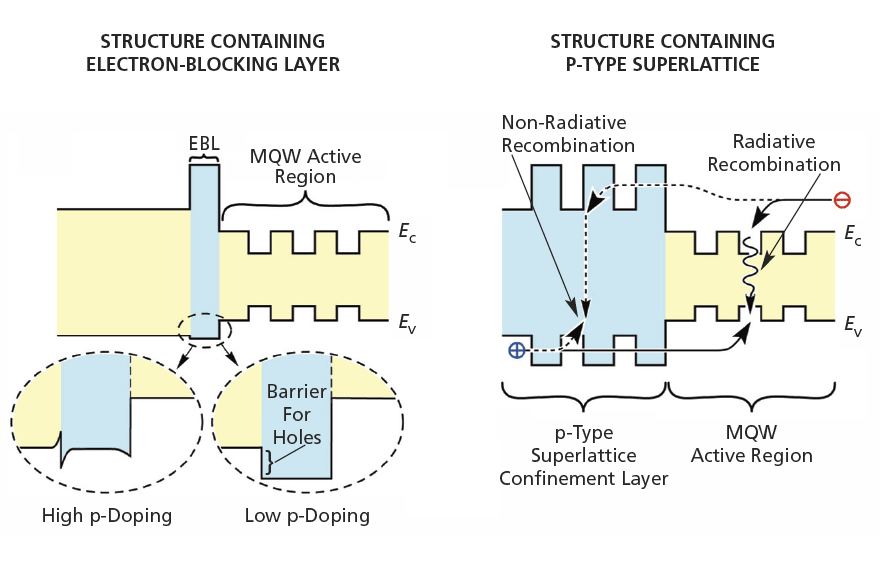
In the other alternative structure, instead of an EBL, there is a p-type (Mg-doped) AlxGa1-xN/GaN superlattice. In such a superlattice, the transport of charge carriers is enhanced in lateral directions [directions in the superlattice planes (directions in planes perpendicular to the page)]. However, transport of charge carriers through the p-n junction (along the right/left direction in the page), is less efficient than along the lateral directions because most of the holes ionized from the acceptors are localized inside the quantum wells, which are clad by potential barriers as high as 0.1 to 0.4 V. Like the potential barrier in the EBL in the structure described above, the potential barriers in this structure hinder the desired injection of holes into the active region. Efficient injection of holes into the active region of an LED is necessary for high radiative efficiency. In inefficient injection of holes into the active region, internal quantum efficiency is reduced because electrons diffuse through the active region into the p-type confinement layer, wherein non-radiative electron/ hole recombination is likely.
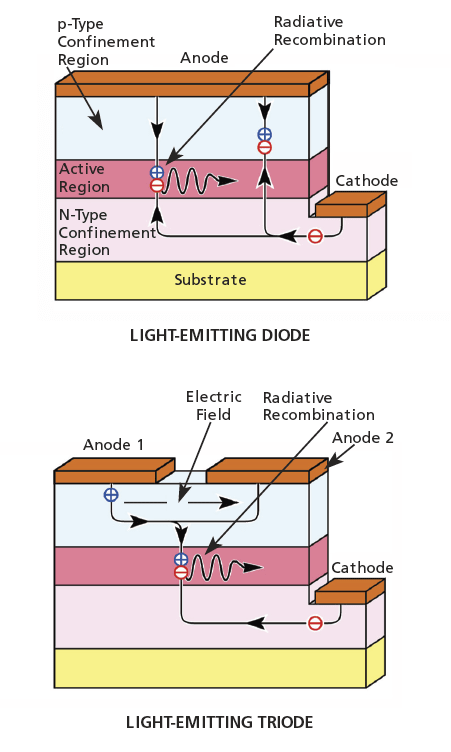
It has been proposed to use an LET to investigate the relationship between the hole injection efficiency and the efficiency droop: Computational simulations have led to the tentative conclusion that in a case of low efficiency of injection of holes into the active MQW region, the overflow of electrons into the p-type cladding layer is the mechanism responsible for the efficiency droop. Therefore, the LET, in which the hole injection efficiency can be controlled by controlling the bias potential on a second anode, is expected to be a means of confirming the above-mentioned tentative conclusion concerning the cause of the efficiency droop.
This work was done by E. Fred Schubert and Jong Kyu Kim of Rensselaer Polytechnic Institute, for the Army Research Laboratory.
This Brief includes a Technical Support Package (TSP).
AlxInyGa1-x-yN Ultraviolet Light-Emitting Triodes
(reference ARL-0025) is currently available for download from the TSP library.
Don't have an account?
More From SAE Media Group

Tech Briefs
Light-Emitting Tattoo
Tech Briefs
Molecular Highway for Electrons in OLEDs
Tech Briefs
Turning Diamond into Metal
Photonics Tech Briefs
Semiconductor Quantum Dots as Radiation-Hard Light Emitters
Tech Briefs
Stable Polymeric Ink with High Conductivity

Aerospace & Defense Tech Briefs
Magnetic Memory Devices for Embedded Computing
Tech Briefs
Organic Material for Printed Electronics


Tech Briefs
Products of Tomorrow

Tech Briefs
Organic Carbon-Nitride Semiconductor
Tech Briefs
Enhanced Material Stable Enough for Solar Cells
Tech Briefs
A Thin, Flexible OLED Display
Tech Briefs
Material Increases Efficiency of LED Devices



Photonics Tech Briefs
Inter-Valence-Subband/Conduction-Band-Transport IR Detectors
Electronics & Sensors INSIDER
Scientists Create Superconducting Semiconductor Material
Electronics & Sensors INSIDER
Laser Diode Emits Deep UV Light

Aerospace & Defense Tech Briefs
Miniature Semiconductor Diodes as Pumps and Motors

Overview
This document presents research on GaN-based light-emitting diodes (LEDs), particularly focusing on a novel device called the light-emitting triode (LET). The study addresses the critical challenge of efficiency droop in III-V nitride pn-junction devices, which is characterized by a decrease in efficiency with increasing injection current. This phenomenon is particularly problematic for deep UV LEDs, which have low internal quantum efficiency.
The research highlights the role of carrier loss over the electron-blocking layer (EBL) as a significant factor contributing to efficiency droop. Through current transport simulations using the Crosslight APSYS program, the authors confirm that electron overflow into the p-type GaN cladding layer occurs due to low hole-injection efficiency into the multi-quantum well (MQW) active region. This loss of carriers is identified as a viable hypothesis for the physical origin of the efficiency droop.
The LET is designed to enhance hole injection efficiency by utilizing a lateral electric field created between two anodes. This field provides additional energy to carriers, allowing them to overcome potential barriers and improving their injection into the active region. The study demonstrates that applying a negative bias to the second anode increases both the current and light output power, confirming the effectiveness of this approach.
Theoretical calculations indicate that the lateral electric field can significantly raise the temperature of holes, enabling them to surmount barriers posed by superlattices or the EBL. The findings suggest that the LET can serve as an effective tool for investigating the relationship between hole-injection efficiency and efficiency droop, thereby contributing to the understanding and resolution of this major issue in LED technology.
In conclusion, the research provides valuable insights into the mechanisms behind efficiency droop in GaN-based LEDs and proposes the LET as a promising solution for enhancing hole injection efficiency. This advancement is expected to facilitate the development of more efficient UV emitters, which are crucial for applications in chemical and biological detection, sterilization, and phosphor-based white LEDs. The document emphasizes the importance of addressing efficiency challenges to advance III-V emitter technology.
Top Stories
INSIDERManufacturing & Prototyping
 How Airbus is Using w-DED to 3D Print Larger Titanium Airplane Parts
INSIDERManned Systems
 FAA to Replace Aging Network of Ground-Based Radars
NewsTransportation
 CES 2026: Bosch is Ready to Bring AI to Your (Likely ICE-powered) Vehicle
NewsSoftware
 Accelerating Down the Road to Autonomy
EditorialDesign
 DarkSky One Wants to Make the World a Darker Place
INSIDERMaterials
 Can This Self-Healing Composite Make Airplane and Spacecraft Components Last...
Webcasts
Defense
 How Sift's Unified Observability Platform Accelerates Drone Innovation
Automotive
 E/E Architecture Redefined: Building Smarter, Safer, and Scalable...
Power
 Hydrogen Engines Are Heating Up for Heavy Duty
Electronics & Computers
 Advantages of Smart Power Distribution Unit Design for Automotive...
Unmanned Systems
 Quiet, Please: NVH Improvement Opportunities in the Early Design...
