




Piezoelectric Actuator Amplifies Small Motions
Engineers at Dynamic Structures and Materials, LLC (DSM, Franklin, TN) have used funding from a Missile Defense Agency (MDA) Small Business Innovation Research (SBIR) Phase II grant to squeeze an actuator system — a piezoelectric actuator, sensors, and associated electronics — into a small package that provides improved control for missile actuation systems in comparison to baseline electromagnetic actuators. The novel piezoelectric actuator system's features include the use of low-voltage piezo material that can operate in more extreme temperatures than electromagnetic systems.
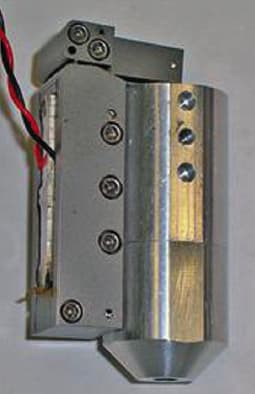
If incorporated into missile valve systems, DSM's technology would be used to control the flow of hot gases in miniature kill vehicles. This type of actuator system could also improve the performance of cold-flow propulsion systems like those used in an astronaut's manned maneuvering unit (MMU) for extra-vehicular activities (EVAs) or spacewalks.
How it Works
A piezoelectric material changes shape when an electrical field is applied. The resulting electric charge in the piezo element causes it to extend in subnanometer increments at a minimum and by approximately 70 to 80 microns at a maximum in DSM's valve actuator.
Stacking piezo elements adds incrementally to the displacement range, but to achieve significantly more displacement, the team designed a multihinged (flexured) metal composite housing — an "exoskeleton" — to bind the piezo elements together and mechanically amplify the piezo element's output. DSM has produced a range of valve actuators with mechanical amplification ratios of 5 to 100 times, producing strokes from 100 microns to 10 millimeters. In the MDA valve application, the stroke is proportionally controlled to a fine degree over the range of 0 to 1.5 mm, which is the amount necessary for proportional control of many miniature missile valve applications.
Because of the choice of piezo material, the actuator system requires only 60 to 200 volts, which is generated onboard DSM's drive electronics from the missile platform's 28-volt battery source. In contrast, typical singlecrystal piezo materials, which are considered to be "super" types of ceramics, generally require a substantially higher operational voltage. In addition, the lower voltage range used in DSM's actuator systems enables the use of a much broader selection of associated drive electronic components for miniaturization objectives.
Electromechanical actuators have drawbacks such as backlash and overshoot, which can lead to slower move and settle times. Traditional electromechanical systems require up to 10 to 20 milliseconds to move and settle into position, while the DSM piezo systems require less than 5 milliseconds. Electromechanical systems also use a significant amount of power during hold maneuvers to maintain an electric field and, thereby, to hold position. The capacitive nature of the piezoelectric load means that the actuators do not use any power to hold position.
Its composition and features ensure that the actuator can withstand extremely low or high temperatures. For example, although a standard piezo material starts to lose its piezoelectric properties above 100°C, the material and electrical connections used in DSM's design help it to operate reliably at up to 250°C.
Where it Stands
The most difficult part of building the technology was reducing the size of the system — the actuator, drive electronics, and sensor packaging size — to offer higher power density (power per unit mass) relative to electromagnetic systems. Simultaneously, DSM's efforts have focused on increasing the technology's Technology Readiness Level (TRL) for future insertion into MDA platforms. DSM is continuing to pursue its miniaturization process on several fronts, including material selection and system stiffness/ control analysis.
The company, which is focusing largely on the piezo system's military and space-related applications, has also obtained additional funding from commercial sources to continue developing these technologies for related applications.
More Information
Click here for more information on Dynamic Structures and Materials, LLC . (Source: MDA TechUpdate, Missile Defense Agency, National Technology Transfer Center Washington Operations.)
Top Stories
INSIDERManufacturing & Prototyping
 How Airbus is Using w-DED to 3D Print Larger Titanium Airplane Parts
INSIDERManned Systems
 FAA to Replace Aging Network of Ground-Based Radars
NewsTransportation
 CES 2026: Bosch is Ready to Bring AI to Your (Likely ICE-powered) Vehicle
NewsSoftware
 Accelerating Down the Road to Autonomy
EditorialDesign
 DarkSky One Wants to Make the World a Darker Place
INSIDERMaterials
 Can This Self-Healing Composite Make Airplane and Spacecraft Components Last...
Webcasts
Defense
 How Sift's Unified Observability Platform Accelerates Drone Innovation
Automotive
 E/E Architecture Redefined: Building Smarter, Safer, and Scalable...
Power
 Hydrogen Engines Are Heating Up for Heavy Duty
Electronics & Computers
 Advantages of Smart Power Distribution Unit Design for Automotive...
Unmanned Systems
 Quiet, Please: NVH Improvement Opportunities in the Early Design...
