




Nanowire-Based Chemical and Biological Sensor Arrays
Capabilities for detection of biological and chemical threats are undergoing development.
Acontinuing effort that supplements and complements the one summarized in the immediately preceding article is dedicated to the development of nanowire-based sensor arrays, with emphasis on maximizing the utility of such arrays for real-time sensing of molecular species associated with chemical and biological threats. Like the sensors described in the immediately preceding article, most of these sensors are based on chemically functionalized semiconductor nanowires that are parts of fieldeffect transistors. In addition, some of these sensors are based on piezoelectric nanowire resonators.
This effort is oriented toward aggressively exploiting the unique electronic properties of nanowire-based electronic devices and the potential for integration of these devices with each other and with electronic readout circuitry to obtain the desired sensor-array functionalities. The effort has thus far yielded, and continues to yield, arrays of sensor devices that enable highly robust, ultrasensitive detection and identification of chemical species of interest while also effecting large reductions in the incidence of false positive sensor readings. The following is a summary of results achieved thus far in this effort:
- Detection of Biomolecules in Aqueous Solutions at Low Concentrations. Reversible detection of proteins and of single viruses in aqueous solution at concentrations somewhat less than 10-12 M has been demonstrated. Concentration-dependent detection has been demonstrated over a range characterized by a ratio of somewhat more than 104 between the extremes of high and low concentration. It was also demonstrated to be possible to detect a compound of interest with high selectivity and sensitivity, even when it is part of a complex mixture in which the other constituents are present at much greater concentrations.
- Detection of Chemical Threats at Low Concentrations. It has been demonstrated that chemical threats (more specifically, several explosive compounds) can be detected in a solution with high selectivity at concentrations somewhat below 100 parts per billion. Concentration-dependent detection of these compounds has been demonstrated over a range characterized by a ratio of somewhat more than 103 between the extremes of high and low concentration.
- Multiplexing. Multiplexed detection from 10 or more nanowire sensor devices for simultaneous detection of multiple proteins and toxins has been demonstrated. Multiplexed detection from two nanowire sensor devices for simultaneous detection of two viruses has also been demonstrated. Methods of processing utilizing complementary components of electrical responses of multiplexed pand n-type-nanowire sensors to discriminate against false positive readings caused by electrical noise and nonspecific binding have been demonstrated.
- Analysis of Sensor Readings. Methods of computational analysis of raw sensor output signals to extract the maximum useful information have been developed and demonstrated to be, as intended, robust to all expected sources of electrical noise (e.g., faulty nanowires) and to chemical contamination.
This work was done by Charles M. Lieber of Harvard University for the Air Force Research Laboratory. For more information, download the Technical Support Package (free white paper) at www.defensetechbriefs.com/tsp under the Electronics/Computers category. AFRL-0025
This Brief includes a Technical Support Package (TSP).
Nanowire-Based Chemical and Biological Sensor Arrays
(reference AFRL-0025) is currently available for download from the TSP library.
Don't have an account?
More From SAE Media Group
Aerospace & Defense Tech Briefs
Dense Functionalized-Nanowire Biosensor Arrays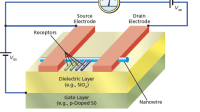


Tech Briefs
Bioelectronic Devices Enable Real-Time Sensing

Tech Briefs
A Two-in-One Storage and Computing Device
Embedded Technology INSIDER
Newly Discovered Property Could Help Keep Computer Chips Cool


Tech Briefs
Enhanced Material Stable Enough for Solar Cells
Tech Briefs
Products of Tomorrow
Tech Briefs
Health Monitoring with Skin-Like Electronics

Tech Briefs
Smart Molecules Act as Computer Transistors

Tech Briefs
5Ws of the Silk Transistor
Tech Briefs
Nanotransistors Stay Cool at High Voltages
Aerospace & Defense Tech Briefs
Future Advances in Electronic Materials and Processes - Flexible Hybrid Electronics
Tech Briefs
Biofilm Harvests Energy in Evaporation
Embedded Technology INSIDER
Could Black Phosphorus be the Next Silicon?
Electronics & Sensors INSIDER
Careful Heating Unlocks Unprecedented Sensitivity to Pressure in Semiconductor Materials

Tech Briefs
Synapse-Like Phototransistor
Tech Briefs
Graphene “Nano-Origami” Creates Tiny Microchips
Overview
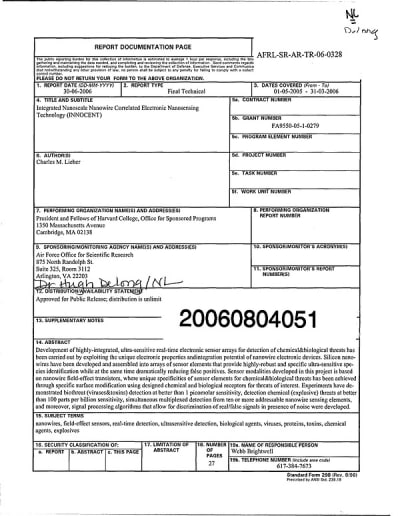
The document is a Final Technical Report for the Integrated Nanoscale Nanowire Correlated Electronic Nanosensing Technology (INNOCENT) project, covering the period from May 1, 2005, to March 31, 2006. Authored by Charles M. Lieber from Harvard University, the report outlines significant advancements in the development of ultra-sensitive electronic sensors designed for real-time detection of chemical and biological threats.
The Executive Summary emphasizes the challenges faced in creating highly-integrated nanosensing devices and the breakthroughs achieved in nanowire growth, surface functionalization, and device properties. These advancements have enabled the assembly of defect-tolerant sensor arrays that meet and exceed program goals. The report highlights the development of various sensor modalities, including nanowire field-effect transistors and piezoelectric nanowire resonators, which have demonstrated exceptional sensitivity and specificity in detecting a wide range of substances.
Key scientific results include the ability to detect biomolecules at concentrations lower than 1x10^-12 M, reversible detection of proteins and viruses, and high-selectivity in complex mixtures. The sensors have shown the capability to detect chemical threats at concentrations of 100 parts per billion (ppb) or better, with methods developed for false positive discrimination and robust data analysis. The report indicates that the ongoing MoleSensing effort promises to lead to revolutionary advances in integrated electronic chem/bio sensor arrays, with applications in national security and battlefield defense.
The document also includes a section on presentations stemming from the research effort, detailing invited talks given by Lieber at various prestigious institutions, where he discussed the implications of nanoscience and nanotechnology in electronics and biology.
Overall, the report underscores the potential of nanowire technology in enhancing the sensitivity and specificity of electronic sensors, paving the way for significant advancements in the detection of chemical and biological threats. The findings and methodologies presented in this report contribute to the broader field of nanotechnology and its applications in security and safety, showcasing the innovative approaches being developed at the intersection of biology, chemistry, and engineering.
Top Stories
NewsRF & Microwave Electronics
 Microvision Aquires Luminar, Plans Relationship Restoration, Multi-industry Push
INSIDERAerospace
 A Next Generation Helmet System for Navy Pilots
INSIDERDesign
 New Raytheon and Lockheed Martin Agreements Expand Missile Defense Production
INSIDERMaterials
 How Airbus is Using w-DED to 3D Print Larger Titanium Airplane Parts
NewsPower
 Ford Announces 48-Volt Architecture for Future Electric Truck
ArticlesAR/AI

Webcasts
Aerospace
 Cooling a New Generation of Aerospace and Defense Embedded...
Automotive
 Battery Abuse Testing: Pushing to Failure
Transportation
 A FREE Two-Day Event Dedicated to Connected Mobility
Unmanned Systems
 Quiet, Please: NVH Improvement Opportunities in the Early Design Cycle
Transportation
 Advantages of Smart Power Distribution Unit Design for Automotive &...
Energy
 Sesame Solar's Nanogrid Tech Promises Major Gains in Drone Endurance