




Compensating for Parasitic Effects in Low-Pass Filters
Parasitic inductances are effectively transferred; parasitic capacitances are effectively neutralized.
Techniques to compensate for the effects of parasitic inductances and capacitances have been developed as part of an effort to improve the performances of low-pass filters in electronic power circuits. As used here, "parasitic" refers to departure from an ideal inductive or capacitive characteristic. No inductor, capacitor, or other electronic component is ideal: wherever a current loop exists, there is inductance, and wherever two conductors are near each other, there is a capacitance between them. Parasitic capacitances in inductors and parasitic inductances in capacitors degrade the performances of low-pass filters, especially at high frequencies.

The compensation techniques, denoted inductance cancellation and capacitance cancellation, are useful for improving the high-frequency performance of a filter capacitor or a filter inductor, respectively. The details of implementation of these techniques are complex and highly susceptible to application- specific variation. Notwithstanding this complexity, the underlying principles can be stated simply:
- Inductance Cancellation — The effect of parasitic inductance in a capacitor can be shifted from a circuit branch where it is undesirable to other circuit branches where it is desirable or at least acceptable. In inductance cancellation, this shift is accomplished by use of magnetically coupled windings. From the perspective of traditional lumped-element circuit analysis, the net effect is to place a negative inductance in series with the parasitic inductance while placing larger positive inductances in the other circuit branches. Although the total inductance is increased, the effective decrease in the parasitic inductance improves the high-frequency performance of the affected capacitor.
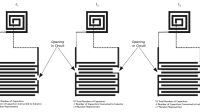
- Capacitance Cancellation — The undesirable effect of parasitic capacitance in a filter inductor is to couple highfrequency current from a noisy input port to an output port that is desired to be quiet. In capacitance cancellation, one introduces additional passive components to inject a high-frequency current approximately equal in magnitude and opposite in sign to the current flowing through the parasitic capacitance so that the net high-frequency current arriving at the output port is greatly reduced. In the example illustrated in the figure, capacitance cancellation of a toroidal filter inductor is effected by adding a compensating winding in series with a compensating capacitor. To a first approximation, cancellation could be achieved by choosing m(1-m)Ccomp = Cp, where m is the ratio between the number of turns in the compensating winding and the main winding, Ccomp is the compensating capacitance, and Cp is the parasitic capacitance of the main winding.
This work was done by Timothy C. Neugebauer, Brandon J. Pierquet, and David J. Perreault of Massachusetts Institute of Technology for the Naval Research Laboratory. For further information, download the free white paper at www.defensetechbriefs.com under the Electronics/Computers category. NRL-0003
This Brief includes a Technical Support Package (TSP).
Compensating for Parasitic Effects in Low-Pass Filters
(reference NRL-0003) is currently available for download from the TSP library.
Don't have an account?
More From SAE Media Group

Aerospace & Defense Tech Briefs
Improved Magnetic Sensor Based on Giant Magneto-Impedance


Tech Briefs
Improved Q-Switch Drivers
Electronics Tech Briefs
Microelectromechanical SPDT Switches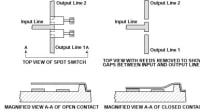
Tech Briefs
Inrush-Current-Control Circuit
Tech Briefs
Torque Sensor Based on Tunnel-Diode Oscillator
Embedded Technology
Sensor Interface Design Demystified
Battery Technology
Charge Control Methods for Supercapacitors
Aerospace & Defense Tech Briefs
How High-Reliability Capacitors Support Electrical Power in Military Vehicles

Aerospace & Defense Tech Briefs
DC Power Converter for 200°C Containing SiC Transistors
Tech Briefs
164-GHz MMIC HEMT Frequency Doubler
Tech Briefs
Capacitor-Chain Successive-Approximation ADC

Tech Briefs
Bounceless Switch/Monostable Multivibrator
Tech Briefs
Vibration-Powered Lowpass Filter


Sensor Technology
Near-Zero-Power Temperature Sensor

Aerospace & Defense Tech Briefs
Life Tests of a Microwave MEMS Capacitive Switch
Tech Briefs
X-Band, 17-Watt Solid-State Power Amplifier

Tech Briefs
Power-Amplifier Module for 145 to 165 GHz

Overview
The document is a final report prepared for the Office of Naval Research (ONR) under Grant N00014-02-1-0481, focusing on advanced filters and components for power applications. Authored by Timothy C. Neugebauer, Brandon J. Pierquet, and David J. Perreault from the Massachusetts Institute of Technology, the report was completed on August 31, 2006.
The primary objective of the research is to enhance the performance of power filters, which are critical components in electronic systems. The report emphasizes the importance of addressing the high-frequency behavior of filters, which is often limited by parasitic components inherent in passive elements. These parasitic elements arise from the physical design and layout of the filters and cannot be entirely eliminated through improved component design alone.
A significant focus of the report is on the design of integrated LC filter elements that utilize inductance cancellation techniques. The authors demonstrate that by implementing a conventional capacitor alongside an air-core inductance cancellation transformer on a printed circuit board, it is possible to achieve better filter performance. This approach allows for the reduction of parasitic effects, leading to improved efficiency and functionality of the filters.
The report includes detailed performance results of the prototype integrated filter element, comparing it to traditional capacitors. The findings indicate that the integrated filter element exhibits superior performance characteristics, particularly in terms of frequency response and overall efficiency.
In the summary and conclusions section, the authors highlight the effectiveness of parasitic cancellation or compensation techniques in mitigating the adverse effects of parasitic components on filter performance. They assert that these techniques can significantly enhance the design and application of power filters, making them more suitable for high-frequency operations.
Overall, the report provides valuable insights into the design and implementation of advanced filtering technologies, showcasing innovative methods to improve the performance of power applications. The research contributes to the ongoing development of more efficient electronic systems, with potential applications in various fields, including military and commercial electronics. The document is approved for public release, indicating its relevance and importance to the broader scientific and engineering community.
Top Stories
INSIDERManufacturing & Prototyping
 How Airbus is Using w-DED to 3D Print Larger Titanium Airplane Parts
INSIDERManned Systems
 FAA to Replace Aging Network of Ground-Based Radars
NewsTransportation
 CES 2026: Bosch is Ready to Bring AI to Your (Likely ICE-powered) Vehicle
NewsSoftware
 Accelerating Down the Road to Autonomy
EditorialDesign
 DarkSky One Wants to Make the World a Darker Place
INSIDERMaterials
 Can This Self-Healing Composite Make Airplane and Spacecraft Components Last...
Webcasts
Defense
 How Sift's Unified Observability Platform Accelerates Drone Innovation
Automotive
 E/E Architecture Redefined: Building Smarter, Safer, and Scalable...
Power
 Hydrogen Engines Are Heating Up for Heavy Duty
Electronics & Computers
 Advantages of Smart Power Distribution Unit Design for Automotive...
Unmanned Systems
 Quiet, Please: NVH Improvement Opportunities in the Early Design...
