




Microwave Sources Utilizing Linear Induction Accelerators
Hybrid antenna/amplifiers would incorporate electron-beam sources and dielectric-rod antennas.
Progress has been reported in a continuing effort to develop pulsed, high-power microwave signal sources based on (1) oscillators in the form of relativistic magnetrons containing transparent cathodes, and (2) hybrid antenna/ amplifiers powered via electronbeam generators. The underlying concept is that a compact, high-power microwave source could be constructed by integrating an electron-beam accelerator with a radiating antenna and an electrodynamic-interaction space.
If, in particular, the electron beam were generated by a linear induction accelerator and had an annular cross section and the radiating antenna were of a dielectric-rod surface-wave type (see figure), then amplification of a drive signal generated by the magnetron could be achieved by means of the Cherenkov mechanism of interaction between the electron beam and surface waves on the antenna. In effect, the accelerator / antenna / electrodynamic - interactionspace unit would function as a travelingwave- tube amplifier. Moreover, by virtue of the physical principles of a linear induction accelerator, it would be possible to keep the cathode holder of the accelerator at ground potential, making it possible to connect the accelerator to the magnetron or other external drivesignal source. There would be no need for either a microwave transmission line between the amplifier and antenna or a mode converter for coupling the output of the amplifier to an external antenna. In addition, characteristics of the output radiation could be controlled.
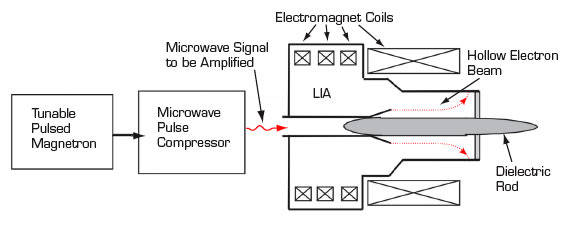
In a parallel development effort, work was performed in preparation for experiments on a relativistic magnetron containing a transparent cathode. The intention is to demonstrate the rapid start of microwave oscillation in such a magnetron, as proposed and studied previously by means of numerical simulations by researchers at the University of New Mexico. In this effort, the magnetron electrodes were designed and manufactured on the basis of the simulation studies. At the time of reporting the information for this article, assembly and testing of the experimental apparatus was underway.
This work was done by Kiyoshi Yatsui, Weihua Jiang, Anatoli Shlapakovski, and Tsuneo Suzuki of Nagaoka University of Technology for the Air Force Research Laboratory. For further information, download the free white paper at www.defensetechbriefs.com under the Electronics/Computers category. AFRL-0012
This Brief includes a Technical Support Package (TSP).
Microwave Sources Utilizing Linear Induction Accelerators
(reference AFRL-0012) is currently available for download from the TSP library.
Don't have an account?
More From SAE Media Group
Tech Briefs
Multimode Broad-Band Patch Antennas



Aerospace & Defense Tech Briefs
Shape-Shifting Origami Could Help Antenna Systems Adapt On-the-Fly


Tech Briefs
Submillimeter-Wave Image Sensor
Tech Briefs
High-Aperture-Efficiency Horn Antenna
Tech Briefs
Aperture-Coupled Thin-Membrane L-Band Antenna

Tech Briefs
Multiplexed Optical Antennas
Aerospace & Defense Tech Briefs
New, Portable Antenna Could Help Restore Communication After Disasters
Aerospace & Defense Tech Briefs
From DC to Daylight — How Innovations in Microwave Absorbers Shield the Warfighter
Tech Briefs
Small X-Band Oscillator Antennas

Aerospace & Defense Tech Briefs
Fundamentals of Metamaterials for High-Power RF Applications
Tech Briefs
Dual-Band Feed for a Microwave Reflector Antenna

Aerospace & Defense Tech Briefs
To 6G and Beyond: Penn Engineers Unlock the Next Generation of Wireless Communications
Tech Briefs
Electric Nanoscale Device Sees Through Walls

Tech Briefs
Optically Transparent Patch Antennas

Tech Briefs
Finned-Ladder Slow-Wave Circuit for a TWT

Tech Briefs
Detecting Negative Obstacles by Use of Radar

Overview
The document is a final report on the development of high-power microwave sources based on induction linear accelerators (ILAs), authored by Weihua Jiang, Anatoli Shlapakovski, and Tsuneo Suzuki from the Extreme Energy-Density Research Institute at Nagaoka University of Technology, Japan. The report covers research conducted from May 1, 2005, to April 30, 2006, under contract number AOARD-05-4041.
High-power microwaves are increasingly relevant in various applications, particularly in space and defense sectors. The report emphasizes the importance of microwave source development, focusing on critical factors such as power, efficiency, compactness, durability, and output stability. These aspects are essential for practical applications and require extensive experimental studies.
The research is part of an international collaboration involving Nagaoka University of Technology, the Nuclear Physics Institute at Tomsk Polytechnic University in Russia, and the University of New Mexico in the USA. The collaborative effort aims to enhance the compactness, durability, and stability of high-power microwave generators. The report outlines two main areas of research: the hybrid antenna-amplifier and the relativistic magnetron.
Section 2 of the report discusses the hybrid antenna-amplifier, detailing experimental demonstrations using linear induction accelerators. This section highlights the design and performance of the antenna-amplifier, showcasing its potential for high-power microwave applications.
Section 3 focuses on the relativistic magnetron, presenting experimental and simulation studies aimed at improving electrode configurations. The findings in this section contribute to the understanding of magnetron operation and its efficiency in generating high-power microwaves.
The report concludes with a summary of the research findings and their implications for future developments in high-power microwave technology. It underscores the significance of ongoing research in this field, particularly in enhancing the performance and reliability of microwave sources for various applications.
Overall, the document serves as a comprehensive overview of the collaborative research efforts aimed at advancing high-power microwave technology, providing valuable insights into the experimental methodologies and results achieved during the study period.
Top Stories
INSIDERManufacturing & Prototyping
 How Airbus is Using w-DED to 3D Print Larger Titanium Airplane Parts
INSIDERManned Systems
 FAA to Replace Aging Network of Ground-Based Radars
NewsTransportation
 CES 2026: Bosch is Ready to Bring AI to Your (Likely ICE-powered) Vehicle
NewsSoftware
 Accelerating Down the Road to Autonomy
EditorialDesign
 DarkSky One Wants to Make the World a Darker Place
INSIDERMaterials
 Can This Self-Healing Composite Make Airplane and Spacecraft Components Last...
Webcasts
Defense
 How Sift's Unified Observability Platform Accelerates Drone Innovation
Automotive
 E/E Architecture Redefined: Building Smarter, Safer, and Scalable...
Power
 Hydrogen Engines Are Heating Up for Heavy Duty
Electronics & Computers
 Advantages of Smart Power Distribution Unit Design for Automotive...
Unmanned Systems
 Quiet, Please: NVH Improvement Opportunities in the Early Design...
