




Automotive Engineering - January 2015
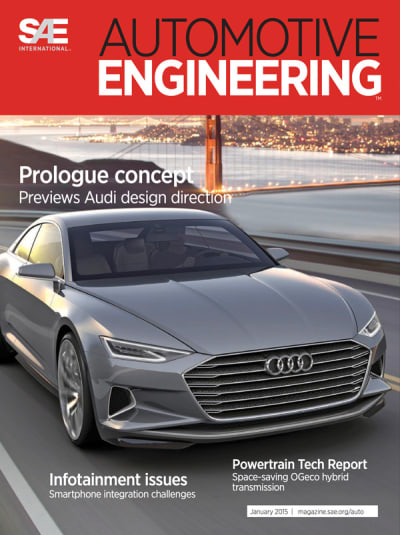
Inside this issue
Overview
The January 2015 issue of Automotive Engineering presents a comprehensive overview of the latest trends and innovations in the automotive industry, focusing on engineering advancements, design directions, and the challenges posed by new technologies. This edition is particularly relevant as the industry grapples with the increasing demand for connected vehicles and the need to enhance driver safety and experience.
Key Highlights:
-
Smartphone Integration Challenges: A significant feature of this issue is the exploration of the complexities involved in linking smartphones to vehicles. The article titled "Hard to Answer" delves into both technical and personal issues that complicate this integration. As human-machine interfaces (HMIs) evolve, developers are tasked with creating systems that allow drivers to interact with apps and smartphones seamlessly. The article emphasizes that a well-designed HMI can differentiate a vehicle in a competitive market, while a poorly executed one can lead to driver distraction and criticism.
-
Powertrain Innovations: The issue also covers advancements in powertrain technology, highlighting the new OGeco hybrid transmission. This innovative design is noted for its space-saving capabilities, which is crucial in the context of modern vehicle design where space optimization is a priority. The hybrid transmission represents a significant step forward in enhancing vehicle efficiency and performance, aligning with the industry's push towards more sustainable solutions.
-
Automaker Design Directions: Audi's Prologue concept car is showcased as a representation of the brand's future design philosophy. This full-size luxury coupe not only reflects Audi's commitment to aesthetic excellence but also hints at the technological advancements that will define their upcoming models. The Prologue serves as a benchmark for the integration of style and functionality in automotive design.
Industry Trends and Best Practices: The issue includes insights from a softbound book edited by Kirsten M. Koepsel, which compiles supply-chain best practices identified through surveys of electronic parts manufacturers and government contractors. This resource aims to address the impact of counterfeits on the supply chain, providing a high-level overview of legislative and standards-driven solutions that are essential for maintaining integrity in the automotive supply chain.
-
Upcoming Events and Publications: The magazine outlines a series of upcoming newsletters and publications, including technology-focused editions on aerospace engineering, electronics, and automotive engineering. These resources are designed to keep industry professionals informed about the latest developments and innovations.
-
Professional Development Opportunities: The issue highlights the benefits of SAE membership, which includes access to exclusive coaching programs, discounts on insurance, and professional development seminars. These offerings are aimed at enhancing the skills and knowledge of automotive professionals, ensuring they remain competitive in a rapidly evolving industry.
-
Product Innovations: A section dedicated to product briefs showcases the latest sensors and technologies that are shaping the automotive landscape. These innovations are critical for improving vehicle safety, efficiency, and overall performance, reflecting the industry's commitment to leveraging technology for better outcomes.
Conclusion:
The January 2015 issue of Automotive Engineering serves as a vital resource for industry professionals, providing insights into the challenges and opportunities that lie ahead in automotive engineering. With a focus on smartphone integration, powertrain innovations, and design directions, this edition encapsulates the dynamic nature of the automotive sector. As the industry continues to evolve, the insights and trends presented in this issue will be instrumental for engineers, designers, and decision-makers striving to navigate the complexities of modern automotive technology.
Overall, this issue not only highlights the current state of the automotive industry but also sets the stage for future developments, making it a must-read for anyone involved in automotive engineering and design.
Features
-
Articles
Regulars
-
Global Vehicles
Audi Shows Design, Fuel-Cell Directions
2016 Explorer Gains More Powerful Four-Cylinder, Platinum Opulence
-
Technology Reports
-
Product Briefs
Book Examines Challenges of Electronic Parts and Their Impacts on Consumer and Industrial Products
Automotive System-On-Chip Family
Multi-Core Safety Operating System
CAN FD Serial Trigger, Decode Solution
-
What’s Online
Ford Aims for New 'Halo' Products and More Female Engineers, Says COO Barb Samardzich
Chinese Automakers Focus on 'Internet Mind-Set'
No 'Shaky Start' for Opel/Vauxhall’s New Corsa Triple
Connected/driverless Car Future Seen in Any of Four Scenarios
Toho Tenax Develops 'Super-Heat-Resistant' Prepreg for Engine Apps
Stories
-
News
Toyota Seeks Industry Joint Effort to Solve Takata Airbag Issue
Cybersecurity Issues Pondered at Connected Car Expo
VW Reveals Hot New 10-Speed DSG—and a Cool Dashboard Design
BorgWarner Expects EGR, Natural-Gas Growth for Commercial Vehicles
Voice Recognition Draws High Interest but Disappointment in J.D. Power Survey
No Simple Roadmap to Autonomous Cars
Toyota Pumps 6M into Michigan R&D Expansion
Growing Interest in Bio-Based Material Parts
Attacking GDI Engine Particulate Emissions
See-Through A-Pillars, Ghost Navigation, and Discovery Sport Extreme Testing
Top Stories
INSIDERManufacturing & Prototyping
 How Airbus is Using w-DED to 3D Print Larger Titanium Airplane Parts
INSIDERManned Systems
 FAA to Replace Aging Network of Ground-Based Radars
NewsTransportation
 CES 2026: Bosch is Ready to Bring AI to Your (Likely ICE-powered) Vehicle
NewsSoftware
 Accelerating Down the Road to Autonomy
EditorialDesign
 DarkSky One Wants to Make the World a Darker Place
INSIDERMaterials
 Can This Self-Healing Composite Make Airplane and Spacecraft Components Last...
Webcasts
Defense
 How Sift's Unified Observability Platform Accelerates Drone Innovation
Automotive
 E/E Architecture Redefined: Building Smarter, Safer, and Scalable...
Power
 Hydrogen Engines Are Heating Up for Heavy Duty
Electronics & Computers
 Advantages of Smart Power Distribution Unit Design for Automotive...
Unmanned Systems
 Quiet, Please: NVH Improvement Opportunities in the Early Design...
