




Mazda's 2017 G-Vectoring Control Brings Dynamic Refinement

Spend time with Mazda's talented vehicle-dynamics engineers as they fine-tune a new model before production release and you may hear the Japanese term jinba ittai—the concept of driver and car (more literally, horse and rider) as one. And that concept was very much at play during development of the automaker's latest technology for improving steering response, smoothness and precision.

It's called G-Vectoring Control (GVC), a name that is a bit of a misnomer. It is not a torque-vectoring system aimed at dramatically improving race-circuit lap times. Rather, the purpose of the system is to endow the vehicle with refined and natural smoothness in normal day-to-day driving environments.
To hear Daisuke Umetsu, Mazda's 35-year-old development leader explain it, "Longitudinal acceleration is modulated in response to lateral jerk for harmonious G transition. The GVC control applies minute, almost imperceptible longitude deceleration, less than 0.05 g—far less than normal engine braking—sensing two input sources: steering input angle and vehicle velocity.” He says the resulting system, standard on the 2017 Mazda3 (Axela in Japan) and Mazda6 (Atenza) and expected to spread to other models, is designed to provide "peace of mind."
Controller integrated with PCM
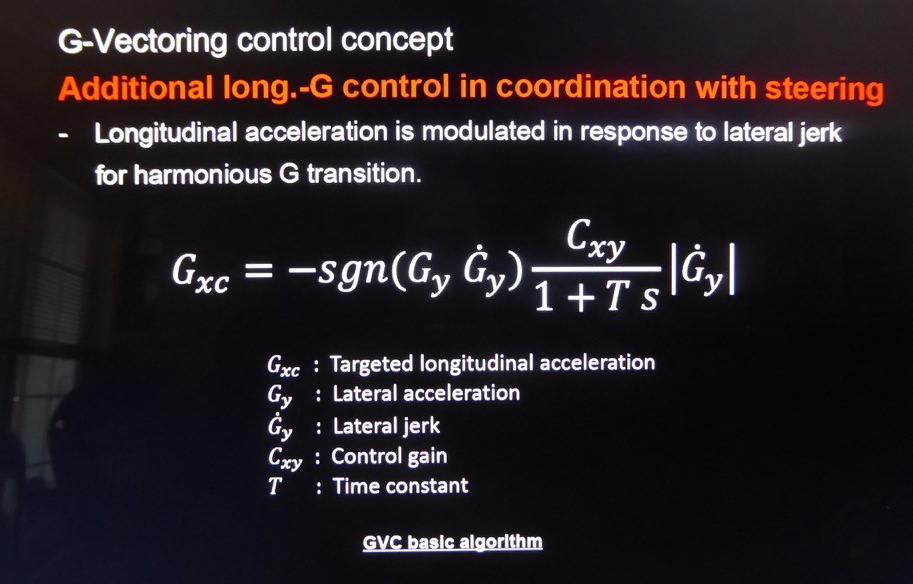
A simpler explanation is that GVC, co-developed with Hitachi Automotive and Kanagawa Institute of Technology, closely monitors the speed of steering-wheel inputs then signals the engine to reduce torque to a minute degree. The resulting deceleration, hardly perceptible to the driver and without drama, delicately loads the front axle and thus tightens up compliance in the car's steering and front suspension.
Umetsu likens the function to that of the top expert drivers, citing the example of the legendary Yoshimi Katayama, who drove various Mazda works racing cars at Le Mans and elsewhere. Turning into a bend or curve, Katayama would have smoothly increased vertical force up front, through steady-state, to accelerating with vertical force shifting rearward.

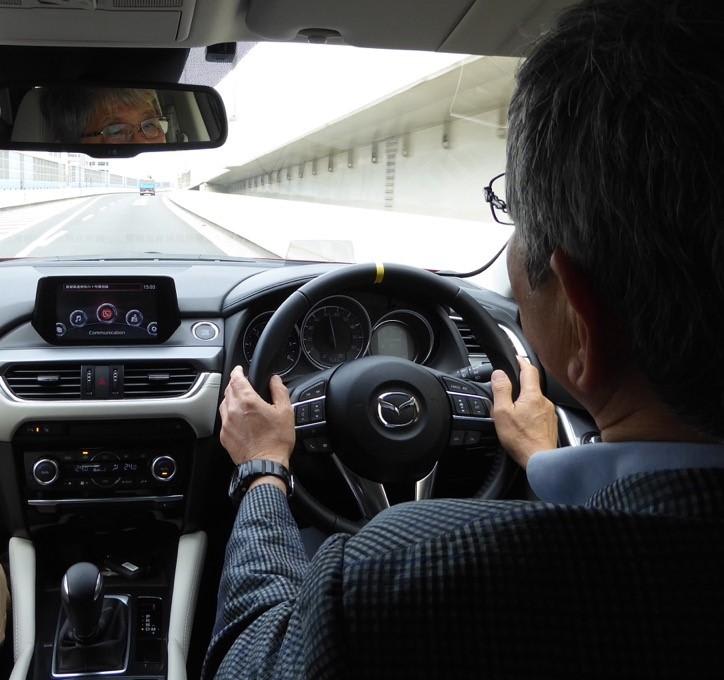
Developed over a nearly eight-year period, GVC performs the expert-like function seamlessly and smoothly while using the engine as "the actuator, with no additional hardware required,” Umetsu explained to Automotive Engineering during a technical presentation and ride-and-drive event earlier this year. He noted that the GVC controller is integrated within the powertrain control module (PCM), occupying a scant 3-kB in Mazda’s 3-MB passenger car PCM.
Mazda dispatched a development team to Europe with the GVC-equipped Mazda6 prototype to obtain subjective responses and evaluations on public roads including high-speed motorways in the hands of 20 drivers of different nationalities and varying driving skills. Reactions were most positive, noted Umetsu.
Unique development team
The cross-functional GVC team of about 40 members is an interesting and unique joint R&D entity of OEM, supplier and academic engineers. There is no middle-management supervision, but the organization has the full support of Mazda Chairman Seita Kanai, R&D head Kiyoshi Fujiwara and his predecessor. Hirotaka Kanazawa.
Umetsu, an-art-major-turned-neuroscience-graduate of the University of Tsukuba, joined Mazda in 2006. He is a senior specialist in the vehicle development department, responsible for chassis dynamics. Like the team's other members he does not specialize in GVC; his primary job function is a vehicle development engineer-driver. Umetsu has been involved in the development of such vehicles as the CX-5, the new MX-5 roadster and its near-twin Fiat 124 Spider, spending a year with the latter in Italy.
The initial proposal came from Hitachi, employing brakes for vehicle dynamics control with higher deceleration intervention. This ordinary approach was quickly abandoned. Umetsu’s first encounter with the GVC concept was on the Tsukuba race circuit where he met Prof. Yamakado, at the time a Hitachi researcher specializing in engine control and fuel injection and a fellow track-day enthusiast. Their meeting, and conversations with others at J-SAE events, spawned ideas that led to G-Vectoring Control.
Umetsu also attributes quantum leaps in powertrain control and chassis technologies. Included were learnings from development of the Mazda Demio (Mazda2) battery-electric vehicle that the company offered to selected lease customers. That car's brake- or electrically-actuated deceleration was in the order of 0.1 to 0.3 g, versus the production GVC system’s 0.05 g. But a key enabler is the Skyactiv engine family, both gasoline and diesel, that incorporates extremely high control precision and responsiveness.
Technical details of the G-Vectoring Control can be found in JSAE technical papers 20165248, 49, 50 (in Japanese).
More From SAE Media Group
Automotive Engineering
Mazda Enters Subcompact Crossover Segment with 2016 CX-3
Automotive Engineering
Lotus Breaks out with New Eletre Electric SUV
Automotive Engineering
Mazda Trickles out More New MX-5 Details
Off-Highway Engineering
REE’s P7 Brings Advanced Suspension Control to Medium-Duty Trucks
Automotive Engineering
Lexus Unveils Concept Flagship Crossover
Automotive Engineering
2026 Nissan Sentra Review: Putting the Pieces Together
Off-Highway Engineering
Volkswagen ID.Buzz All-electric Vans Combine Iconic Styling With Modern Technology
Automotive Engineering
2021 Toyota Supra 2.0
Automotive Engineering
No 'Shaky Start' for Opel/Vauxhall’s New Corsa Triple
Automotive Engineering
New Ford S-Max to Get Class-Leading Driver Assistance Features
Motion Design
Self-Contained Wheel Unit
Off-Highway Engineering
Freightliner’s Medium-Duty Makeover
Automotive Engineering
Jaguar’s Making of a Sports Sedan

Automotive Engineering
Fiat 124 Spider Returns After More Than 30 Years
Automotive Engineering
Audi Unveils New R8 and All-Electric E-Tron Version
Automotive Engineering
Mercedes-Benz Melds SUV and Coupe Styling for GLE Coupe
Automotive Engineering
2016 Mazda MX-5 Stays True to Its Roots
Off-Highway Engineering
Western Star Adds ‘Weight Sensitive’ 47X to Vocational Lineup
Tech Briefs
Are In-Wheel Motor Systems Catching On?
Automotive Engineering
5 More HP for 2026 Kia Sportage: First Drive
Automotive Engineering
2023 Cadillac Lyriq Executive Chief Engineer: New EV Her ‘North Star’
Automotive Engineering
Supercar Concept Previews Lamborghini Plug-In Possibilities
Automotive Engineering
Mercedes Board Member Demonstrates Upgrades for New C-Class
Automotive Engineering
Lighter, More Powerful 3rd-Gen Pilot Debuts Honda’s NPD Process
Automotive Engineering
Mercedes Boosts Off-Road Prowess of 2019 G-Wagen
Automotive Engineering
Audi's New Compact Q2 Blends 3-Cylinder Efficiency, Agile Chassis
Autonomous Vehicle Engineering
AV Powers Bring May Flowers
Automotive Engineering
New XF Moves to Jaguar's Aluminum Architecture
Top Stories
INSIDERManufacturing & Prototyping
 How Airbus is Using w-DED to 3D Print Larger Titanium Airplane Parts
INSIDERManned Systems
 FAA to Replace Aging Network of Ground-Based Radars
NewsTransportation
 CES 2026: Bosch is Ready to Bring AI to Your (Likely ICE-powered) Vehicle
NewsSoftware
 Accelerating Down the Road to Autonomy
EditorialDesign
 DarkSky One Wants to Make the World a Darker Place
INSIDERMaterials
 Can This Self-Healing Composite Make Airplane and Spacecraft Components Last...
Webcasts
Defense
 How Sift's Unified Observability Platform Accelerates Drone Innovation
Automotive
 E/E Architecture Redefined: Building Smarter, Safer, and Scalable...
Power
 Hydrogen Engines Are Heating Up for Heavy Duty
Electronics & Computers
 Advantages of Smart Power Distribution Unit Design for Automotive...
Unmanned Systems
 Quiet, Please: NVH Improvement Opportunities in the Early Design...
