




Cadillac Pulls the Wraps off Two New V-Series Sedans
Repositioning V-Series products as daily-drive sporty vs. track-day machines, the all-new CT4-V and CT5-V sedans still get potent turbo engines and athletic chassis tech.

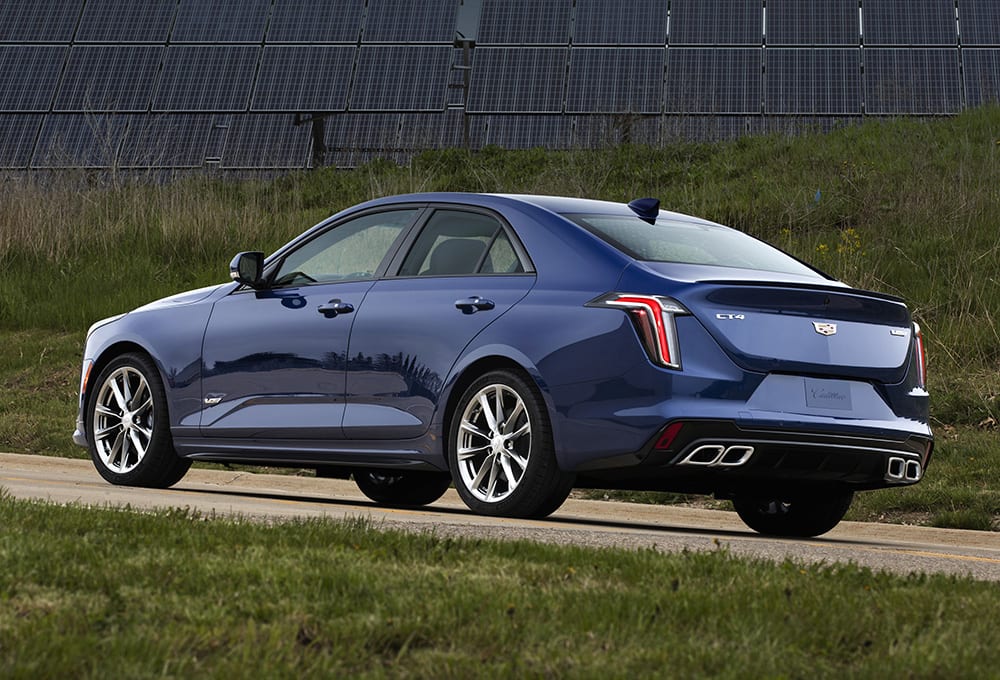
Cadillac has added two more sedans to its V-Series performance lineup, the all-new 2020 CT4-V and CT5-V. The CT4-V will square off against established C-segment players such as the BMW 3-Series and Mercedes-Benz C-Class, along with the new Genesis G70. The CT5-V will compete with the BMW 5-Series and Audi A6. The two new 4-door sedans join the larger 2019 CT6-V sedan in the V-Series stable, though the company noted that the series is evolving to be less focused on hard-core, track-worthy machines, and more about sporty and comfortable daily drivers.

“We are inviting even more customers into the V-Series family,” said Brandon Vivian, Cadillac executive chief engineer, “by adding a new level of elevated performance between our Sport models and the ultimate, high-performance track capability that the V-Series has grown to represent.”

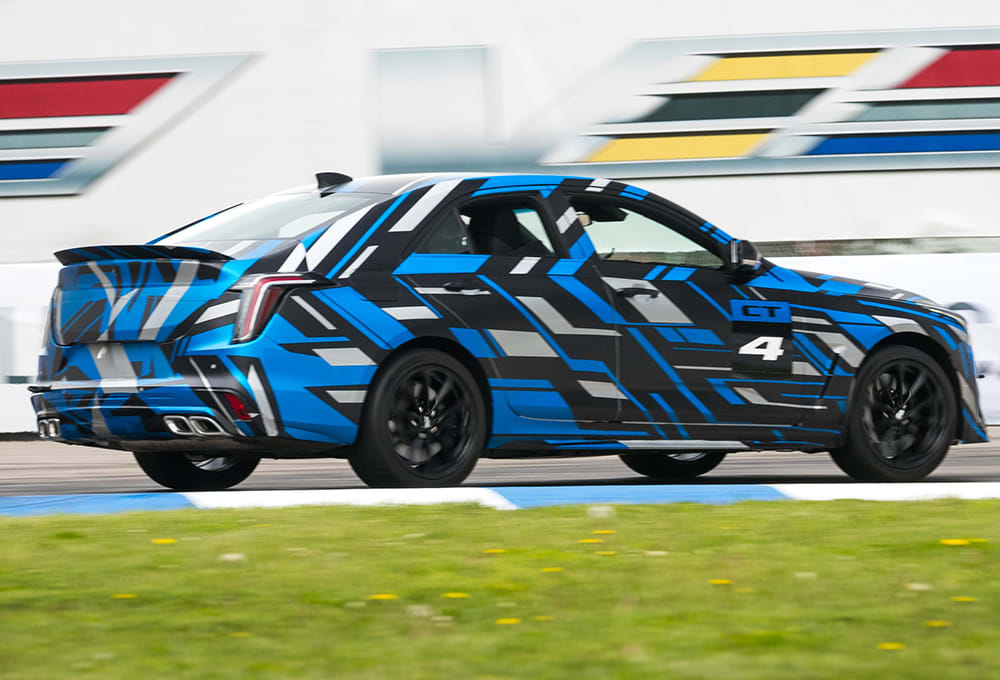
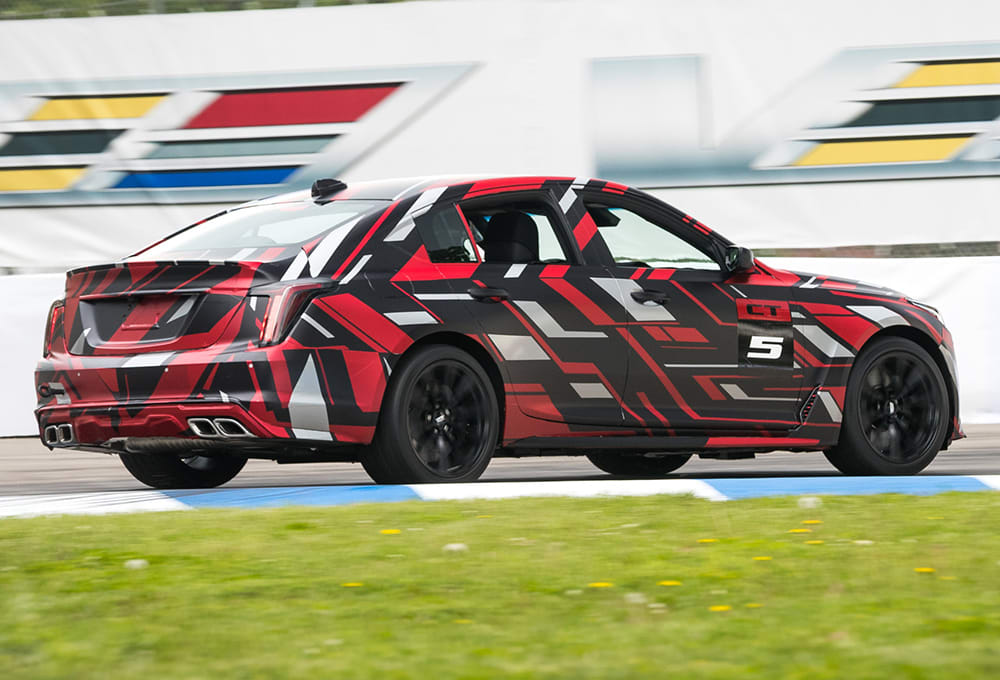
Though an apparent shift from the original track-ready V-Series ethos, the company hinted at upcoming V-Series models that will provide elevated, closed-course performance. True to its word, two days after the new V-Series sedan were revealed, two prototypes took to the track at the Detroit Grand Prix on Belle Isle. Beyond the “CT4” and “CT5” labels integrated into the camouflage and several images (see gallery, and below), Cadillac provided no additional details on the prototypes.
Turbocharged and 10 speeds
The CT5-V will arrive powered by a 3.0L twin-turbocharged V-6 rated at a Cadillac-estimated 355 hp (265 kW). The CT4-V will be powered by GM’s all-new 2.7L “dual-volute” turbo 4-cylinder (which made its recent debut in the Chevy Silverado), rated at a Cadillac-estimated 320 horsepower (239 kW). Both the CT4-V and CT5-V will be paired with a 10-speed automatic transmission, and both models will be available in RWD or AWD configurations.

Both the CT4-V and CT5-V are underpinned (like the ATS and CTS models they replace) by GM’s rear-wheel-drive Alpha architecture. The larger CT5-V will feature a rear electronic limited-slip differential (eLSD), while the CT4-V will get a mechanical unit. Both models will feature the latest version of GM’s magnetorheological dampers, what it labels Magnetic Ride Control 4.0, claiming a tune that enhances comfort without sacrificing responsiveness.
Each of the new sedans will feature Brembo front brakes, launch control and a number of drive modes, including a “V-Mode” that permits a customized set of parameters. The CT5-V will feature 19-inch wheels, the CT4-V will arrive with standard 18-inch wheels, with RWD versions shod with summer performance tires and AWD models getting all-season rubber. Cadillac’s Super Cruise advanced driver-assist system (ADAS), will become available on both sedans in calendar year 2020.
The CT4-V and CT5-V are expected to go on sale in early 2020. Though pricing specifics have yet to be revealed, Cadillac noted the price differential between standard versions should be $6K-$7K. Both sedans will be produced at GM’s Lansing Grand River facility in Lansing, Michigan.
More From SAE Media Group
Automotive Engineering
What We’re Driving: 2018 Chrysler 300 S AWD
Automotive Engineering
2019 Volvo S60 T6
Automotive Engineering
Toyota Stretches SUV Line-Up with World Debut of Grand Highlander
Automotive Engineering
What We’re Driving: 2020 Kia Telluride
Automotive Engineering
What We’re Driving: 2020 Kia Seltos SX
Automotive Engineering
First Electrified Dodge Arrives for 2023 MY
Automotive Engineering
NAIAS 2022: Seventh-Generation of Ford Mustang Is Highest Performer Yet
Automotive Engineering
2020 Ford Explorer: Knockout Styling Caches All-New Engineering
Automotive Engineering
Suzuki Vitara 1.4 Turbo SZ5 Allgrip
Automotive Engineering
A Brief History of Chevrolet Corvette Concepts
Automotive Engineering
Cadillac Reveals 2025 CT5-V and CT5-V Blackwing with More Tech
Off-Highway Engineering
Mercedes-Benz Details All-New Platform for EV Vans
Automotive Engineering
2019 Honda Pilot Gets Refined 9-Speed, Tougher Styling and Standard Safety Suite
Automotive Engineering
With 2019 Sierra, GMC Puts Brand Differentiation Behind It—literally
Automotive Engineering
2019 Volkswagen Jetta GLI
Automotive Engineering
Sparkling RWD Platform Underpins 2021 Genesis GV80
Automotive Engineering
Tackling the Elements with the Ineos Grenadier Quartermaster and Wagon
Automotive Engineering
2019 Genesis G70 RWD
Automotive Engineering
Hyundai Reveals Market-Sized 2022 Tucson SUV
Automotive Engineering
Detroit Three Focus on Customer-Friendly Tech at 2023 NAIAS
Automotive Engineering
Dodge Ready with a Sting for the Compact-SUV Market
Automotive Engineering
All-New 2021 Chevrolet Tahoe, Suburban Get IRS, Inline-6 Diesel
Automotive Engineering
NAIAS 2019: The Tech-Savvy Next-Generation Ford Explorer
Off-Highway Engineering
Freightliner’s Medium-Duty Makeover
Automotive Engineering
Hyundai Puts the N in Performance
Automotive Engineering
Toyota Takes Corolla to the ‘Truck’ Side
Automotive Engineering
2019 Acura RDX Brings World’s-First Chassis Tech
Automotive Engineering
What We’re Driving: 2020 Mazda3 Premium AWD
Automotive Engineering
New Lexus SUVs: GX for Show, TX for Dough?
Automotive Engineering
2019 New York Auto Show Wrap Up
Top Stories
NewsRF & Microwave Electronics
 Microvision Aquires Luminar, Plans Relationship Restoration, Multi-industry Push
INSIDERAerospace
 A Next Generation Helmet System for Navy Pilots
INSIDERDesign
 New Raytheon and Lockheed Martin Agreements Expand Missile Defense Production
INSIDERMaterials
 How Airbus is Using w-DED to 3D Print Larger Titanium Airplane Parts
NewsPower
 Ford Announces 48-Volt Architecture for Future Electric Truck
ArticlesAR/AI

Webcasts
Electronics & Computers
 Cooling a New Generation of Aerospace and Defense Embedded...
Automotive
 Battery Abuse Testing: Pushing to Failure
Power
 A FREE Two-Day Event Dedicated to Connected Mobility
Unmanned Systems
 Quiet, Please: NVH Improvement Opportunities in the Early Design Cycle
Automotive
 Advantages of Smart Power Distribution Unit Design for Automotive &...
Energy
 Sesame Solar's Nanogrid Tech Promises Major Gains in Drone Endurance