




JLR Uses Predictive Technology to Reduce Motion-Sickness Risk
JLR’s research has created an algorithm to check occupant “wellness” and trigger action to mitigate effects.

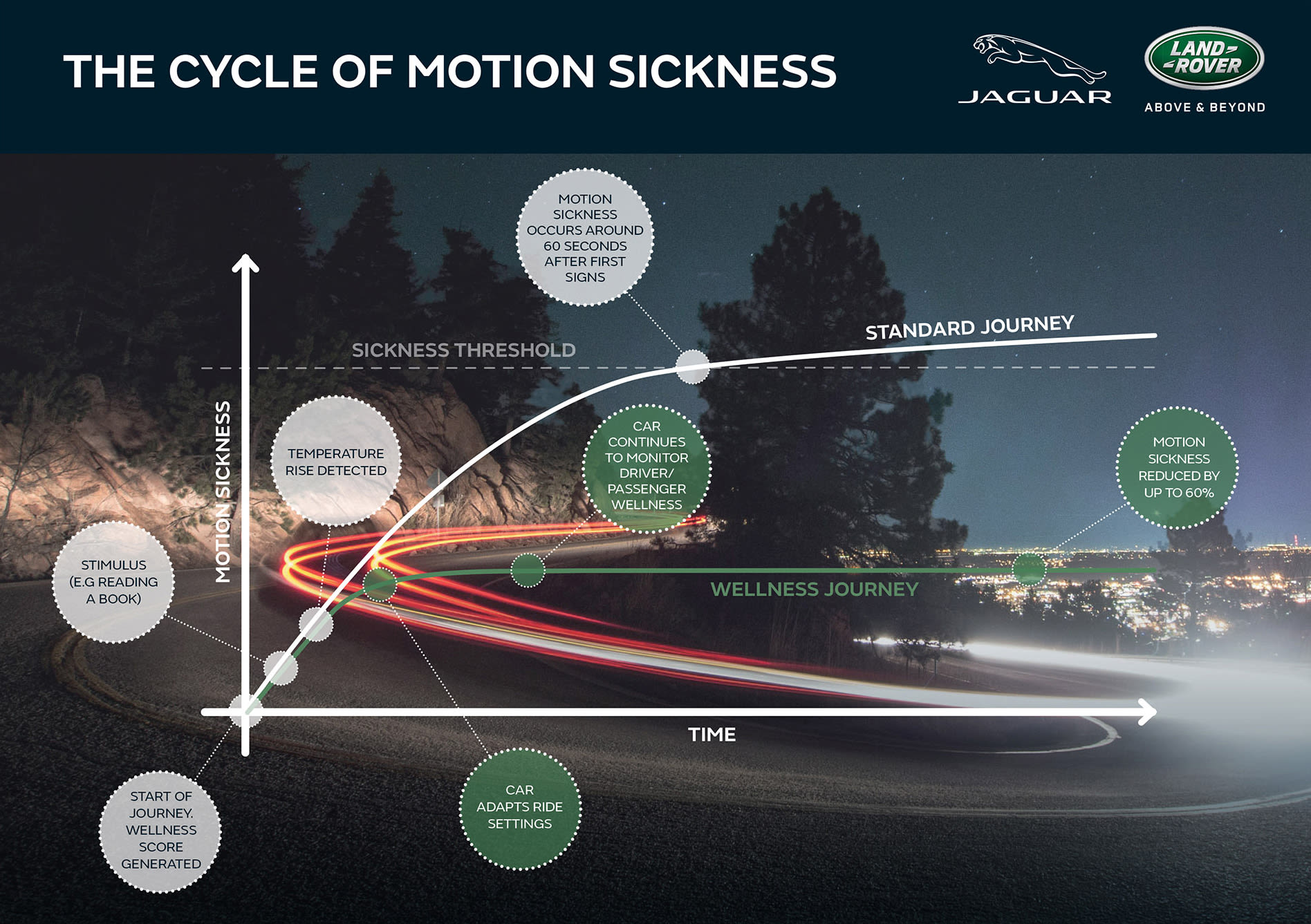
Jaguar Land Rover (JLR) has revealed that a specialist “wellness research” team has created an algorithm to help reduce vehicle motion sickness by up to 60%. The algorithm generates a “wellness score” for each passenger. When it detects changes in the score it can automatically initialize personalization of both vehicle dynamics and cabin settings to reduce the effects of motion sickness.
Dr. Steve Iley, JLR’s Chief Medical Officer, described the research’s “solid scientific foundation” as having created a solution regardless of an individual’s susceptibility to travel sickness. Young children are most likely to suffer symptoms: “I am particularly excited by the benefits this research can have in making long journeys comfortable and stress-free for families.”
Linking systems
A key member of the research team is Spencer Salter, a JLR engineer who uses comprehensive modeling specifically to achieve pre-emptive solutions within dynamic systems. A further link embraces satellite navigation systems that can support “optimum wellness routes” that take into consideration speed, journey time and distance.
JLR’s wellness score is compiled using biometric sensors to record physiological signals together with motion and dynamics data which together are designed to signal a potential motion sickness event, even before the vehicle occupant will be aware of it. The research work has so far involved some 15,000 miles, enabling the JLR team to establish a baseline driving style as a target for autonomous applications. A particular aim is to minimize steering corrections and unnecessary inputs.
Information correlation
Salter said that little had previously been known about causes of motion sickness and how to prevent or reduce it, despite the fact that up to 70% of vehicle occupants are estimated to be affected. What is known is that the problem may occur when a vehicles occupant’s eyes observe information that does not correlate with information sent to the brain via the inner ear, skin, and forces on the body. This happens particularly when reading – something that autonomous-vehicle travel will increasingly allow.
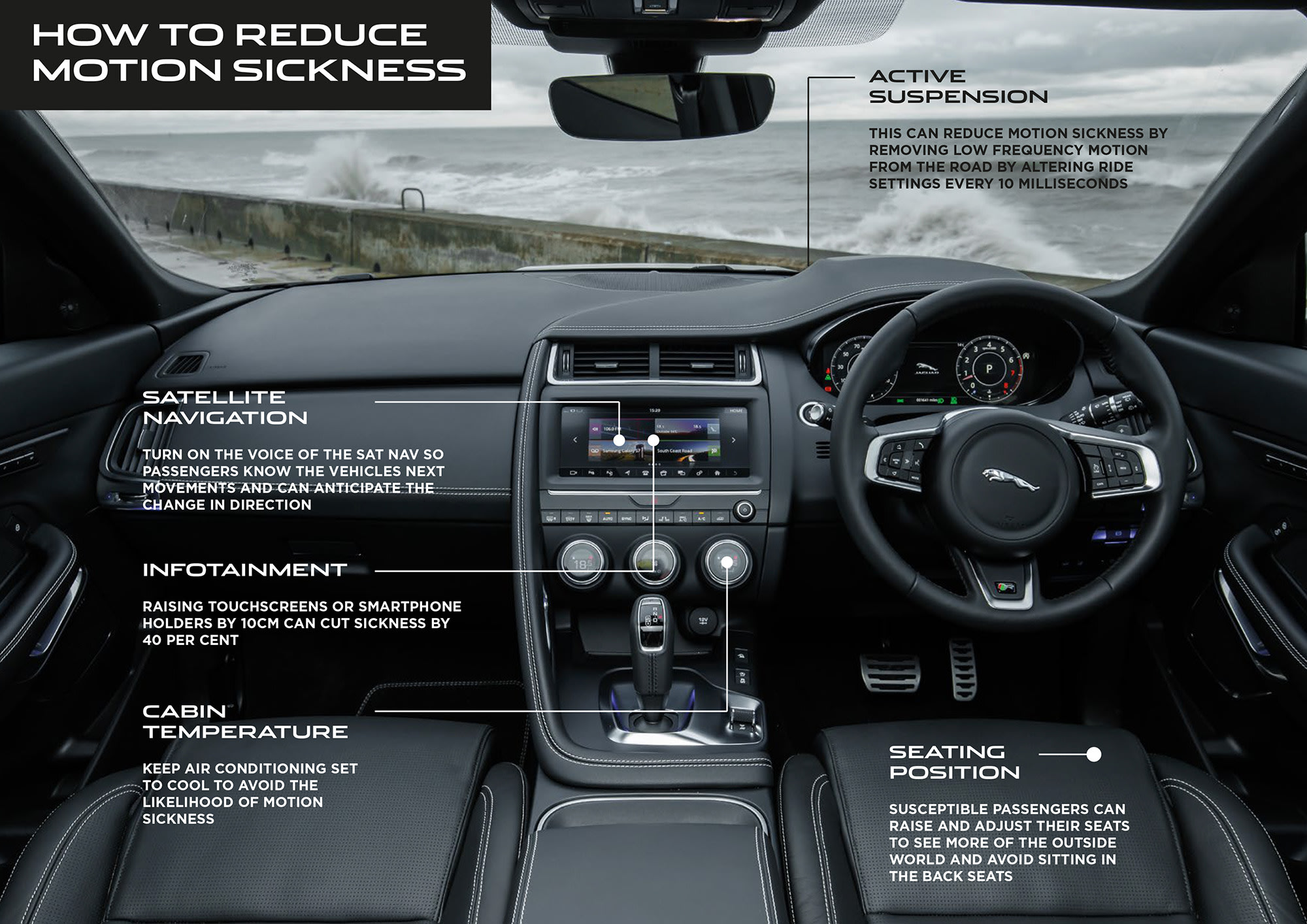
Although not specifically anti-sickness targeted, technology is already available on production cars that can help reduce the likelihood of its manifestation. Salter noted JLR’s capability in this area, which includes multiplicity of seat adjustments, and adaptive dynamics to cope with road-induced low frequency motion.
The first phase of the anti-motion sickness research program is scheduled to be completed by late November and JLR states that the findings to date are already being implemented into further research projects.
More From SAE Media Group
Sensor Technology
Measurement Technology Drives Vehicle Development Forward
Automotive Engineering
FCA Claims North America’s Most-Advanced Driving Simulator
Aerospace & Defense Tech Briefs
Industry Invited to Participate in AeroTech Aerospace and Defense Technical Program

Off-Highway Engineering
WCX 2019: IAMTS Association Will Establish Standardization and Testing for Connected Vehicles
Off-Highway Engineering
Beep and Bestmile Partner on Self-Driving Fleets in Florida

Aerospace & Defense Tech Briefs
SAE International Extends Call for Abstracts, Seeks Submissions for AeroTech Conference
Automotive Engineering
Tactile Data for Autonomous Driving Recognized with TU-Automotive Award
Aerospace & Defense Tech Briefs
SAE International Anti-Counterfeit Standards Integral to Obsolescence Management
Automotive Engineering
Honda to Reveal Autonomous Work Vehicle at CONEXPO
Off-Highway Engineering
How Can Engineers Help Ensure the Safety, Reliability of Automated Vehicles?
Motion Design INSIDER
Can Self-Driving Cars Navigate Roundabouts?
Automotive Engineering
As Early Autonomy Questions Roil the Industry, Toyota Hews to Driver-Enhancement Philosophy
Sensor Technology
RTK and Sensor Fusion for Autonomous Vehicle Navigation & Guidance
Autonomous Vehicle Engineering
UofM Research Hopes to Eliminate That Queasy Feeling
Aerospace & Defense Tech Briefs
Connect Them All
Automotive Engineering
As Automotive Climates Shift, GKN Ramps up Its Winter Testing
Aerospace & Defense Tech Briefs
GE Aviation, Teradata Partner on Data Analytics, Edge Connectivity for Airlines
Motion Design INSIDER
Improving Traffic Signal Timing with a Handful of Connected Vehicles
Aerospace & Defense Tech Briefs
New Zealand and LeoLabs Establish the First Low-Earth Orbit Regulatory Platform
Automotive Engineering
Airbus’ Connected Cabin Concept Is Materializing with First Round of Partnerships
Off-Highway Engineering
Michigan to Start a Year-Long Autonomous Vehicle Trial This Week
Automotive Engineering
Snapdragon Ride Flex Puts Safety, Infotainment onto Single Chip
Automotive Engineering
Debating Data Monetization Vs. Privacy
Automotive Engineering
AVSC Develops Best Practices for Traceable AV Safety Inspection Protocols
Autonomous Vehicle Engineering
GM Announces Door-To-Door Ultra Cruise ADAS
Aerospace & Defense Tech Briefs
EU to Deploy UAV Traffic Management System by 2019
Top Stories
INSIDERManned Systems
 How Airbus is Using w-DED to 3D Print Larger Titanium Airplane Parts
INSIDERAerospace
 FAA to Replace Aging Network of Ground-Based Radars
NewsUnmanned Systems
 Microvision Aquires Luminar, Plans Relationship Restoration, Multi-industry Push
NewsDesign
 CES 2026: Bosch is Ready to Bring AI to Your (Likely ICE-powered) Vehicle
NewsSoftware
 Accelerating Down the Road to Autonomy
INSIDERManned Systems
 Can This Self-Healing Composite Make Airplane and Spacecraft Components Last...
Webcasts
Power
 Hydrogen Engines Are Heating Up for Heavy Duty
Transportation
 Advantages of Smart Power Distribution Unit Design for Automotive...
Automotive
 Quiet, Please: NVH Improvement Opportunities in the Early Design...
Power
 A FREE Two-Day Event Dedicated to Connected Mobility
Connectivity
 E/E Architecture Redefined: Building Smarter, Safer, and Scalable Vehicles
Manufacturing & Prototyping
 How Sift's Unified Observability Platform Accelerates Drone Innovation