




Toyota Bringing Fuel Cell Technology to Heavy-Duty Market

Toyota Motor North America (TMNA) has announced “Project Portal,” a feasibility study examining the potential of its fuel cell technology in a heavy-duty drayage application at the Ports of Los Angeles and Long Beach. In 2006, both ports launched the San Pedro Bay Clean Air Action Plan (CAAP) to reduce emissions from all port sources—ships, trucks, trains, harbor craft and cargo-handling equipment. Project Portal is the next strategy in the plan that has reduced particulate matter by 85%, nitrogen oxides by 50% and sulfur oxides by 95%.
“Toyota believes that hydrogen fuel cell technology has tremendous potential to become the powertrain of the future,” said TMNA Executive Vice President, Bob Carter, in a statement. “From creating one of the world’s first mass-market fuel cell vehicles, to introducing fuel cell buses in Japan, Toyota is a leader in expanding the use of versatile and scalable zero-emission technology.”
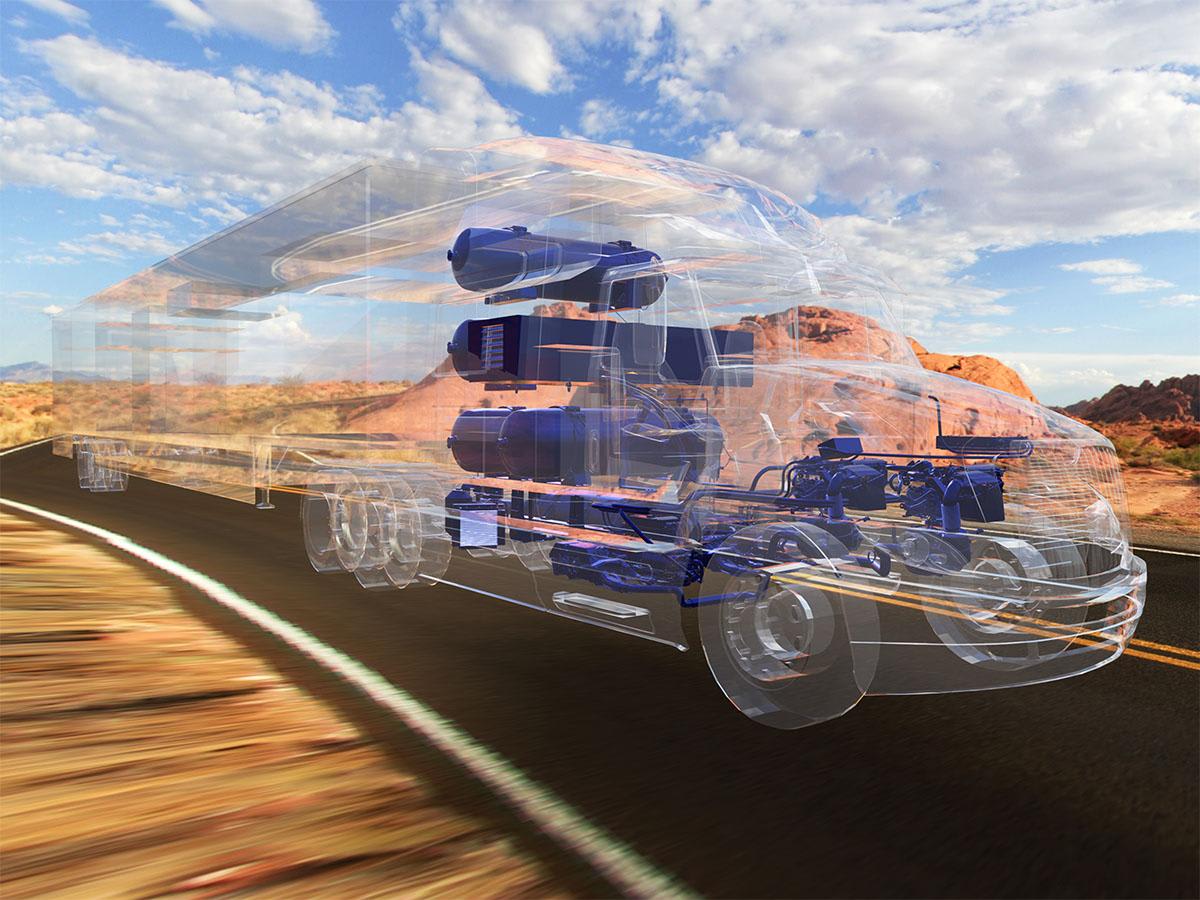
The Class 8 platform used for Project Portal starts with a Kenworth T660 frame and then leverages two fuel cell stacks from the production Mirai, four hydrogen storage tanks and a 12-kW·h battery pack, which is smaller than the pack used in a Chevrolet Volt. All of this powers two electric motors in series that generate 670 hp (500 kW) and 1325 lb·ft (1796 N·m) of torque and give the truck over 200 mi (322 km) of range. The concept’s gross combined weight capacity is 80,000 lb (36,000 kg) under normal operation.
The decision to utilize a hydrogen fuel cell driveline over other alternative powertrains came down to emissions and packaging requirements. A gasoline-electric hybrid combination still emits some gas emissions while a battery-only powered electric truck would require a significantly larger and heavier battery pack.
“Instead of having a large and heavy battery, which basically takes over the cargo space and cargo total weight, a fuel cell becomes a more optimized application,” Tak Yokoo, Senior Engineer for Toyota NA R&D, explained to Truck & Off-Highway Engineering. “The key study of this proof-of-concept truck is using a small battery and how we can optimize the energy from a fuel cell and energy from a battery to meet all the requirements of a port drayage truck.”
The project also has the support of the California Air Resources Board (CARB) and the California Energy Commission (CEC). “As they did with the Prius and the Mirai, Toyota is taking a leap into the future of technology. By bringing this heavy duty, zero emission hydrogen fuel cell proof-of-concept truck to the Port, Toyota has planted a flag that we hope many others will follow,” said Mary D. Nichols, Chair of CARB, in a statement.
This expansion of hydrogen fuel cell vehicles would not be possible without an expansion of California’s hydrogen refueling infrastructure. The CEC is investing in this infrastructure to support the refueling needs of the trucks. Toyota has also recently announced a partnership with Shell to increase the number of hydrogen refueling stations in the state as sales to customers have started on the Mirai, one of the few commercially available fuel cell vehicles in the country.
Project Portal promises an alternative for the numerous trucks that travel between the Ports of Los Angeles and Long Beach and the city along the 710 Freeway every day, where the only emission is water. This is a vital next strategy for the CAAP that continues to reduce the emissions from the port operations and improves the health of the region. Toyota’s commitment to hydrogen fuel cell driveline technology provides another zero-emission mobility option for the heavy-duty trucking industry.
More From SAE Media Group
Off-Highway Engineering
Nikola Producing Battery-Electric Trucks, Fuel-Cell EVs Coming
Off-Highway Engineering
GM Nikola Tie-Up Sparks Worldwide Hydrogen Fuel Cell Interest
Off-Highway Engineering
Toyota’s Proven Fuel-Cell Stack Reduces Cost, Complexity in H2 Semi-Truck
Off-Highway Engineering
Hydrogen Generates BUZZ in Power Generation
Off-Highway Engineering
Hydrogen Shows Increased Commercial Interest
Off-Highway Engineering
Cummins Unveils PowerDrive Hybrid-Electrics, Euro 7 Diesel Concept
Off-Highway Engineering
Nikola Looks to Accelerate Production, Hydrogen Infrastructure
Off-Highway Engineering
Combustion Engines Carry on in Construction
Off-Highway Engineering
ZF, Freudenberg Developing Integrated Fuel-Cell and E-Drive System
Off-Highway Engineering
ACT Expo: Honda Shows Class 8 Hydrogen Fuel-Cell Truck Concept
Off-Highway Engineering
Hydrogen ‘Inevitable’ for Commercial Vehicles
Off-Highway Engineering
Blue Bird Adds Electric School Buses to Alt-Powertrain Portfolio
Off-Highway Engineering
Hyundai’s Fuel-Cell Dreams Remain Xcient
Off-Highway Engineering
Batteries Not the Only Route to EV Efficiency
Tech Briefs
Making Hydrogen Power a Practical Proposition
Automotive Engineering
Hydrogen Storage in a Box!
Automotive Engineering
Engineering ‘Electron Guzzlers’
Off-Highway Engineering
Hybrid Powertrains in the Product Mix
Tech Briefs
High-Power Direct Borohydride Fuel Cells
Off-Highway Engineering
Hyundai CE Debuts Hydrogen and Electric Excavators at Bauma 2022
Off-Highway Engineering
Allison’s Now Open for Hydrogen Testing
Off-Highway Engineering
ACT Expo 2022 Roundup: Bollinger, Hyundai and Volvo Clean-Vehicle Updates
Off-Highway Engineering
EVs Are Coming, but Challenges, Alternative Fuels Will Slow Turnover
Automotive Engineering
Wheel-Hub-Motor Innovations in Flux
Automotive Engineering
Electrons, Combustion, and Bosch
Off-Highway Engineering
Zeroing in on Zero Emissions
Off-Highway Engineering
Many ICE Paths Lead to Reduced Emissions
Off-Highway Engineering
Hexagon Bullish on CNG for Long-Haul Trucks
Off-Highway Engineering
A Bevy of Battery and Fuel-Cell Electric Truck Reveals
Automotive Engineering
Wide Collaborations Aim to Advance the Fuel-Cell Future
Top Stories
INSIDERManufacturing & Prototyping
 How Airbus is Using w-DED to 3D Print Larger Titanium Airplane Parts
INSIDERManned Systems
 FAA to Replace Aging Network of Ground-Based Radars
NewsTransportation
 CES 2026: Bosch is Ready to Bring AI to Your (Likely ICE-powered) Vehicle
NewsSoftware
 Accelerating Down the Road to Autonomy
EditorialDesign
 DarkSky One Wants to Make the World a Darker Place
INSIDERMaterials
 Can This Self-Healing Composite Make Airplane and Spacecraft Components Last...
Webcasts
Defense
 How Sift's Unified Observability Platform Accelerates Drone Innovation
Automotive
 E/E Architecture Redefined: Building Smarter, Safer, and Scalable...
Power
 Hydrogen Engines Are Heating Up for Heavy Duty
Electronics & Computers
 Advantages of Smart Power Distribution Unit Design for Automotive...
Unmanned Systems
 Quiet, Please: NVH Improvement Opportunities in the Early Design...
