




Volvo "Triple Boost" Engine Uses Twin Turbos plus E-Compressor
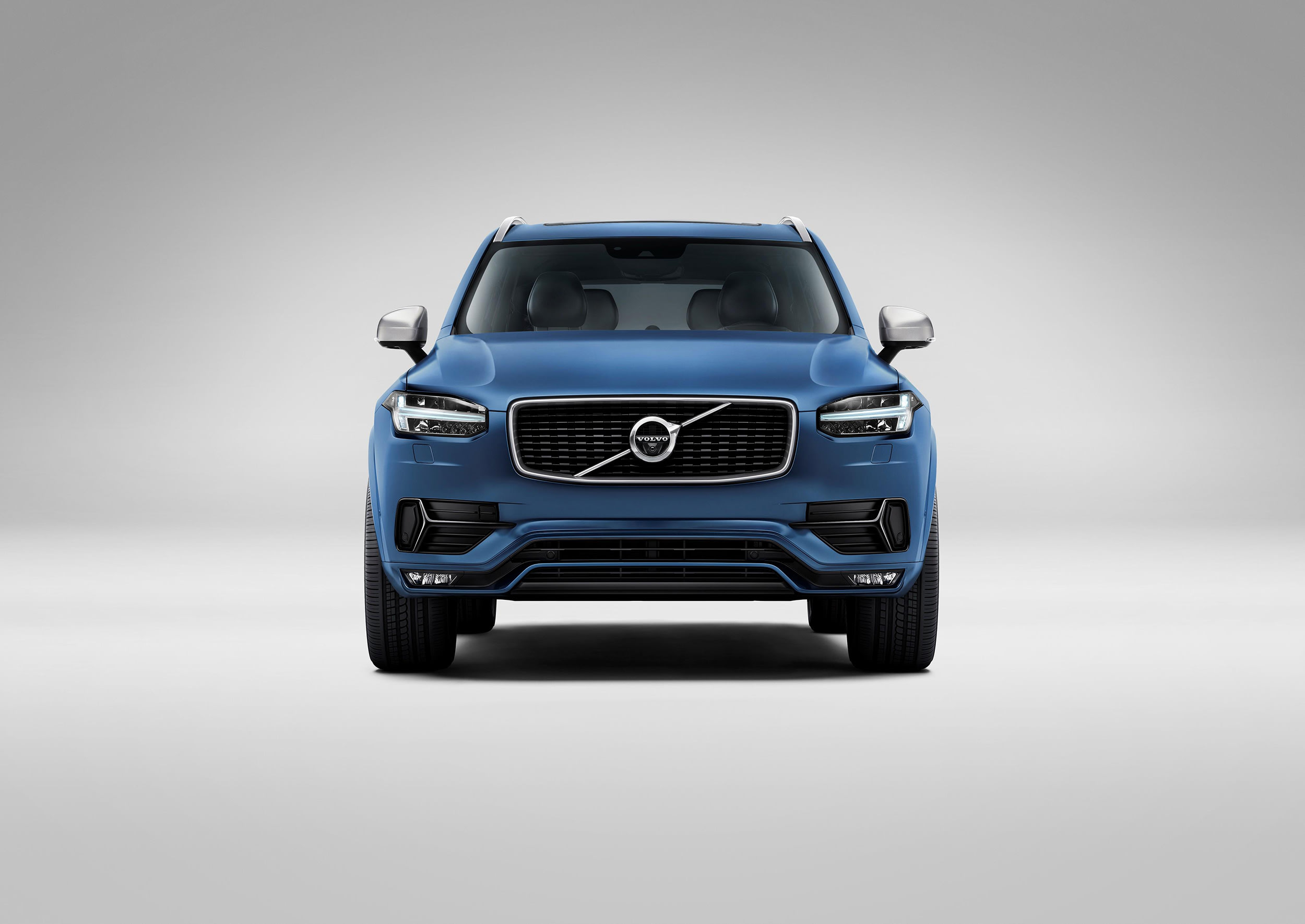
The old automotive adage that “there’s no replacement for displacement” is consistently challenged by automakers as they follow the downsizing road. Now Volvo has come up with a 2.0-L four-cylinder engine that produces a claimed 450 hp (331 kW) and could be offered in the company's latest generation XC90.
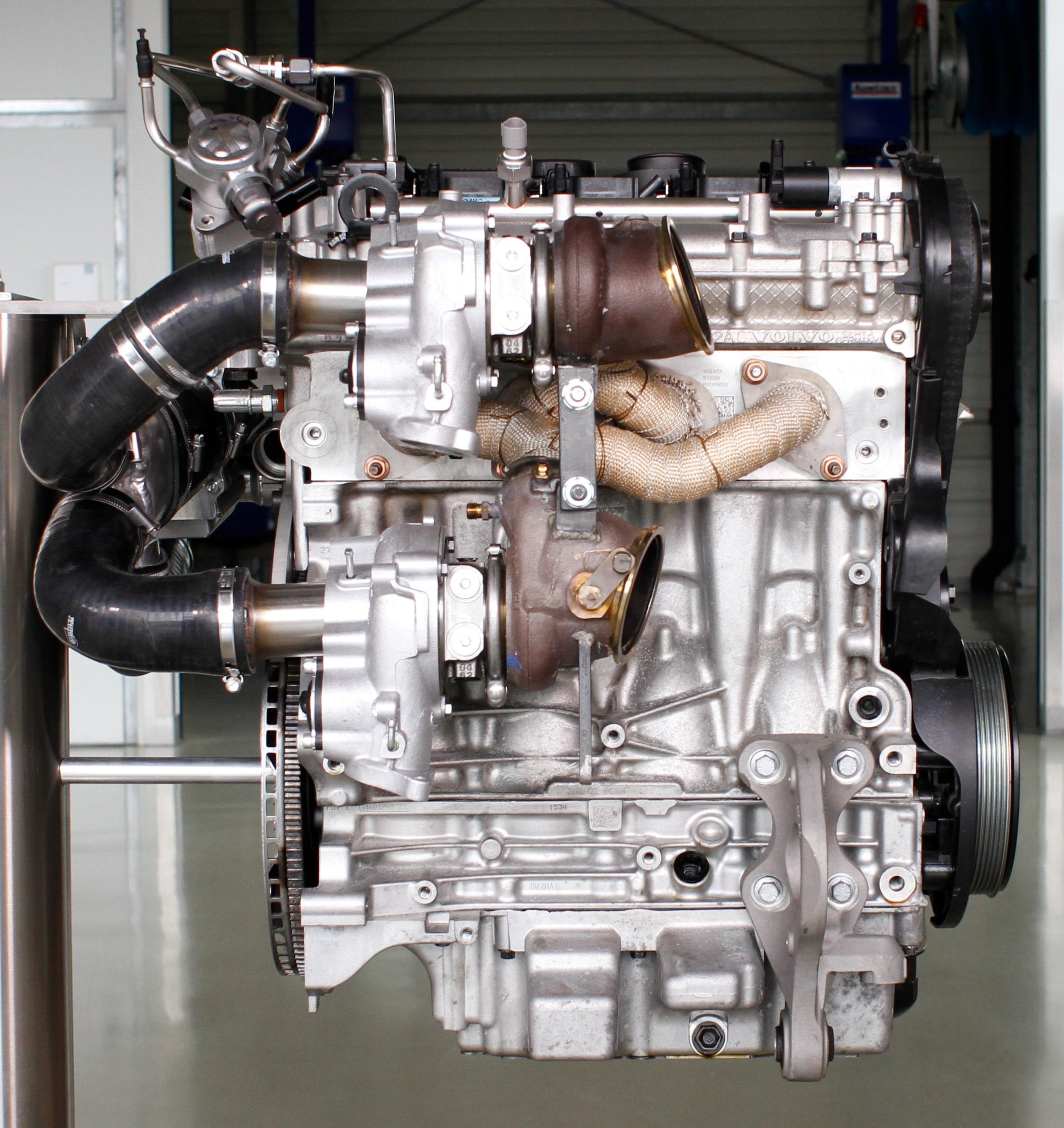
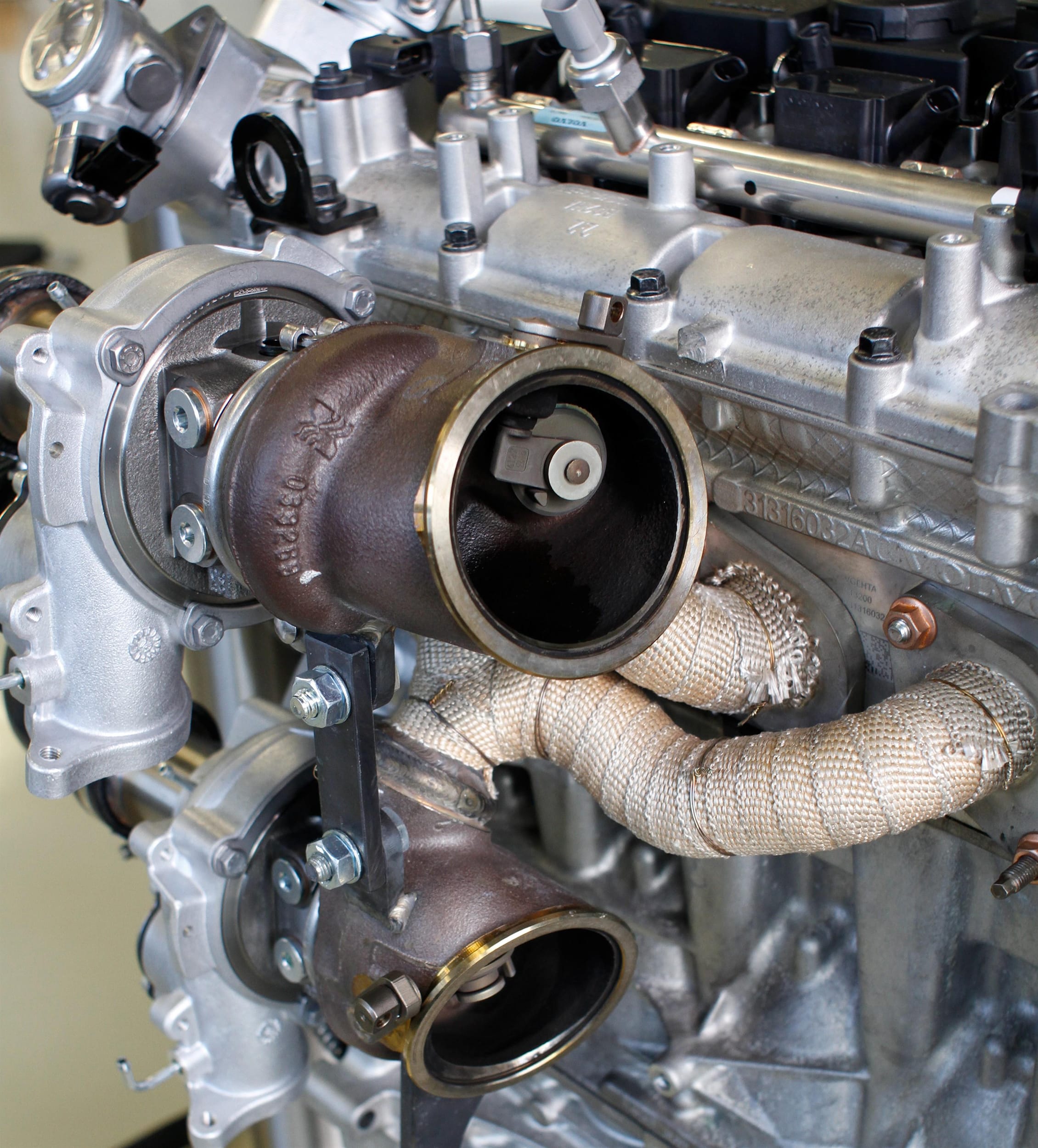
Its novel boosting system features a bi-turbo configuration supported by an electrically-driven compressor, ensuring maximum power and linear torque delivery. Volvo is the latest OEM to probe the potential of e-boosting (see Audi’s latest development: (Testing Audi’s New E-Booster Reveals Turbocharging's Future).
Volvo describes the engine simply as “triple boost technology.” It is part of the company’s Drive-E development program, the downsizing criteria for which include “attractive and usable power” for broad scale emissions reductions.

When Volvo launched the Drive-E family in 2013, its stated aim was to deliver advanced four-cylinder engines based on emissions and fuel consumption relative to performance and drivability. “We knew that 320 hp (236 kW) in our gasoline configuration was just a starting point,” says Dr. Peter Mertens, Volvo Car Group’s Senior Vice President for R&D.
The new engine is currently in development. The two parallel turbochargers are linked to the electrically-powered compressor, which spools up the turbos lower down in the rev range than is typical, thus virtually eliminating lag. A fuel pump working at a high 250 bar (3626 psi) is also an important part of the system to achieve Volvo’s driving experience targets.
Volvo worked closely with suppliers, including AVL, BorgWarner, Valeo, Denso, and Volvo Polestar Racing, from the engine’s concept stage. It regarded racetrack expertise as an essential part of the project to achieve required power density.
This density allows for compact package size and reduced weight, compared to an engine of six or eight cylinders, making for improved front/rear weight balance and a lower center of gravity.
The new engine, regarded by Mertens as an important part of Volvo’s Drive-E program, uses common architecture for both gasoline and diesel power units.
At present, Volvo is not talking dates for the introduction of the new race-bred 2.0-L nor which vehicle model might take it. But the new XC90 looks a likely contender; in the past its engine range included a V8.
Currently the most powerful version of the new XC90 is the gasoline plug-in hybrid (PIH) T8, which is also turbo and supercharged. It produces a claimed 236 kW (316 hp) at 5700 rpm, with 400 N·m (295 lb·ft) available from 2200 to 4500 rpm. Its electric motor produces a supplemental 59 kW (79 hp).
The latest XC90, which was publicly unveiled at the 2014 Paris Motor Show, is the first to be built off Volvo’s scalable modular architecture and has received a positive reaction. The car is built alongside other models, including the XC70, at Volvo’s Torslanda, Gothenburg, plant where the workforce is being increased by some 1300 in 2015, representing a near 40% boost in numbers. Volvo is looking to achieve a total 470,000 unit sales figure for 2014, about 10% up on 2013.
A new body shop is part of Volvo’s manufacturing expansion plans at Torslanda. This will help provide a capacity there of around 300,000 units per annum.
More From SAE Media Group
Automotive Engineering
Mazda’s 2024 CX-90 Offers Turbo I-6, PHEV Propulsion
Automotive Engineering
2019 Chevrolet Silverado 2.7L
Automotive Engineering
Balancing the Scales in Dakar
Automotive Engineering
FCA Turbocharges the 2019 Jeep Cherokee
Automotive Engineering
Nissan's New Twin-Turbo V6 Powers 2016 Infiniti Q50
Automotive Engineering
First Drive: 2027 Mercedes-Benz CLA Hybrid
Automotive Engineering
New-Gen Torque Converter Aims at 2017 Vehicle Intro
Automotive Engineering
Testing Audi’s New E-Booster Reveals Turbocharging's Future
Automotive Engineering
Cross Coupé GTE Previews Seven-Seat SUV from VW Chattanooga
Automotive Engineering
Mercedes-Benz Replaces M-Class with GLE, Adds Plug-In Hybrid
Automotive Engineering
Chevrolet Ups the Performance Ante with MY2015 Corvette Z06
Automotive Engineering
GKN Puts Electric-Drive TV System for 2019 on Ice
Off-Highway Engineering
Compact Diesel
Automotive Engineering
Renault Reboots Espace with Crossover Leanings
Automotive Engineering
Honda's New 8-Speed DCT Uses a Torque Converter
Automotive Engineering
V-Charging Aims to Add Muscle to Downsized Engines
Off-Highway Engineering
Engineering the World’s Fastest Tractor
Off-Highway Engineering
Perkins Offers Electronic Engine Range for Lesser Regulated Countries
Automotive Engineering
Toyota Stretches SUV Line-Up with World Debut of Grand Highlander
Automotive Engineering
Sunset for the American V8
Automotive Engineering
GKN Readies New 2-Speed E-Axle for 2020
Automotive Engineering
Bridging the Power Gap with 48 Volts
Automotive Engineering
Volvo Bets on New PowerPulse, Not 48V, for Turbodiesel Boost Assist
Automotive Engineering
Ford Tests Cylinder Deactivation on Its 1.0-L EcoBoost Triple
Automotive Engineering
EV Motor Development Is on the Move
Automotive Engineering
Fisker Karma Retrofitted as VL Destino, First Delivery Tagged for 2014
Automotive Engineering
Nissan Debuts Front-Engine, Front-Drive GT-R LM Nismo Racecar
Automotive Engineering
Cadillac Reveals 2025 CT5-V and CT5-V Blackwing with More Tech
Automotive Engineering
BorgWarner Launches Low-Friction Engine Timing Chain
Automotive Engineering
What We’re Driving: 2020 Range Rover Sport HST
Top Stories
NewsSensors/Data Acquisition
 Microvision Aquires Luminar, Plans Relationship Restoration, Multi-industry Push
INSIDERRF & Microwave Electronics
 A Next Generation Helmet System for Navy Pilots
INSIDERWeapons Systems
 New Raytheon and Lockheed Martin Agreements Expand Missile Defense Production
NewsAutomotive
 Ford Announces 48-Volt Architecture for Future Electric Truck
INSIDERAerospace
 Active Strake System Cuts Cruise Drag, Boosts Flight Efficiency
ArticlesTransportation

Webcasts
Aerospace
 Cooling a New Generation of Aerospace and Defense Embedded...
Energy
 Battery Abuse Testing: Pushing to Failure
Power
 A FREE Two-Day Event Dedicated to Connected Mobility
Automotive
 Quiet, Please: NVH Improvement Opportunities in the Early Design Cycle
Electronics & Computers
 Advantages of Smart Power Distribution Unit Design for Automotive &...
Unmanned Systems
 Sesame Solar's Nanogrid Tech Promises Major Gains in Drone Endurance