




Cylindrical Array Radar: Comparison to Multi-Faced Systems for Horizon Surveillance and Application to Ubiquitous Radar
Cylindrical phased arrays are an attractive aperture for radar applications due to their steering-angle independent gain, beamwidth, polarization, sidelobe levels, and reflection coefficient, as well as the ease with which they form omnidirectional and wide-sector-covering transmit beams.
Cylindrical phased arrays are an attractive aperture for radar applications due to their steering-angle independent gain, beamwidth, polarization, sidelobe levels, and reflection coefficient. Moreover, the ease with which they form omnidirectional and wide–sector–covering transmit beams facilitates ubiquitous radar – allowing the ability to simultaneously see everywhere. The reduced scan time of ubiquitous radar, however, is coupled with an increased dwell time to maintain constant range.
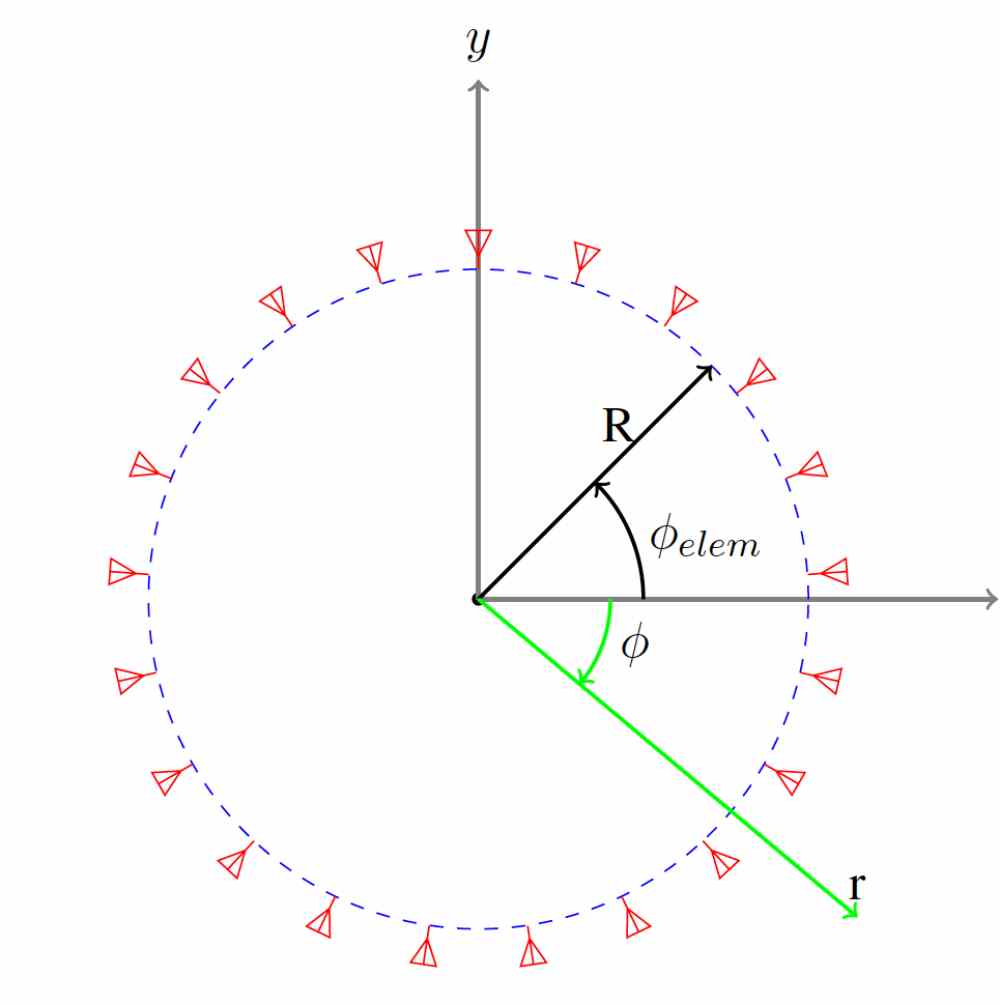
Small platforms play a pivotal role in the modern Navy by performing the forward sensing required to extend the eyes and ears of larger platforms. Efficient surveillance radar is a necessity, enabling these platforms to sense their environment. Initial studies investigating the optimal configuration for a multi-faced array-based surveillance radar focused on horizon surveillance and used the relative horizon search time as the defining metric. In these studies, it was assumed that transmit/receive (T/R) modules were distributed equally throughout the array. The benefits of simultaneously using multiple array faces were considered, but no mention was made of the benefits obtained when using multiple faces coherently.
The initial studies concluded that the optimal number of faces is three – a finding reinforced by a later study on volume surveillance. However, a subsequent study that included a redefined representation of scan loss and the impact of clutter fill pulses concluded that the reduction in scan positions offered by a four-face system proved optimal.
The concept of ubiquitous radar is to look everywhere, all the time – a concept that is seen as a way of providing the persistent awareness desired by small Navy platforms. In ubiquitous radar systems, a broad transmit beam illuminates a large surveillance volume that is then tiled with many simultaneous, contiguous, high-gain receive beams. This continuous illumination allows increased integration time to make up for the decrease in sensitivity resulting from a low-gain transmit beam. This radar concept is now realizable thanks to advances in digital beamforming (DBF).
The concept of ubiquitous radar was initially discussed using planar arrays. However, key limitations are presented by planar arrays that limit the effectiveness of this radar technique. Synthesizing broad transmit patterns without severely limiting effective radiated power (ERP) is a challenging problem with planar arrays. Techniques have been developed, but even those cover an angular sector of only moderate width.
Circular/cylindrical apertures overcome many of the challenges presented by planar arrays to a ubiquitous radar system. Transmitting with omnidirectional patterns – or broad, sector–covering patterns – is straightforward with appropriately designed circular apertures. Directional radiation patterns may also be formed and steered over a full 360 without significant changes to pattern shape, sidelobe structure, or polarization. The width of the sector and beamwidth of directional beams are reconfigured with ease, thus providing variation on the effective size of the transmit/receive faces. These advantages make cylindrical apertures preferable, in principle, over planar arrays for applications requiring 360 visibility.
Despite these obvious advantages, radar systems have been slow to adopt circular apertures and instead accept the limitations offered by the more traditional aperture of a planar array. One reason for this is the ease of design. Planar array design is a straightforward design process often consisting of unit-cell simulations and array factor synthesis. The design process for circular arrays is less simple and straightforward. The geometry of the circular array gives each element a unique pointing direction, which makes each embedded element pattern unique. This further complicates the design of the array by making the synthesis of array tapers and the steering of directional beams more challenging.
In recent years, increased interest in the benefits offered by circular/cylindrical apertures has led to increased research and development to mitigate the limitations in their design, implementation, and characterization. The limitations in pattern-synthesis techniques have become less of a roadblock as algorithms have been developed for both transmit and receive operation. Phase-only pattern synthesis techniques exist to form omnidirectional transmit patterns with multiple nulls to minimize radiation in desired directions while still maximizing transmit power. On receive, directional patterns with custom sidelobe constraints may be formed and steered over a full 360 in azimuth with no significant degradation to pattern characteristics.
This work was done by W. Mark Dorsey for the Naval Research Laboratory. For more information, download the Technical Support Package (free white paper) below. NRL-0079
This Brief includes a Technical Support Package (TSP).
Cylindrical Array Radar: Comparison to Multi-Faced Systems for Horizon Surveillance and Application to Ubiquitous Radar
(reference AD1110196) is currently available for download from the TSP library.
Don't have an account?
More From SAE Media Group
Tech Briefs
Test Strategies to Track Hypersonic Threats
Aerospace & Defense Tech Briefs
Pathfinder Radar ISR and SAR Systems: Tactical Eyes for the Warfighter
Aerospace & Defense Tech Briefs
Making Fully Digital Beamforming for Radar and Electronic Warfare Applications a Reality
Aerospace & Defense Tech Briefs
Australian Air Surveillance Radar Upgrade
Aerospace & Defense Tech Briefs
Co-Prime Frequency and Aperture Design for HF Surveillance, Wideband Radar Imaging, and Nonstationary Array Processing
Aerospace & Defense Tech Briefs
Developing New Anti-Drone Radar Technology
Air Force Research Laboratory Technology Horizons
Collapsing and Closing Unmanned Air Vehicle Swarms
Aerospace & Defense Tech Briefs
Stepped-Frequency Distributed Radar for Through-the-Wall Sensing
Aerospace & Defense Tech Briefs
Airborne Early Warning and Control Sensor
Aerospace & Defense Tech Briefs
Validation of Ubiquitous 2D Radar
Aerospace & Defense Tech Briefs
Next-Generation Phased Radar Systems Lead to Hardware Improvements
Tech Briefs
New Phase Shifter to Reduce Antenna Signal Loss
Aerospace & Defense Tech Briefs
3D Radar
Aerospace & Defense Tech Briefs
Improving Transmit/Receive Module Test Accuracy and Throughput
Aerospace & Defense Tech Briefs
Air Force Technology Tracks “Sporadic E”

Aerospace & Defense Tech Briefs
Monitor Your Spectrum for Signs of Threats
Aerospace & Defense Tech Briefs
Development of a 94 GHz Radar System for Dedicated Bird Detection at Airports and Airfields
Aerospace & Defense Tech Briefs
An Integrated Framework for Complex Radar System Design
Aerospace & Defense Tech Briefs
Detecting Drones with Doppler-Based Radar
Aerospace & Defense Tech Briefs
Vehicle-Mounted Tactical Radars
Automotive Engineering
Homing in on STEM Innovation
Aerospace & Defense Tech Briefs
Migrating Advanced Signal Processing Technology to Rugged SFF Platforms
Aerospace & Defense Tech Briefs
Communicating from Space: The Front End of Multiscale Modeling
Aerospace & Defense Tech Briefs
Army and Universities Deploy New Warfighter Communication Technology
Tech Briefs
Digital Beamforming Interferometry
Tech Briefs
Wireless, Wearable Transmitter
RF & Microwave Technology
Improved Interference Rejection Using Multi-Static Radar Signal Processing
RF & Microwave Technology
Ultra-Wide-Band Radar Imaging for Activity Detection
Tech Briefs
Toroidal Radiation Pattern Patch Antenna
Overview
The document titled "Cylindrical Array Radar: Comparison to Multi-Faced Systems for Horizon Surveillance and Application to Ubiquitous Radar," authored by W. Mark Dorsey from the Naval Research Laboratory, presents a comprehensive analysis of cylindrical phased array radar systems and their advantages over traditional multi-faced planar arrays in surveillance applications.
Cylindrical array radars are highlighted for their unique characteristics, including steering-angle independent gain, beamwidth, polarization, sidelobe levels, and reflection coefficients. These features make them particularly suitable for radar applications that require omnidirectional and wide-sector coverage, facilitating what is termed "ubiquitous radar." This capability allows for simultaneous monitoring of vast areas, enhancing situational awareness.
The report discusses the trade-offs involved in radar system performance, particularly the relationship between scan time and dwell time. While ubiquitous radar systems benefit from reduced scan times, they require increased dwell times to maintain constant range, which is a critical factor in effective surveillance.
The document is structured to provide a thorough overview of cylindrical arrays, including their transmit and receive patterns, and compares their performance to multi-faced systems, specifically three-faced and four-faced configurations. The analysis includes a detailed examination of how coherently using the faces of multi-faced systems can impact performance, leading to the concept of polygonalized arrays.
In addition to theoretical comparisons, the report explores practical applications of these radar systems, particularly in the context of ubiquitous radar, which aims to provide comprehensive coverage and real-time data acquisition. The findings suggest that cylindrical arrays can significantly enhance radar capabilities, making them a valuable asset for modern surveillance needs.
The report concludes with insights into the future of radar technology, emphasizing the importance of continued research and development in this field to leverage the benefits of cylindrical arrays fully. Overall, the document serves as a critical resource for understanding the advancements in radar technology and their implications for horizon surveillance and broader applications in defense and security.
Top Stories
INSIDERManned Systems
 How Airbus is Using w-DED to 3D Print Larger Titanium Airplane Parts
INSIDERAerospace
 FAA to Replace Aging Network of Ground-Based Radars
NewsUnmanned Systems
 Microvision Aquires Luminar, Plans Relationship Restoration, Multi-industry Push
NewsDesign
 CES 2026: Bosch is Ready to Bring AI to Your (Likely ICE-powered) Vehicle
NewsSoftware
 Accelerating Down the Road to Autonomy
INSIDERManned Systems
 Can This Self-Healing Composite Make Airplane and Spacecraft Components Last...
Webcasts
Power
 Hydrogen Engines Are Heating Up for Heavy Duty
Transportation
 Advantages of Smart Power Distribution Unit Design for Automotive...
Automotive
 Quiet, Please: NVH Improvement Opportunities in the Early Design...
Power
 A FREE Two-Day Event Dedicated to Connected Mobility
Connectivity
 E/E Architecture Redefined: Building Smarter, Safer, and Scalable Vehicles
Manufacturing & Prototyping
 How Sift's Unified Observability Platform Accelerates Drone Innovation